Pages

Showing posts with label markets. Show all posts

Sunday, February 28, 2021

not investing

What is value investing? It means nothing, or nobody knows what it means. In fact, it is nonsense. 

If you acknowledge value investing, well... If you criticize value investing, well… Heck, if you write about value investing, well... People think that low PE/PB stocks are value investing. It’s fool’s paradise to assume that. 

Academicians come out with stories that bring down the very premise of value investing. And the self-proclaimed value investors have their stories that always uphold their virtues. The truth is that both stories have a lot to catch up. 

Because, there’s no such thing as value investing. The definition of investing was laid down by the great BG long back. It doesn’t have value or growth attributed to it. There’re 3 key components to investing: Thorough analysis, safety of principal, and expectation of adequate return. So it’s either investing, or it isn’t. 

Stocks represent businesses behind them. To be a good investor, you need to understand the business first. You need to know the difference between price and intrinsic value. 

Price changes all the time, and therefore the multiples change too. Because prices change to weird levels, and thus create a wide enough gap between price and value, there’s scope for investing. If this ain’t so, it ain’t investing: It is something else: can be speculation or trading, or anything…

Academicians have a constant itch to talk and write, and even concoct theories. They come up with stories about almost anything, and put up for display. Their job is done.  

Finance is commonsense, in that there’s not much difference between personal finance and corporate finance. Coming out with Greek letters and complex theories don’t make good financial decisions. They make good looking books. Good financial decisions make good financial decisions. 

A business is formed to make money. If it’s viable, it’ll make money. As it makes money, it grows. And it doesn’t happen over a quarter, or a year. It takes time; it’s a long process. In the meantime, people price it based on their theories. Most often, these theories are crap; therefore, investors get opportunities to invest, and make money. 

Investing is neither value investing, nor growth investing, nor momentum investing, or any other. Investing is just investing. 

CAPM is crap; and so is the margin of safety in the sense that some people view it. Cost of capital used in finance to discount cash flows is also stupid because that is supposed to be a theoretical business valuation. What investors want is make money, not theory; and for that their own opportunity cost is a better discount rate. 

Starting a new business is a waiting game. Making it expand, and grow its cash flows is a waiting game. Making business profits is a waiting game. And for the same reason, investing is a waiting game. 

Cash flows are powerful indicators. Focus on them. It is very much possible to earn excess returns (beat the index) if you know how to estimate cash flows, know your opportunity cost, and you’ve the behavioral acumen to play the waiting game. If not, no worries; invest in the index. 

Individual investors are neither answerable to the marginal investors of the business, nor to the academic finance. 

Don’t listen to self-proclaimed value investors; and don’t listen to the academicians. Most people, most of the time are better off not listening to other people’s opinions.

Saturday, September 21, 2019

things burry cannot explain too well

Recently, Michael Burry made a comment which the investors seem have taken too seriously. The story is short, but has made the news big.

Burry rose to fame after he made loads of money predicting the crash of the housing bubble in 2008. He was made more famous by Michael Lewis through his book, the big short. So yeah, he is a great guy. 

But that does not mean whatever he says has to be sacrosanct. He makes mistakes too. In the story, he saying that index investing is proving to be bad. In fact, so bad that he is likening it to the subprime CDOs. 

I am not sure whether I have to feel sorry for him, or for those who believe him. There is one thing I have found short in the investors' mind: that they don't have their own conviction. That's a behavioral debt which often becomes too expensive. 

Well, Burry is saying that index investing is bad, because it does not support market price discovery. Because when too much cash chases the index, prices of all stocks - good, bad, and ugly - will shoot up. Because investors buy without any regard for the price and value of stocks. Because the index comprises of far too many small, bad businesses whose stocks do not have liquidity, and yet are priced high. And he says the crash will be ugly. 

Then he goes on to compare index investing with the synthetic asset-backed CDOs. Here I am not sure whether he is actually comparing the bubble to the bubble, or the index investing itself to the CDOs. If he did the latter, his blunder is more prominent, for the CDOs are based on disproportionate leverage, and the index stocks are not that much. So that aspect is never comparable. But let's give the benefit of doubt to Burry, and believe that he just said about the bubble, like any other bubble. 

Now coming back to his concerns regarding the bubble in the index investing, we all know that the economy and markets are like a cycle. They go up and down all the time. There are times when the prices shoot up so much that they have to eventually fall, and yet other times, the other way is true. When taken to extreme, the bubbles have to eventually lead to price fall, and the busts, price rise. And they always do. 

Also, the free market mechanism comes into play all the time. Let's suppose that the bubble crashes badly. When the prices of the index stocks go up disproportionately compared to their fundamentals, the crash is bound to happen. Remember the dot-com bust. After the crash, the good stocks represented by high quality businesses become cheap compared to their intrinsic value, and the bad stocks represented by poor quality businesses may remain somewhat expensive. The investors will shun the index and buy good quality stocks, and may even short poor quality stocks. The index will then eventually move towards becoming fairly priced, making the case for index investing. 

Let's assume that the index investors, after the crash, sell their index stocks and buy good stocks which became cheaper. After the continual demand, prices of good stocks will go higher, and value of the index will correct. Now we have the case for index investing again. Because of this free market mechanism, even those index investors, who do not sell after the index bubble and crash, will also benefit by staying put on the index investing.

In fact, that is the essence of index investing: to keep going during both good times and bad times, pushing the average price of index units lower, and getting a reasonable market return. I can even say that a good index investor can achieve a return slightly higher than the market by increasing buys during bad times. But that's another story.

The hedgers, speculators, and short-sellers are always alert in a free market, and they take advantage of all arbitrage opportunities ensuring that the price and value of stocks and, therefore, the index are never too far off, for too long.

I am surprised Burry missed this point big time. We should be asking him where else to put money if not the index. The treasuries and high quality corporate bonds yield much lower. Junk bonds are not an option for the real investors. We have two choices then: Pick the stocks, or go to the index. 

Picking stocks is not for everybody. It requires time, interest, skill, and behavior. Index investing is for everyone who cannot be a stock picker, for the investor is assured of the market returns. 

For someone who has at least a decade of investing ahead, index makes the perfect choice. Once the horizon becomes shorter, asset allocation will have to come into play. A right mix of the treasuries, high quality bonds, and the index should take care of the investor's cash requirements for the rest of life.

The fun part is that we are not even close to all-passive investing. There is huge money actively and continually chasing stocks all the time, and I believe that as much as we know of the human behavior, we have a very long way to go against it. The fear, greed, and envy will ensure that active investing will stay for a long time, and index investing will continue to give market returns for those who find it satisfactory.

It is far better to use common sense and wisdom than borrowed conviction. Life and investing then will be rewarding.

Friday, March 22, 2019

coffee day

Coffee Day Enterprises operates in 6 segments: Coffee and related; Logistics; Financial services; Leasing of commercial office space; Hospitality services; and Investment operations. It operates Cafe Coffee Day chain across India. 

The total business had revenues of Rs.37 b in 2018, an increase of 21% over 2017. Revenues have been growing in double digits for the last 3 years, 2018 being the best year of growth. The financial services revenues were Rs.5.7 b and that of leasing were Rs.1.4 b. Investment operations were Rs.530 m. 

The company had book debt of Rs.50 b and operating lease debt of Rs.1.8 b in March 2018. Because it also operates in financial services business, I am not going to look at its operating profits. That will not be meaningful because for financial services, debt is like a raw material, and interest costs are part of its operations as opposed to other businesses.

Earnings for 2018 were Rs.1 b. But after adjustment for the exceptional item (sale of stake in Global Edge Software) of Rs.532 m, it is actually an increase of 13% over 2017. Earnings per share were Rs.2.51 excluding the exceptional item compared to Rs.2.28 of 2017. Return on equity is less than 5%. There aren't free cash flows generated by the business. 

But the stock is trading at Rs.291.75 implying over 100 times 2018 earnings. Who are its buyers? 

The company owned 28,056,012 shares in Mindtree representing 17.08% ownership as of December 2018.

Coffee Day Trading is a subsidiary of Coffee Day Enterprises. In March 2019, the news is that the company and its promoter have signed a definitive agreement to sell their entire stake (20.41%) to L&T for a consideration of Rs.32.69 b. The price per share works out to Rs.975; and the stock is currently trading at Rs.950. 

As per this report, the total investment in Mindtree was Rs.3.4 b: Rs.440 m in 1999 for 6.60% stake; Rs.850 m (5.57%) and Rs.400 m (2.05%) in 2011; Rs.1.71 b in 2012 (6.84%). 

If the transaction does go through, the company will have a cash flow of Rs.27 b, handy enough to reduce debt. And the promoter will reap over Rs.5 b.

Coffee Day came out with an IPO in October 2015 at Rs.328 per share, and the stock commenced listing in November 2015.


The stock is yet to recover from its IPO price. But the question is: Is the business worth Rs.62 b? 

Monday, March 18, 2019

lyft ipo

Lyft is coming up with an IPO at an expected valuation of $20 b to $25 b. Its previous private valuation was $15 b in June 2018. Now that it is coming out with a $2 b IPO, the market is going frenzy.

Here are the investors seeking a valuation as high as possible. 


And why not, when there are buyers at the price? But then pricing is a game played by the private equity and venture capitalists, and for the right reasons: They want to cash out. That's their compensation for taking risk.

What about investors who like looking at the business and numbers? I haven't got a story for Lyft, for it is beyond my imagination how far it can or cannot go. It could do very well, or it could falter. I am not sure. That's not my game. But I can lay down the numbers. 

Lyft had revenues of $343 m in 2016. They became $1 b in 2017, and $2.1 b in 2018. That's a massive increase. But the business incurred losses in operations: $693 m, $708 m, and $978 m. Markets say it is the nature of the business like any other high growth start-up. 

The business is not using much of capital. It had $3 b in cash, marketable securities, and restricted cash as of December 2018. But it will need a lot of capital going forward. Because it is losing cash every year: It has been losing over $500 m each year (2016 to 2018). For 2018, this is despite $625 m positive cash flows from changes in non-cash working capital.

We haven't got a firm hold of numbers since operating profits and earnings per share are both negative. It has had low capital spending: $71 m for 2018, and much lower during the previous two years. It acquired Bikeshare Holdings (Motivate) for $250 m, and spent $300 m on research and $352 m on advertising in 2018. That's a significant portion of revenues. There are no free cash flows yet. 

Where do we go? Easy, look at the pricing multiples. 

If we price Lyft based upon revenues: For $20 b valuation, it will be 10 times revenues. That will come down to 8x if revenues increase by 25% next year, or 6.67x if they increase by 50%, and so forth. Pricing always gets interesting.


If we choose riders: The price per rider will be $667 for the $20 b Lyft. The catch is Lyft had 18.6 m active riders. The the price per active rider will be $1,075.


How about pricing based upon bookings? 


Lyft at $20 b = 2.5 times its 2018 bookings. Cool.

There were 241.614 m shares outstanding after conversion of preferred shares as of December 2018. If we round off and consider 250 m shares, the expected IPO price will be $80 per share to get that $20 b value.

Then you can juggle, and include the options (6.828 m) and RSU (31.605 m) outstanding, and come up with 280 m shares; and the price per share will be about $70. If you include $2 b coming from IPO, the price will be $64 per share, with an additional 31 m shares being issued and totaling 311 m shares.

Lyft is a good business. But the question is at what price. That's the conundrum we face with every technology growth business, don't we?

Monday, March 11, 2019

coke and pepsi

Coke or Pepsi, which is better? Both are lousy as consumer products. But I mean, which is better as a stock? Coke is worth $191 b, and Pepsi, $161 b. The Coke stock implies nearly 30 times its earnings, the Pepsi stock, 13 times. Why should Coke trade at a higher multiple than Pepsi? Is Coke growing better than Pepsi? Which business has a better return on capital and return on equity? Or is there a bias?

Coke has a better operating margin (20%) compared to Pepsi (16%). But I don't care much about operating margin. What I do care is return on capital. Pretax return on capital for Coke is 25%, and that of Pepsi is 30%. These are long term averages. The most recent values are 36% for both Coke and Pepsi. 

And I care as much about sustainable growth rate. The 5-year average growth rate in revenues for Coke is negative 7.43%, and the 10-year average is 0%. It had revenues of $31 b in 2008, and they were $31 b in 2018. For Pepsi, the 5-year average growth rate in revenues is 0%, and the 10-year average is 4%. It had revenues of $66 b in 2013, and they were $64 b in 2018. Pepsi's revenues grew 1.79% in 2018, and Coke's fell 10%. So much for growth rates. 

They have products that are not healthful, and there is no growth in revenues. Do we really want to talk further? Both companies spend considerable amount on advertising. But it seems that Coke is more desperate, for its average ad spending is 10% of its revenues compared to Pepsi's 4%. Yeah, Pepsi has more diversified products. 

When we capitalize advertising costs, the pretax return on capital changes to 27% for Coke and 31% for Pepsi for 2018. I am using pretax return on capital because of strange things that have happened in tax rates recently. 

Both companies are mature businesses and payout significant dividends. The 5-year average growth rate for Coke dividends is 6% and 8% for Pepsi. The 10-year average is 7% for both. 

Let's look at free cash flows. Pepsi had $6.75 b pretax cash flows for 2018, and Coke had $6.1 b. The 5-year average for Pepsi is $9 b and $6.79 b for Coke. For both companies, free cash flows have not been growing. In fact, they are falling. 

So again, why should Coke be priced higher than Pepsi? Is it because a prominent investor holds it and backs it? That's appears to be a stupid idea. But then we are not dealing with rational people.

I will start with $6 b as aftertax free cash flows for Coke and $6.5 b for Pepsi. Never mind these are much higher for Coke compared to its historical numbers. With these assumptions and a growth rate of 5% leading to a cap on the growth rate after a decade, we get similar values ($85 b) for both at an expected rate of 10%. 

Based upon free cash flows at least, the market pricing for both companies appears to be on the higher side. But my point is that Coke should not be priced higher but lower than Pepsi. And this has not happened for a long time. In fact, most of the time, the yearly low market value of Coke has been higher than the yearly high market value of Pepsi. That is bias, Coke being accepted as a more prestigious brand. But then who cares for the brand when the cash flows behind it do not justify the price? 

I am no fan of either, for I don't like their products. But it is time that the market realizes the potential of these companies, and prices them accordingly. 

Friday, February 22, 2019

the tata group

The executive chairman of Tata Sons said recently, "we have moved away from fixing to focus on growth".  I have not dug deep into the context behind the statement. What I know is that just physical growth will not contribute to value. That has to be accompanied with consistent excess returns. Value creation to shareholders is the primary focus for managers of any business. Their duty is only towards their owners; everything else is incidental. But the chairman knows better than we do. 

The Tata group sells from salt to trucks, covering the entire gamut of consumption. There are 17 companies listed on the stock markets, and have a total market capitalization of Rs.10,401 b ($148 b). In addition to these companies, there are many private organizations - including not-for-profit - set up to serve the society. With more than 700,000 people, the group is probably the largest private employer in India. That is commendable. 

This post analyzes only the publicly traded entities within the group. These 17 companies have total revenues of Rs.6,496 b and total earnings of Rs.560 b (March 2018). That implies the group is priced at an earnings multiple of 18.55. Although price-sales multiple is not the best measure - enterprise value to sales is better - 1.60x seems quite interesting.

Yet when we look a little closely, we can note some peculiarities. Consider this: Just one company makes about 70% of the group's market value. With Rs.7,185 b market cap, TCS stands singular. It is a little hard to believe that the rest of the group - 16 publicly traded companies - are only 30% of value, and are collectively worth only Rs.3,216 b.


One of the most important measures of how well a company is managed is the return on capital, and TCS stands out with stellar performance. It also generates large amounts of free cash flows. Titan also has superior return on capital over the past decade. But then market's inconsistency in pricing equities is evident: TCS contributes (Rs.258 b) over 45% of the total earnings of the group and Titan (Rs.11 b) only 2%, and yet, TCS is priced 27x and Titan 81x earnings. This is not to say that only earnings matter for pricing stocks; what I mean to say is that Titan is richly priced as of now considering its growth prospects and return on capital.


Tata Motors revenues for 2018 were Rs.2,954 b (over 45% of total group revenues) and earnings were Rs.89 b (over 15%); similarly, Tata Steel too had significant revenues and earnings for 2018; but both are priced less than 6x their earnings. For Tata Steel it is understandable because it is in the cyclical business, and its average earnings over the decade have not been impressive, and we are never certain about timing of commodity cycle. For Tata Motors, the situation is different; having had some good times through Jaguar, Land Rover in the past few years, with slowdown in JLR business in its key markets, the business is faltering. A large amount of capital is required for its ambitious electric vehicles project, and it is not coming through easily. We are not sure if those revenues, earnings, and more importantly, free cash flows are going to be large enough to price its equity. At the moment, though, Tata Motors is worth just Rs.519 b. 

If return on capital is less than cost of capital over a long period of time, it is not possible to have free cash flows. No excess returns, no free cash flows. Tata Steel and Tata Power have failed in this test. Tata Communications is worth Rs.147 b, and its performance has not been impressive either. Tata Chemicals showing has been deteriorating over the past decade.

Tata Global Beverages and Tata Coffee, both, have not had decent growth. Their return on capital has not been good. Tata Global is priced at 24x earnings (Rs.119 b), and Tata Coffee at 14x earnings (Rs.15 b). They may well have potential going forward.

Voltas growth numbers haven't been good, but it is priced about 30 times earnings. We haven't got much to say about Indian Hotels which is priced rather rich and is worth Rs.165 b now. Trent has low return on capital and free cash flows over the past decade.

Tata Elxsi and Tata Metaliks are performing well, but aren't big enough to make meaningful contribution to the group; yet. Tata Sponge and Nelco are collectively priced only Rs.15 b, and aren't the best performers.

For 2018, TCS, Tata Motors, and Tata Steel contributed about 85% of the total group revenues and earnings. In July 2017, I noted what would happen if TCS falters and JLR slows down. Well a little over a year, and TCS is doing fine, but JLR is actually faltering.

Yes, the Chairman is right, the group needs growth. But growth requires capital for reinvestment, and more importantly, for growth to create value, it has to show excess returns. Superior return on capital and free cash flows.

Tata group, no doubt, is a significant contributor to the Indian economy and society. It intends well and means well. With the change in focus, we are confident that the group will emerge stronger than before. 

Monday, December 10, 2018

market cap meltdown

I just thought of noting down the change in market caps of some of the largest companies in the US. Let's start with the market itself. The S&P-500 started the year with 2695.81. Here we have the google screen shot of the index.


On 7 December 2018, it was at 2633.08. Not that good. People are giving all sorts of reasons for the fall; but none of them are convincing, because it is the nature of the market to fall and rise, and rise and fall. Frequently, it forms sort of cycles that we call bulls and bears. There is no linear progression to be expected from markets or individual stocks. They don't have maturity values either. Stocks represent businesses; and businesses are perpetual, although they have their own life cycles based upon which they live their life, and often vanish. If we don't learn these lessons, we will have tough time dealing with volatility; and then, we will not be worthy of profits to be made from businesses. 

Look at Facebook:


25 July 2018 was the peak time for Facebook when it traded at $217.50 per share; and the market cap was over $625 b. But then it fell sharply on July 26, the next trading day, and closed with a market cap of $509 b. That was a near-19% crash. Was it due to the release of earning reports and expected growth rates? May be, but at $137.42, it is not looking good in terms of its past performance. Is it a good buy now? Time will tell. 

Apple is better:


Apple is comparatively better as the stock price now is near where it started the year. That it is far away from its trillion dollar valuation may be some consolation for those who try to compare intrinsic value with market price. That it is far too dependent upon one product, iPhone, that the overall growth may not be too high, and that it has too much cash may have implications on its financial and market performance in future. That Warren Buffett is the largest individual investor in Apple does not make it a buy. Cash flows, growth, and risk are the things that matter more than anything else. 

Alphabet has a full circle:


Alphabet stock was just above $1,000 in February and March 2018. In July, it reached $1,285.50 (more than $850 b market cap). As of now, it is back to about $1,000 from where it will begin again. 

Amazon makes an exception:


Amazon started the year with $1,189.01 per share. The latest price is $1,629.13. That's a 37% upside. The market cap touched $ trillion quite briefly on 4 September 2018, but closed the day lower. Compared to that the market cap now ($765 b) seems like a big fall. The thing is, stocks in general are moving down, aren't they?

We cannot leave Microsoft out of the equation, can we?


That old horse is still riding far and wide. That Apple is worth about $750 b and Microsoft is about $780 b tells us something. With windows and office as stable businesses, and cloud computing as its growth engine, the combo looks interesting. 

The fun is in the game
With 10-year treasuries yielding 2.85% and 1-year yielding 2.68%, investors are looking for a decent premium. A 5-point premium would lead to the expected returns of about 8%. That much, I reckon, markets and large-cap stocks should be able to give. For anything more than that, investors will have to look deep. Value is there in every market; it is easier to look at it in hindsight though.

As of now, it is much wiser to ignore the gyrations of the market and concentrate on the individual affairs. If you are an index investor, just continue the process. No worries. If you are a stock picker, look at the individual stock prices and their intrinsic values, and ignore the broader market index. More importantly for every sensible investor, ignore the experts and their stories. 

Thursday, November 29, 2018

yes bank, market, and rating

Yes Bank is taking its toll; rather its investors are. It is becoming too much, or it's not? In September, the RBI said, weak compliance, weak governance, and wrong asset classification. The CEO had to step down without extension of tenure. 

It was enough for the stock to plunge. On 28 September, the stock was staring at Rs.165 per share. Things seemed to be better in October and November as the stock was trading at around Rs.200, not moving much. October's high was Rs.248.90; and low was Rs.180.70. November's high was Rs.227.90. But then...

Some of the board members resigned later in November. The stock closed below Rs.200 for the first time in the month on 16 November. Here's the snapshot of the skin in the game that the board exhibits (as of March 2018).


Not all directors own shares in the bank, and those who own have insignificant number of shares.  This is not new to only Yes Bank; most of the companies in India have board members and even executive officers who do not own meaningful number of shares. I find that surprising, but want to keep the story for another day.

Whereas look at the volume of shares owned by the CEO and the CFO. I wouldn't conclude that they will act against the interest of their fellow shareholders. I don't know the inside story; but the RBI's remarks regarding corporate governance are serious, and should be taken seriously. There is time to repair the damage caused, and that should be the new CEO's top priority.

On 26 November, it was reported that the CEO, who is also one of the promoters, had raised money from two mutual funds through his associate firms by keeping his stake in Yes Bank as some sort of a guarantee. It was interpreted by the market as shares pledged, but not reported. This perception was bad enough for the stock, and it closed the day at Rs.187.90.

On 27 November, Moody's downgraded Yes Bank's ratings citing corporate governance and growth concerns. The stock had to react; Rs.182.65. On 28 November, Rs.162.10. And today, 29 November, it quoted as low as Rs.146.75, but closed at Rs.160.45. The trading volume was 292 m shares. I don't have any respect for the rating agencies, but the truth is that it becomes difficult for the downgraded business to raise cash on favorable terms; the cost of borrowing goes up. 

The two promoters must have felt it too. Let's do some math. Rana Kapoor, including Yes Capital and Morgan Credits, owns 245.875 m (10.65%) shares in the bank, and Madhu Kapur, including Mags Finvest, owns 213.987 m shares (9.27%). 

Based on the 20 August 2018 price of Rs.404, the market value of Rana Kapoor's shares was Rs.99.333 b ($1.419 b); and Madhu Kapur's was Rs.86.450 b ($1.235 b). As of 29 November, the respective market values are Rs.39.450 b ($563.580 m) and Rs.34.334 b ($490.489 m). It is still a lot of wealth. But, when the stock price falls 60% from its high, the value of shares goes down with it. Yet, it is important to remember that these are only paper losses until they are realized through transaction. 

Is the reaction from market an overreaction of some sort? While time will tell us about it, I guess, there are a lot of people out there on the media and social media giving enlightened opinions about how a badly managed business is a bad investment. Well, when the stock was going up, these naysayers were probably talking about some other stock. Never mind, it is the business of people to talk about other people. 

Every business has a price. A good business has a price, and a bad one has another. I am not too sure at the moment whether Yes Bank is a bad business. Yet, at the price it is quoting now, probably there is some value to be claimed by patient investors. Didn't I say something like that in early October too?

Wednesday, November 28, 2018

kotak bank stake conundrum

Kotak Bank has been a well run bank among the private banks of India. With gross npa of 1.94% and net npa of 0.73%, its track record has been extraordinary. The net margins are over 4%; business is growing. And the market is willing to pay the price for its equity. At current prices, it doesn't come cheap in excess of 4 times September 2018 adjusted book value. 

Yet I reckon, if it grows at 15% in the next 3 years and market allots a pb of 3.50, the investor will have about 8.50% annualized return. Is that enough, is a question for the investor as of now. 

However, with the RBI asking the promoters to reduce their stake from 30% (current) to 20% by December which we see likely not happening by the time, there are chances that the stock prices might get lower. Time will tell whether they will become attractive enough to meet the investor's opportunity costs.

This article presents options available to the promoters well; however, I don't think this will leave investors on edge. Investing isn't a short term game; so they should relax and take it easy. If they believe in the capabilities of the promoter manager, they should be fine.

At the moment though, the promoters have the following options to keep the regulator happy, unless the RBI accepts the current status of Rs.5 b perpetual non-cumulative preferred shares.


The promoters have the option of selling 191 m shares or issuing 477 m fresh shares in order to meet the RBI's directive. I am assuming that fresh issue will have to take place at discounted prices. With the first option, the promoters will have challenge of dealing with some Rs.224 b cash; they will not only have to pay taxes on it, but also will have to check out the alternative investment opportunities. If fresh shares are issued, the bank will get about Rs.530 b in cash which can be useful in meeting its growth targets. But then, Kotak bank has a Tier 1 capital ratio of 17.04%; so it already has enough cash for its growth requirements. 

It is an uneasy conundrum for the promoters for sure. To keep able promoters' stake high enough is a good idea so that investors benefit from aligned objectives. Whether 30% or 20% is a good stake, will have to be dealt with independently. Yet, the RBI cannot have a separative guideline for one bank and another for other banks. 

Kotak bank stock had a high price of Rs.1,417 in July 2018. I find that even at current prices which are much lower, it is not cheap. But then investing is a waiting game, isn't it?

Thursday, October 4, 2018

yes bank's september

Never mind what happened to the Indian markets today. The nifty-50 fell 2.39% to end at 10599.25. Yeah it fell yesterday too. Let's keep the index story for another day. On 6 September, Yes bank traded at a high of Rs.347.80. On 20 August, at a high of Rs.404 per share. Things were looking alright for the bank until 21 September. The day before was a market holiday. On 19 September, the stock closed at Rs.319.20.

On the same evening, the bank reported that the RBI had rejected its request to extend the CEO's tenure by three years. The next trading day on 21 September, the stock tanked 29%, and closed at Rs.226.50 per share, equivalent of a loss of Rs.213 b in market value. Can one person be so important for a publicly traded, large banking business, or was it just the market's whims? The quantity traded on that day was over 293 m on the NSE, compared to the average of less than 30 m during the previous seven trading days.

As per this report of that fateful day, the bank was cited three reasons for the RBI's deadline for the CEO's tenure until 31 January 2019: Weak compliance culture; Weak governance; and Wrong asset qualification. The allegations seemed too brutal, and the bank made a new low of Rs.197.25 on 25 September when the board was to meet for the future course of action. 

However, 28 September was more special when the stock quoted at Rs.165 at some moment, but closed the day at Rs.183.65 per share. The market capitalization of the bank stood at Rs.423 b, some 54% down from its August's high. Too much, too soon? Is the market crazy, or is there more to this?

As of June quarter, Yes bank had impressive performance to show: Gross npa 1.31%; Net npa 0.59%. Net npa, security receipts and standard restructured assets totaled 1.52%. Yet, herein lies the catch. If these numbers are good, at the current price of Rs.215 per share, the stock is trading at 2.15x its adjusted book, a reasonable price having potential to yield better returns in the next 2 to 3 years. 

If the asset quality is worse than it is reported, it becomes a little complicated. The value becomes a function of how the book looks like. For instance, if the net asset quality is worse off to say, 3%, the current price becomes 2.50 times its adjusted book. If 5%, the price will be 3.19 times the adjusted book. Naturally, the returns will be impacted. That is why the management trust factor is so important when it comes to valuing banks.

The bank's capital raising plans have been held up because of the story that has unfolded. At the moment, therefore, the capital ratio is not the best which means the bank's near term growth will be somewhat subdued. After new capital, the bank should be able to move on to the growth path. Its return on assets (1.35%) and return on equity (16.40%) are pretty decent. There is a reason to believe that this should continue. 

On 1 October though the bank released its unaudited details for the latest quarter, and noted that its gross npa were stable compared to the previous quarter. 

In the meantime, there is no dearth of recommendations:


Time will tell whether Rs.215 is a good buy, or a great buy, or something else. It looks like there is an opportunity here for the investors if they are willing to show some patience after picking it. 

Tuesday, September 18, 2018

lehman, financial crisis 2008, and more

Lehman's history
Lehman Brothers was founded in 1850, and became an important trader in cotton during those times. Later it focused on trading and brokering of commodities. The firm dealt with great depression, and came out having survived. The business of venture capital and underwriting of capital issues was steady and successful in the subsequent years. By 1975, Lehman had became a prominent investment banker for the American businesses. 

American Express acquired Lehman in 1984 for $360 m to form Shearson Lehman American Express. In 1988, the firm merged with EF Hutton stock brokerage to form Shearson Lehman Hutton Inc. 

Before the initial public offering, the banking and brokerage operations were divested of, and retail brokerage and asset management business was sold by American Express. Lehman Brothers Holdings Inc. became a publicly traded firm in 1994 with Richard Fuld as its CEO. His 14-year stint as CEO had to end with filing for bankruptcy on 15 September 2008. Before that, the firm fended off rumors of cash crunch due to the collapse of Long Term Capital Management in 1998 as fake news. By 2007, Lehman had posted record revenues, earnings, and earnings per share for four consecutive years. Fuld became a hero after leading the firm to post 14 consecutive years of profits after it had reported a loss of $102 m in 1993. Little did the market know of the amount of leverage used to drive returns on equity. The asset management business was revived in 2003. In 2007, Lehman had revenues of over $19 b and posted record high earnings of $4.2 b. 

Perhaps things would be fine had it not ventured into the lower grade mortgage lending business. Of course it was lucrative, and seemed like a good idea at that time. The Alt-A mortgage, considered lower than prime but better than subprime, began after Lehman acquired Aurora Loan Services in 1997. Later in 2000, BNC Mortgage LLC was acquired, and Lehman became a subprime mortgage lender. These lower grade, higher risk mortgage lending operations had a stunning growth story: Lending in 2003 was $18.2 b; in 2004, it was $40 b; and in 2006, both Alt-A and subprime loans comprised more than $40 b per month. Quite naturally, Lehman started 2007 with too much of risky assets supported by too little of equity. Any good year with this capital structure would yield enormously high earnings for common shareholders; and it did, in 2007 of about $4.2 b. Any bad year would be of enormous losses. And a very bad year, would let the course to bankruptcy; and it did in 2008. 

2008 operations
The winding down of BNC subprime operations in August 2007 perhaps came a little too late. Consider this: Lehman posted profits of $489 m in the first quarter of 2008. Citigroup posted losses of $5.1 b, and Merrill Lynch had $1.97 b losses. In the second quarter though Lehman reported record losses of $2.8 b which came after a very long time. Revenues for the quarter ended May 2008 were $6.240 b, and interest costs alone were $6.908 b. It had $6.513 b of cash available for operations. Total assets were $639.432 b, of which $13 b was cash deposits mainly with the regulatory authorities. In effect, its net operating assets were: Financial instruments and securities of $269 b; Collateralized agreements of $294 b; and receivables of $42 b; totaling $605 b. You couldn't do much with property and equipment ($4 b), intangible assets ($4 b), and other assets ($5.8 b). During the quarter, Lehman lost $17.899 b of cash from operations which was made good by debt.

In June 2008, Lehman raised $4 b of common stock at $28 per share, and $2 b of non-cumulative preferred stock carrying 8.75% coupon, which had a mandatory convertible clause. Apparently, this capital raising was not good enough because its statement of financial position as of May 2018 looked like this: Assets ($639.432 b) financed by common equity ($19.283 b), preferred stock ($6.993 b), and debt and other payables ($613.156 b). Just 3% common equity meant that asset losses of only 3% would wipe out entire equity; a very vulnerable situation to be in.

The auditor's report dated July 2008 based on their review of May 2008 (quarter) operations, and the report dated January 2008 based on their audit of November 2007 (year) operations, expressed unqualified opinions on the financial statements. There wasn't a note on Lehman's going concern issues.

Lehman reported Tier1 capital ratio of 10.7% and risk-weighted capital ratio of 16.1% as of May 2008. This wasn't reflective of the risks that the firm was up against. As long as property prices remained high it was fine. If prices were to fall, Lehman would need cash to make good on margins to its lenders. When prices came crashing, the firm would need significant amounts of cash on short notice. Inability of the original individual mortgage borrowers also had a role to play which had cascading effects on property prices and consequently on the bundled mortgage assets prices; there was a reason they were called subprime.

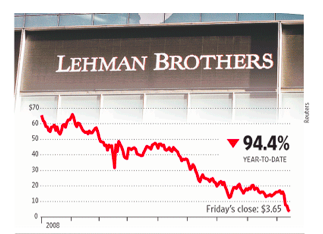
Lehman stock prices started falling, and the subsequent downgrades on Lehman by the rating agencies meant its derivative contracts demanded billions of dollars in collateral. By 9 September 2008, Lehman was worth only $6 b while it began 2008 with a market capitalization of over $35 b.


Nevertheless, here's the thing: If the markets trusted on Lehman's ability to recoup, even if it were to take a long time, it would have been ok. However, it was not to happen. Lehman lost on its credibility to raise short term cash, and there was no other choice. 

No bail out
Even the government turned the other way. It would rescue Fannie Mae and Freddy Mac; both firms had owned or guaranteed about $6 t of the total $12 t US mortgage market. It bailed out AIG. It also facilitated the $50 b Merrill Lynch buyout by Bank of America. But not Bear Stearns and Lehman. The first to go was Bear Stearns when the government let JPMorgan Chase buy Bear Stearns for $2 per share. Warren Buffett bailed out Goldman Sachs by investing in its $5 b preferred stock carrying 10%, which helped boost the firm's credibility and made its capital raising easier. All the firms that survived were beneficiaries of the government's $700 b troubled assets relief program bailout. 

Of course, the government thought Korea Development Bank would rescue Lehman. When it did not, the stock price crashed below $8 per share. It also hoped that Barclays would buyout Lehman which did not happen thanks to the veto of the UK regulators. 

Then the bankruptcy was made inevitable; 15 September 2008 and Lehman became part of the history being the largest bankruptcy of all time.


The S&P-500 fell more than 4.5% (source: Yahoo finance) on the day, and so did the Dow Jones which fell from 11421 to 10917.

Bankruptcy meant $0 stock prices, and this is how they panned out.


Subsequent to the filing, Barclays bought selected US assets for $1.29 b, and Nomura bought Lehman's Asia operations for $225 m, and parts of European operations for nought ($2 nominal). 

What if
I sometimes wonder what would have happened to Lehman and the financial markets if the US government had bailed it out. That is to supply cash and fill liquidity, and own equity until Lehman was able to get back on its feet. When asset prices and markets recovered, as they did, Lehman would repay its debt (equity) back to the government, and either remain a privately held firm or issue shares to public to operate as a listed entity. Alas, it wasn't to be. And we have a number of lessons to learn. 

Lessons that markets don't learn
The first and foremost is never to be at the mercy of someone else. This position of weakness is almost always caused by excessive leverage compared to own capital. The second is never to trust the governments to come and support during desperate times even while they choose to discriminate. The third is never to be in a business that is mainly dependent upon hope, greed, and the greater fool; most likely, the business itself would end up being one such fool eventually. Lehman, along with other firms that fell, unfortunately did not have the time to learn these lessons. Yet, I hope that those firms that did survive have learned. But then, don't we know that what we learn from history is that we don't learn from history?

Sunday, July 22, 2018

what can you do in these markets

Let's talk about the Indian markets. The Nifty-50 is on a roll. It is selling for more than 27 times earnings, more than 3.50 times book, and has a very low dividend yield. Despite being volatile, the index is quite pricey. 

As usual the talking-heads have been giving their shit cents. They have to remain active you see, otherwise people will forget them soon. They desperately need attention to survive. It's another story that these people have to talk, write, and then seek money from others to pay their bills. Unfortunately, naive investors (or traders should we say?) don't get it, and fall for them. 

Here's some unsolicited advice for them. It is not difficult to feed your needs; but quite impossible to feed your greed. Learn to differentiate, and you are on to something. 

Investing in stocks is akin to owning businesses. If you started a hardware business in your hometown, would you be looking to exit in a few months or even a few years? Check reasons, and you will find that owning a stock does not mean you should sell in months. There is a business behind each stock. Learn about it, and see if it has good prospects. No one got richer overnight. If overnight is what you like, let me put it this way: You need to put in a lot of years before you can get rich overnight. If you can show patience in your hardware business, you might as well show patience after you buy a Nestle, Maruti, or ICICI bank stock. After all, they are all into some business which takes time to grow in a meaningful way. Participate in that growth story.

The best recommendation I can give to anyone including those self-proclaimed expert stock pickers is that buying the index and getting the market returns is not a bad thing. In fact, it should be a pretty good thing to do. Throw cash each month, irrespective of markets being expensive or cheap, into that index, and keep going for as long as you can. Time will then take care of both returns and risk. Ignore other people's opinions; they need your cash more than you need their advice. Let those shit-heads be. 

Of course if you are a stock picker, you could utilize the volatile times to learn about businesses, how they make money in low and high markets, how they allocate capital, what debt they have, their competitive advantages, and so forth. Then wait for the time when others are in a panic mode to make your buy decisions. There will be plenty of such occasions. But to profit from them, you need to learn to wait. The opposite is true when you want to make sell decisions. The irrational exuberance prevailing in the markets is the time to exit if at all you need to exit. 

Nevertheless, the real money is made thus: Buy quality stocks which have long term competitive advantages at reasonable prices, and hold them for as long as those advantages are sustainable. Stick with them in bad times and good times, stick with them in expensive and cheap markets. In a decade or two, this strategy should make enough money for you. 

And yeah, get rid of that emotion called envy, for it will only make you miserable like my cousin who despite earning well, saving well, and having enough, always finds himself talking about how others are making too much money. For me, he looks like an asshole. My advice to all is, don't be him. Learn to live life because it is fun all the way.

Thursday, May 3, 2018

tcs, and $1 trillion

TCS has defied odds; there is no denying. I compared both Infosys and TCS in July 2013, and noted how things changed since 2009 in favor of TCS. In October 2013 when TCS hit $65 b in market capitalization, I wondered whether it was worth it based upon its fundamentals. Then came July 2014 when TCS equity was priced by the markets at $85 b, and I was skeptical again. Now it is a $100 b company. In fact, this report had actually predicted it would. I only hope that the author had put his own cash into his thoughts. 

Sure it is a $100 b firm; so what? What can investors do about it, buy more, or book profits? That's the question. If you read this report, the stock has the potential to rise 10 times, and become a $1 t company. Yeah, that's $1,000 b; isn't that great? For record, there isn't any $1 t company on the planet, not yet. 

TCS had net earnings of Rs.258 b ($3.9 b) for 2018. Let's keep the math simple rather than going into complex predictions. That implies a PE multiple of 25 times as of now. The report says, does not predict, that in 8 years TCS could become $1 t company if it grows at 33% annually over the period.


The author is right. If earnings grow at 33% and the multiple remains at 25 times, it's a $1 t math. But then, if the multiple goes up to 30 times, it will be $1.2 t; or if earnings grow at 25% over 8 years, the market value will be $600 b, keeping the multiple intact. 

We have to remember that a 25 times earnings multiple after 8 years will mean that the business will have strong expectations of earnings growth in years beyond. That implies, TCS has the potential to become much more valuable than $1 t. To see why, let's assume earnings growth of 33% in 8 years, but also assume that the growth rate will taper, and therefore apply a lower multiple of say, 15 times. Now the business will be worth close to $600 b. 

You see what I mean? Math is not the value driver. The value drivers are cash flows and growth, and expected rate of return. 

And there is always the justification. 


In 2009, TCS market cap was as high as Rs.1,034 b and as low as Rs.406 b. In 2009, its earnings were Rs.52.5 b, and for 2018, they were Rs.258 b. The earnings multiple implied in getting a value of Rs.520 b in 2009 is about 10 times. 

Let's do the math again. If the markets knew that TCS would grow at a very high rate from 2009 to 2018, the multiple would have been more than 10 times; let's keep at 25 times. At our new assumed multiple, the market value of TCS equity based upon 2009 earnings would be Rs.1,312 b. That gives us annual growth rate of 20%, not 33%, from 2009 to 2018 for market prices. 

Now even if we apply 22% growth rate in the next 8 years, and give a multiple of say, 15 times, the market capitalization of TCS would be $300 b; we are keeping the currency rates constant. There are two problems with this prediction too. One, it is much easier for Rs.278 b revenues (2009) to grow at 22% than for Rs.1,231 b revenues (2018). It is called the base effect. In fact, the actual revenue growth during the period was 18%. And you know what, TCS revenues grew by 4% for 2018. Two, we are all hopeless in making predictions.

This is how I see it: TCS has been a great business, and ably managed; and in all probability, it will continue to be one. But it is preposterous to assume a large growth rate going forward; and 33% growth rate is outrageous. The business challenges are very different from what they were a decade ago. The Indian IT firms will have a drastic makeover and shift in focus to do if they are to remain relevant and profitable in the coming years. And this itself is a huge headwind.

As I always say, time will tell.

Wednesday, May 2, 2018

indian fmcg, and the fang

Here's an article published today, which says that Dabur's market valuation is absurd, and is not supported by earnings growth.


The author has singled out FMCG stocks for their crazier valuations. He also makes some fancy statements like the gap between their valuations and earnings growth is like earth and sky. There are two problems that I see with his remarks. 

One, you don't see only FMCG stocks priced weirdly. There are a whole lot of other sectors where we find gap between price and value; I mean where price is too much compared to their value. Does he think for instance, Dmart cheap just because it has and is expected generate higher growth rate? Of course it is a well run, profitable retail business; but that does not mean we should buy its stock at whatever prices marked by the markets. How about Eicher Motors? or does he consider Kotak Bank a value buy looking at its price to book? What are his thoughts on the NBFCs, or Airlines, or Telecom?

Then there is the second problem which is with his timing of the post. Does he think Dabur stock is expensive now? Its price was high compared to value in 2017 as well. In fact, a bunch of Nifty stocks was expensive back then. Tell us something new; or at least don't single out. We would have appreciated if the post was of expensive valuations in general. 

It is not about earnings growth only as the author emphasizes. It is always about the price of a stock compared to its intrinsic value. And the value is driven by its cash flows, not earnings. Yeah, earnings help generate cash flows; but they are not the same. Value also depends upon the expected rate of return, which again is influenced by the prevailing interest rates. 

The article also makes a statement: that the Indian FMCG valuations are crazier than that of FANG stocks. How profound is that. The author fails to recognize that value is driven by the prevailing interest rates. And the interest rates are influenced by the inflation rates. Other things being equal, the higher the inflation rates, the higher the growth rate.

Of course the FANG stocks cater to the world markets. But if you look at their annual reports, you know their growth rates; and also know how some of them are not yet that profitable. Here's their story. 


Facebook has been a heck of a story. Look at how the market valuations have progressed over the years. It is priced at 25 times earnings. I haven't had a chance to look at its latest financial statements. It's been some time since I noted my thoughts on Facebook. 


Then you have Amazon. A terrific business, but a terrible investment on value terms. In my view this has always been the case. 


Although Netflix has done well to its shareholders, it is not like other FANGs. It is yet to generate substantial free cash flows. I am not sure if its business model is as strong as Amazon's is.


There is no question that Google has performed well on both operating and market fronts. Value of these FANG stocks depends upon their ability to generate free cash flows on a consistent basis. And this depends upon their revenue growth, operating margins, and reinvestment requirements. Because they are technology stocks, we need to do some adjustments to their reported earnings. One big adjustment is how accounting rules treat research and development costs, and how they should actually be treated. Then you have operating leases and advertising costs. While R&D and advertising costs are like investments for future, operating leases are like debt.

Based upon reported numbers, Facebook trades at 25 times, Amazon at 250 times, Netflix at 187 times, and Alphabet at 27 times earnings.

The author of the article appears to be supportive of PP Long Term Equity Fund. I don't have anything against the fund, and it is left to their managers to manage the fund based upon their philosophies.

I think the fund started buying Alphabet from May 2014 onwards steadily increasing to 16,593 shares as of June 2016. They sold 1,500 (not sure why) shares in July 2016, and the remaining shares are in the fund as of March 2018. It bought its first Facebook stock in July 2017, and has consistently increased the holding to 42,580 shares as of March 2018. In addition to these stocks, the fund has also invested in 3M, IBM, Nestle, and Suzuki stocks. Now, it is a bit surprising to me that the fund finds stocks in the US market to be value accretive compared to the stocks in India.

Facebook isn't a 25% growth stock, and Alphabet isn't a 20% growth stock. In addition, both the firms are quite large: Facebook is priced at $500 b, and Alphabet is a $725 b company. Both are technology companies, where the road ahead to growth is difficult to predict. If Facebook and Alphabet it is, then why not Amazon? The fund hasn't bought Amazon as yet. It did buy Apple, first in May 2016, and then sold all of 12,550 shares it owned in October 2017. To each, his or her own. Remember now Warren Buffett has the second largest holding in the Apple stock.

I am not sure if the fund activities are long term oriented as far as foreign stocks are concerned. It would have been much better if it had created a separate fund called say, US markets fund and made that its investment philosophy. Buyers of the US stocks would go there. The existing fund then would be the long term equity fund focused on only Indian stocks. That way investors would be much clear about its objectives.

Here's the thing: The Indian stocks will aways have higher growth rates compared to the US stocks even when we know that certain of their companies are global. Then it comes to comparing the prevailing prices to their values for each of the individual stocks. There are bargains in both the markets; but, more in the Indian markets simply because it is a growing market.

While the fund may have its good intent, the author of the article appears to be a bit biased, as he is towards other companies too. This isn't a complaint, for all of us are biased in some way or the other. For instance, his dislike for Reliance Industries is well known despite the fact that Reliance has been the most valuable firm in India for long. It throws out a lot of free cash flows from its core petrochemical and refining businesses. Just that its reinvestment has been much higher what with retail and telecom ventures. Here's another question: is Reliance expensive too compared to its earnings growth? What about Hero Motors, or Maruti? Want any more names?

Of course stocks are expensive now compared to their value; but that is not limited to Dabur, or FMCG. A careful unbiased analysis will tell us where we stand today. There are always certain stocks available at prices that we want; for that we need to stop listening to others, and have faith in our own analysis.

Tuesday, March 27, 2018

karnataka bank, holders

Karnataka Bank is a private sector bank, which surprisingly does not have a promoter. The stock has been trading in the range of Rs.108 (March 2018) and Rs.181 (June 2017). Of late, though, the stock has been wavering, what with talks of bad loans in the banking sector in general and public sector banks in particular. In fact, the stock is available at its lower levels as of now. Who's the taker?

The bank has had four major individual public shareholders. As of September 2017, we have got these:


Kedia has been more vocal on the prospects of the bank and consequently, its stock. Of course, he walked the talk. In May 2016, he bought 1 m shares at Rs.121.95 per share. In Feb 2017, he bought 1.5 m shares at Rs.122.18. That means 3.16 m  shares were held by him prior to becoming a major (greater than 1%) shareholder. He had a total of 5.66 m shares as of Sept 2017.


I think we should ignore Nomura; it is either crazy to do what it did in Oct 2016, or we do not have the full story.

Kedia said, in Oct 2016, he was expecting Karnataka bank to be a multibagger


He backed up his faith with a column in Outlook business in Jan 2017; and why not? In fact, he was bullish in Nov 2017 too. Then something happened. By Dec 2017, Kedia's shareholding in Karnataka bank dropped to 3.3 m shares.


That is down 2.33 m shares. Surprisingly, we don't find any bulk or block deals in either NSE or BSE on the stock by Kedia. That's a piece of the puzzle. 

So what do we do with the stock? First, you do not follow anyone without doing your own research. To each his or her own; circumstances of one will be different from another. Caveat emptor is my favorite quote. Be responsible for your own actions. 

For Karnataka bank, it comes to estimating how much of Rs.12.6 b net NPAs and Rs.8.9 b restructured assets is going to actually turn bad. My guess is that the stock is trading at about 1 x its book value after adjusting for the bad stuff.