Pages

Saturday, July 20, 2013

the 1000-6000 market

Nifty crossed 6000.....well,......again. Its journey has been pretty interesting. 

Tryst with 1000 points
In March-1992 Nifty crossed 1000 points for the first time. Then it drifted until Dec-1993 when it got to 1000 again.

I am not sure whether it was possible to trade in 1992 as NSE was incorporated in November 1992, recognized as a stock exchange in April 1993 and the equities market went live in November 1994. But here is how the historical data for 1992 looks like as per the NSE website:


In Sept-1995, Nifty was 1000 points. In Jan-1997 it reached 1000 again. In March-1999, 1000 again. The wait was not over, for it reached 1000 points in Nov-2001; it was 1000 again in Sept-2002 and May-2003. It was like a 7-year-itch with Nifty for the investor.

Talk about investing for the long-term: Where is the return?


The journey to 6000
We know what happened after May-2003. The rally was mind-blowing: 1500 in Oct-2003; 2000 in Dec-2004; 3000 in Jan-2006; 4000 in Dec-2006; 5000 in Sept-2007; 5500 in Oct-2007 and then 6000 in Dec-2007.

More than 5 years later it is back to 6000 in July-2013. On 5 Nov 2010, Nifty reached its highest points of 6312.45. 


Past Vs future
Despite the volatility in the market, if someone had invested in Nifty in 1995 and held on to it until now, the return would have been about 10% compounded; not bad considering the long-term capital gains tax environment. However, there were numerous opportunities in the interim to enhance returns considerably.  For instance, if the investment was made in 2003 the return would have been about 19.6%. It might appear to be an achievement based on the hindsight, but the point is that one need not have had major insight on long-term economics of this emerging market. Instead, the guys waste time on short-term predictions.

The truth is, to make real money, be it investing or anywhere, you need time. Go ask any good businessman. Things falter as they did: investment return from 2007 to now is nil, a heavy opportunity cost. But then who is saying put everything in equities, especially for the passive investor? Let's talk about it in a separate post. Things get back too as they did: recollect that 19.6% return.

Can this return be replicated in the future? We are talking about the foresight now. I don't know, but consider this: this country has gone backward (well, almost..) in the last few years due to pathetic decisions by the government which has brought us higher inflation, rupee depreciation, current account deficit, depletion of foreign exchange reserves, slow growth rate, and much worse. Now there is no choice but to correct those mistakes which is likely to happen irrespective of which party forms the government next year. Back to the same story: growing population, growing needs, growing demand. If the right environment is created this market should go way ahead. There is so much to be done in infrastructure, energy, and other sectors - public-private partnerships, market-driven pricing policies and job creation.

Take your call on this market.

Sellers market 
As of now, Nifty has earning yield of 5.46%; compare this to the government bond rate of about 8%. It is trading at about 3 times book and 1.37% dividend yield. I am not sure if the broader index is in any way attractive. 

Sure there are some good stocks out there. But then they are always there. We need to just dig them out as they don't come announced. That's where investing skills (thorough analysis, not gambling) come to play: right investment behavior and approach. 

All that is required is to beat inflation by some points. Easier said than done for many. You could be a passive investor by buying the market itself; or you could be an analyst picking the right stocks. Where do you belong? Don't tell me there is a middle way. 

Saturday, July 13, 2013

a tale of two stocks

Have a look at the below graph:


Over the last five years, Infosys stock price has increased 67%, TCS 302% compared to Nifty's 48%. While it was better to put money in Infosys instead of the broader Nifty, it isn't the whole truth. 

What are the causes - management, corporate performance or market frenzy? If we analyze the performance of the business of these two firms, we will get some story to tell. 

In 2009, TCS revenue was Rs.27,813 crores and for Infosys it was Rs.21,693 crores. Earnings were Rs.5,256 crores and Rs.5,988 crores. Not poles apart. Market gave higher value to Infosys at about Rs.75,000 crores compared to Rs.53,000 crores to TCS due to the former's superior operating margins. The writing was on the wall in favor of Infosys.

Now in 2013, that writing appears to have been replaced by another script. TCS revenue was Rs.62,989 crores and Infosys, Rs.40,352 crores. Earnings were Rs.13,917 crores and Rs.9,429 crores. 

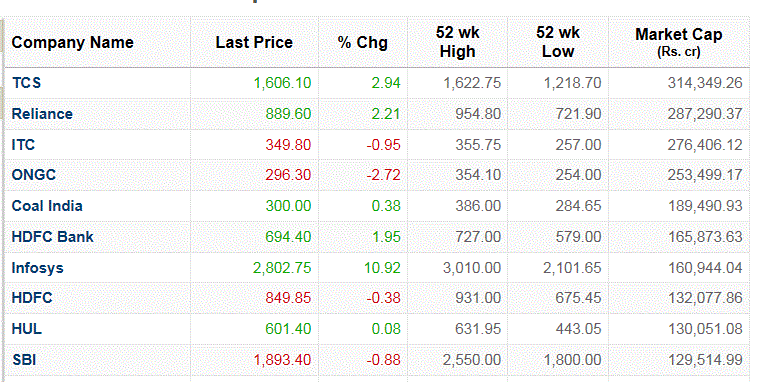
This performance has given TCS a market value of about Rs.314,000 crores compared to Rs.161,000 crores to Infosys. Is this justified?

TCS revenue and earnings grew at a rate of 22% and 27% compared to about 16% and 12% for Infosys. Margins also have been better for TCS. A superior performance. 

However, Infosys has at least one number in its favor: On a per-share basis it has beaten TCS. EPS of Infosys grew from Rs.104.53 to Rs.164.20, a growth rate of close to 12% compared to Rs.54.20 to Rs.71.82 for TCS, a growth rate of just over 7%. 

Return on equity, which is an important indicator of how capital has been employed by management, is definitely in favor of TCS: An improvement from about 43% to 47% now for TCS and deterioration from about 43% to 30% now for Infosys.

The perception of the market has changed clearly though - PE for TCS was about 10 in 2009 compared to more than 22 now (based on annual historical numbers).  For Infosys, it was just over 12 in 2009 compared to about 17 now. 

The story hasn't been that good for Infosys. Well, TCS is the most valuable company in India now; almost double the size of Infosys.

Heck, what's happening at Infosys? Too many things - one is bringing back Mr.Murthy.  His efforts surely would be to narrow the gap we see in the below table as much as possible.


Here's the final piece:


Of course these recommendations are only for the next 12 months. I leave it to you to guess the right one for TCS and Infosys as I am not that interested in the brokers' abilities.

I cannot buy into any of these stocks, for there is too much to predict over the next 5-10 years: Management behavior, Information technology environment, Developed markets growth rates, Emerging markets growth rates, foreign exchange rates, and so on.

Technology is good, but I can only applaud the leaders from a good distance. 

Let's look back some years later to check on them.

Sunday, June 23, 2013

what's up with reliance

I have argued before that ril's cost of diversion is considerable and hinted that its lure of technology may not be necessary. Well, time will tell about it more precisely. 

As of now, it is interesting to see where its current operations have headed. Its 2013 annual report is out and is more telling. 

Return on equity and return on capital have come down significantly. For 2013, ROE is just over 12% and after-tax ROC is just over 9%. I have considered effective tax rates rather than marginal tax rate. These returns were considerably higher in the prior years, especially during 2005 to 2010.

Operating margin and net margin too have deteriorated. For 2013, operating margin was 5.49% which until 2009 was in double digits, and for 2010 and 2011 was close to double digits; then it shrank badly in 2012. 

Revenue has been increasing at a pretty good rate every year. However, it is quite worrying if operating margin and return on capital are not doing as well.

The reason? 

The company has huge investments:


Existing business
Return on these segment assets can be better:


Growth business
However, it is the other segment that is causing maximum concerns: Rs.323 crores earned on Rs.32,520 crores of investment.


We know that the management is betting huge on its retail and technology businesses and anticipates adequate return on investment. But the question is should these investments have taken place in the first place? Would minority shareholders have approved this?

The company has announced huge capex plans in the coming years. Rs.150,000 crores to be spent on all 5 segments: Petrochemicals, Refining, Oil & Gas exploration, Retail and Technology. The last 2 sound a little out of place within this energy giant though.

The minority shareholders
The minority shareholders have invested in the company to participate in its energy business betting on higher oil and gas prices. They already have taken risks related to the energy business which the company is facing - for instance, falling oil and gas production, not-so-good relationship with the government, cyclical refining and petrochemicals markets. They wouldn't want more (i.e. unrelated) risks. If they have to invest in retail or technology it is more logical that they go to that sector independently. 

It is a bit strange to see this company which is pretty good at what it does in its core business to go out of place. 

The focus
The management's focus should be to fix this problem:


This can be done by looking into the following:
  • Increase oil and gas production on current fields;
  • Look for exploration assets both within and outside India at reasonable prices;
  • Improve relationship with the government;
  • Invest in refining and petrochemicals businesses enough to maintain market share and operating margin;
  • Use excess cash to buyback stock if the stock price is far lower than value of the firm;
  • Come out of unrelated ventures.

There is no doubt that management has the ability to take this company much higher in its core business itself. India needs energy; the world needs energy, and they are ready to pay for it. The company should just take advantage of this.

Wednesday, May 1, 2013

hindustan unilever goes like private

The recent past
Hindustan Unilever has gone through some tough times during the recent past. Take a look: It saw its market value stagnate during the period from 2002 to as recent as 2011. Stock price in 2002 was near Rs.290 and until recently in 2011 it was still about that range. Patience is virtue, is it?


Today, the stock is trading nearly at Rs.600. All that increase has been in the past 2 years. While Nifty increased by about 3%, HUL doubled. 


The glorious past
Prior to 2002 HUL was actually a star performer.

That Rupee stayed the same for the next decade, though. Constant pressure from the competition and raw material prices brought EBIT down from 17-18% (2002) to 12% (2011). 

The change in market cap:


The present
Now the market capitalization stands at Rs.126,000 crores with robust performance in 2012-13. The current P/E is 34 and dividend yield is about 3%. 

The open offer on 30 April 2013
Unilever has announced a voluntary open offer to buy 48.7 crores shares in HUL at a price of Rs.600 per share. The stock price jumped by 17% that day from Rs.498 to Rs.584. Not bad for a day-trader.

The signalling effect
Promoter purchases are always considered as some signal to the market about how they feel about the current price compared to the future potential of the business. As the insider managers know more about the business than the market, any announcement or action from them should tell some story. Here, the promoter is trying to purchase voluntarily a significant stake (22%) in the firm. Everything else remaining intact, the market should consider that the price of Rs.600 is cheap compared to its intrinsic value. Is it really?

The promoters' insight, a delayed action
If that were so, why did the promoters (Unilever) wait until the HUL stock price doubled? They could have easily bought the stake for half the price two years ago. May be they did not have the insider's insight. Of course, Unilever is using its own cash (i.e. its shareholders' cash) not HUL's cash for it is not a stock buy-back from HUL. 

If the price is not fair then Unilever's manager is cheating its shareholders. Unilever is paying about Rs.29,220 crores for the purchase. The excess cash, if that was, could have been returned back to the shareholders as special dividends or if its own stock price was cheap, it could have done the stock buy-back itself. 

Obviously, Unilever knows that its future growth lies in the emerging markets. Currently, they account for 57% of its revenue. Sure, India could make a meaningful contribution to its growth, both in terms of revenue and earnings. This is a special business earning very high return on capital.

But the price paid has to be reasonable compared to the cash flows. This part is a bit difficult to figure out since the promoters waited for too long to do this. Now, they are telling us that at 34 P/E this company is worth it. 

Who is going to sell?
I don't think the additional stake will make any difference to its control because Unilever already owns 52.48% in HUL. The additional 22.52% will take it to 75%, the maximum limit. 

What does it mean to the HUL shareholders? The current shareholding is: Promoters 52%, Institutions 30% and Others 18%. The promoters would own 75% if the offer becomes successful. Who is going to sell? About 6.43% is currently with LIC, Oppenheimer fund and Virtus Fund. Assuming that not all shareholders in the others category would sell, a large part of that 22.52% has to come from the institutions. To make it more difficult the run up on the price means that the offer may not be accepted or the offer price has to be increased. 

The easy decision is rejection
Unilever has refused to increase the offer price. This means even if the offer price was fair the shareholders should reject since the current stock price is pretty close to the offer price. Those who believe the promoters can stay on and participate in the Indian FMCG growth story, and those who don't can sell directly in the market. You don't need additional paper work or anything to do with Unilever for now. 

Special dividends to the promoters
There is a new arrangement for royalty payments to the promoters too. It will increase from 1.4% of revenue to 3.15% before 2018. It is quite significant as a percentage of earnings. At the current revenue of Rs.27,000 crores the royalty cost is Rs.378 crores. Is this some kind of special dividend to some special shareholders? This will have impact on the future EPS.

Going like private
If the offer is successful, HUL will act more like a private business in a way than a publicly traded business. For one, the stock would have very little free float; about 54 crores shares will be available for trading. With 75% stock remaining with the promoters and some more with those who really don't want to trade the stock, the trading volume should come down significantly. It is not necessarily a bad thing as long as the business does well. However, this is something that the shareholders should know. The institutions who want to trade will continue to set the stock prices but they will own much less stock than before.

Buying from the market
The hunch is that since the voluntary offer is not likely to be accepted, Unilever will try to buy the stock from the open market as and when the prices are suitable.

Friday, April 26, 2013

the dancing dow and its long-term history

The Dow Jones Industrial Average is probably the oldest stock market index with more than 100 years of history behind it. The history is here:


In 1900 the Dow was just below 70 and now in April 2013 it is 14700. The table shows some facts:


It is evident that the Dow survived the uncertain world: The great depression of 1929, two world wars, the 1973 oil crisis, the cold war, the black Monday of October 1987 (22% fall on a single day), the dot-com bubble, the 2008 financial crisis, and the current economic recession.

Despite all odds, the Dow has marched on. Its 80-year return is about 6% annualized. However, the last 6-year period return since April 2007 is about 1.5%. Probably, its worst 20-year return is for the period from Jan-1965 (889 points) to Jan-1981 (822 points). Talk of long-term investing. Index buyers would have faced some terrible times there. 

The real American growth story began after 1981. Look at the graph. This must have created many a millionaire. 


So what causes the rise or the fall of the index besides the human (rather bad) behavior? Simple to answer but difficult to predict. It is the cash flows (earning power) of the firms. These cash flows are a factor of their growth rate and the riskiness. If growth rate goes up and interest rate goes down, it is good; vice versa is very bad.

The riskiness of cash flows is affected by the prevailing interest rates. As interest rates change practically the value of all assets with cash flows change. 

Have a look at the interest rate history in the US.


Interest rates touched 20% during 1980-82 period. The two decades that ended in 1982 experienced one of the highest interest rate periods in the history. Just as of now, it is facing one of the lowest rates  in the history.  What do you expect the index to do during these high interest times? It promptly fell in the absence of any meaningful growth in cash flows probably. 

What's in store now? The current global recession, the European crisis, the Euro mess, the Japanese regression, and the unstable BRIC markets - where do we go? 

The US may not be the best market in isolation; but if you consider what's happening around the globe, it is still probably the most enduring markets to consider.

At least in the American context, picking the right stocks could help; if not, low interest rates should help the Dow rise from here (take the next decade) until we see significant increase in the rates, of course, subject to a reasonable growth rate in the cash flows of the firms. 

Passive investing should offer some help for those who are wary of stock picking. 

Thursday, April 25, 2013

jet airways dealbook

Jet Airways recently announced a deal with Abu Dhabi's Etihad Airlines based on which Etihad will buy 24% stake in Jet. It will also make additional investments in order to get some slots at Heathrow and frequent flier program.

Jet will issue 27,263,372 equity shares to Etihad at a price of Rs.754.74 totalling Rs.2,057 crores. That should make Jet worth about Rs.8,600 crores. Is it really worth that much? If you were in November 2010, you would have said that it could be. But we are in 2013 not 2010. 

Immediately after the issue, the promoter holding should come down from 80% to about 60%; LIC, Platinum Asia Fund and Birla Sun Life Frontline Equity Fund (other major shareholders) together would own about 4%, down from 5.23%. So effectively it will be Naresh Goyal and James Hogan show going forward.

With over Rs.10,000 crores debt, Jet has its challenges already. The latest announced results for December 2012 quarter have shown a profit of Rs.85 crores from Rs.4,200 crores revenue. This was the best quarter compared to the several previous quarters (which showed losses). Even for December 2012, operating margin of 7%, net margin of 2% and Rs.250 crores of finance costs are more telling. 

The future plans appear to be grand with expansion of capacity, taking advantage of Etihad management skills and possible exposure to more international markets. However, what remains a fact is that Jet is operating in a business that is inherently more risky than many other. High capital needs, uncertain revenues and uncontrollable fuel costs are a few of the business risks.

Jet commenced operations in 1993 and currently it is India's second largest airline in terms of market share and passengers carried. It has about 122 fleet in service and about 40 more fleet in order. Just have a look at its latest annual balance sheet (March 2012) and see its retained earnings, which are the cumulative earnings less any dividends paid to date. It appears that dividends have not been paid since 2007. I don't see much of earnings there.

Even if Rs.2,000 crores realized from share issue are used to reduce debt, the remaining debt would still be in excess of Rs.8,000 crores. Well, that is far in excess of the current market value of Rs.5,500 crores.

This current market value is a result of that sharp run up that has taken place in anticipation of too many good things happening to Jet after the deal. 


The stock price has almost doubled in the past 6 months; that is about Rs.2,500 crores increase in market value. Really, the public exuberance has no limits. Rather is that Etihad's?

I like to travel Jet anytime compared to the other airlines. That I am sure, no buts here.

Saturday, April 20, 2013

movie making: a high risk business of creativity

Creativity.....it is a business
Movie making as it appears is a pursuit of creative satisfaction and also fun. In addition, you get to make a lot of money. But is it really so?
 
I consider movie making as no different from being in any other business. You need to get your investing and financing decisions alright before you can think of any dividends. Here, the producer has  two very complicated numbers to estimate: One, costs of the movie. Two, net collections from the movie. Heck, more often than not you can't get these right, not even approximately right.

Movie failures could be pretty bad for the business. Check this out for the sample.
 
Then why is it that so many movies are being made all over? India, for instance, releases far too many movies compared to any other country; and why not, when about 1.25 billion people are constantly looking for some entertainment in life? It is another matter that the number of flops outnumber the number of hits. If this report has to be believed, the failure rate in India is as high as 95%. Also, hits and flops are being used very loosely. For instance, if the movie collections cross a certain threshold, say, Rs.50, 75 or 100 crores, it is considered a hit. In reality, however, it could be a super-flop movie for the producer. And it shows up: even for hollywood; just have a look at the net cash flows. 
 
The odds of the business....unpredictable cash flows
In general, the odds of making money is a movie business are stacked against the producer. Here is why. The costs of a movie include: 1) The actors' fees, the director's fees, other technicians' fees, and other costs of making the movie; 2) Printing costs; 3) Marketing and publicity costs; 4) Finance costs; and 5) Taxes. A significant part of these costs are not under the producer's control such as lead actors and director fees. Publicity costs which are imperative considering the shelf life of a move these days could run large. Finance costs could be large depending on how the capital is funded. Taxes are taken away by the government in various ways at different stages, not necessarily all from the producer though.

Reducing costs is not easy. Consider the choice of not-so-popular actors and director (lower costs) and higher chance of lower earnings or popular actors and director (higher costs). Talk about the odds.
 
Even when the costs are diligently managed, there is the next element in cash flows which are completely out of control, viz. the collections. The producer wouldn't know how much the ticket sales and other collections from sale of music rights, satellite rights, etc. are going to be until they are actually collected. If people like the movie, the collections are going to be higher; if not, they are going to be lower. On a majority of occasions this has nothing to do with the script, the story, the lead actors, or the director of the movie. The critics can give their opinions (which are more often biased anyway), but they do not matter. What matters is the opinion of the people (as much irrational as it may be) who watch the movie paying for the ticket. Eventually, that is what decides the producer's earnings. From these collections, there are other payments that are to be made such as distribution costs, exhibition costs, and entertainment taxes.
 
So what is under the control of the producer? Well, it may be only the idea. He might have this bright idea of making a movie which he might think might make money for him. However, net cash flows not ideas are important. If an idea, however bright, is not liked by the public it could spell disaster.
 
Overall, movie making is a risky business unless cash flows are carefully estimated and there is fair amount of luck. I wonder how financing is done in this proposition. It has to be the prospect of high returns.
 
There is one silver lining though in this whole process. There are some things that are stacked in favour from the start. Let's consider the Indian market: A growing population (more movie watchers), high inflation (increasing ticket prices) and that craze. Consider this: If only about 25 million people pay Rs.75 per ticket on average for a movie the gross collections would be close to Rs. 200 crores. And we are making a big deal about Rs.100 crores.
 
The only problem is that this business is very unpredictable and requires a lot of luck. Another way to generate cash, if possible, is to insure the movie against failure. That is a gamble for the insurer.

In the final analysis, if one ever wants to value a movie, one has to be sure to use the cost of capital associated with the riskiness of those cash flows. And boy, how risky!

It's a gamble
The statistics for relatively good years for India: for 2012 and for 2011 - not sure of accuracy as financial information is not published. And so far so bad for 2013All time disasters and toppers for hollywood.