Pages

Sunday, August 27, 2017

infosys board immature

On 18 August, the Infosys board released a statement squarely blaming Mr. Murthy for the CEO's resignation, and it went a little further than that.


The board goes again:


It said Mr. Murthy has repeatedly made inappropriate demands:


It concluded by stating that the board has no intention of asking Mr. Murthy to play a formal role in the governance of the organization. What a remark.

While I read the statement I found it a bit funny, and my take on the whole drama was that it was funny. Post appointment of Mr. Nilekani as the new chairman, there was a big shuffle in the board, which was great, although there was a need for a little more. Two former CFOs of the company were apt when they said what they said. 


Then came some more funny moments with the board. On 25 August, the board made a statement again:


I read it again for the sake of clarity; I said, no, it can't be that comical; heck, it was. First, blame the guy, then say it was not the intention to blame. People around are not idiots. The height of immaturity was apparent in the 18 August statement. And  now, I don't know what to say. The better thing would have been either to retract the previous statement, or if that was not possible, at least keep mum. The board has been reshuffled already; all that is needed is to repair the damage and look to the future. 

Investors don't want the shit like, it wasn't our intention to...They are more mature. Yeah, there have been more articles on how the founders have to get off. Basically, they just don't get the point Mr. Murthy is making. You do have some rotten apples in the box, which you cannot help.

The board is in the right hands now; and we do hope that Infosys gets out of the mess.

Monday, August 21, 2017

infosys, analysts and investors

Here's the low-down on the analysts take on the Infosys stock as of today.


You could lose money on the stock according to IDBI Capital, while you could gain as much as 22% as per Jefferies. 

Is there an investor who is betting on the stock for one year? The person should be a trader, rather than investor, for the investors bet on the probability that the business behind the stock is going to do well over a long period. 

My take is that if the earnings per share grow at 5% over the next 10 years, the stock is going to give a return of about 8% including dividends, and a little more than 5% excluding dividends. 

By doing the buyback, Infosys has already done the job of EPS increase for the next year. Post buyback, Infosys will have 2173 million shares outstanding down from 2285 million. Operating earnings remaining constant, the earnings per share will increase by a little over 5%. Any upside in earnings, will increase the per share growth rate.

It is fair to say that for Infosys the operating earnings are expected to grow, not fall, even if it is at a lower rate. If it performs buybacks on a regular basis over the period, yeah, with much lower amounts, 5% increase in per share earnings should not be too difficult, again probabilistically speaking. Any higher growth rate should only increase the rate of return over the period. How much can Infosys grow? That is the question everyone has, and everyone is guessing. During these uncertain times, the guesswork is murkier. 

So, do you want it? Or, is there any other business that you can look at giving you more than what Infosys can give? Tough times, isn't it?

Friday, August 18, 2017

infosys stock, why buy it if you don't believe in it

I have long back compared Infosys with TCS, and I said I was not going to buy into these stocks as there was too much to predict. 


Then I noted in Feb 2017 on how founding shareholders have the right to ask questions of the board on corporate governance matters. I also wondered how the remuneration committee, audit committee, and board could behave in the manner they did. In April 2017, I wondered how an investor in Infosys could make 35% return; and then I wondered whether it was probable. Then in June 2017, I noted how the managers were taking desperate measures what with their take on the risk factors filed in their 20 F.

In my view, the Infosys board and its managers have become a laughing stock. They first list the founding shareholders (they call them activist shareholders) as a risk factor impeding the company's growth. Later they tell the media that the founding shareholders are their well-wishers. And now they blame the founder for the mess that they themselves have created both for the business and its shareholders. 

Any shareholder has the right to ask questions about the way the company is run. When it is from a significant shareholder, there is much weight. And when it is from Mr. Murthy, the board is better off dealing with it as a top priority. 

None of Mr. Murthy's questions have been answered; and the board has the audacity to blame him for all the shit that has been going on. The CEO resigns, and takes on a role of executive vice-chairman. The board blames Mr. Murthy. Even while the shit is falling down, there is some comic sense. 

There are questions of the former CFO severance compensation; the former general counsel and chief compliance officer severance compensation; the Panaya deal; the (former) CEO compensation; and finally, because of all this, of the corporate governance itself. As a former CFO, Mr. Pai puts it, the board has failed in its duties. 

Well, there are many who have been talking good of both the board and managers and putting Mr. Murthy down in the process. They are entitled to their opinions. Yet, transparency is the key for any business organization if it has a long enduring story to tell. Otherwise, the story has to end either slowly or rather abruptly. This is the choice every business manager has to make.

Also, what do you expect from someone who does not even have skin in the game as they say? All shares owned are free; 44,886 free shares: not a penny, well almost, put in from pocket to buy shares of the business you believe in. The CEO also has (unvested) restricted stock units. So the number of free shares are much higher. But hey, they are free.


For those who defend by saying that those shares are a part of the compensation, here's the question: If cash was given instead of stocks, would the CEO have spent that cash and bought stocks? It is ridiculous to see the chairman of the board having virtually no stake in the business. Of course, Infosys is not an exception. Yet, I would have no faith in people who do not put where their mouth is. The logic is simple: if the business fails, they do not lose anything. In fact, they might even gain by hefty severance pay.

Infosys stock fell nearly 10% today after the CEO's resignation. The equity is available for Rs.2120 b now. The analysts are all over talking about how it is either a cheap or an uncertain stock depending upon whose opinions we hear. A 10% fall in a stock is not a big deal for an investor having faith in the business and its execution. So it should really not matter if there is conviction that the growth is visible and business model is sustainable. 

If due to the CEO's exit the execution is going to be an issue, then the investor will have to weigh in, and sell the stock when the price is more appropriate. There will be some opportunities in the near future for such action although a big blown price rise may not be there.

The shareholder-board-CEO saga is not new. It has been going on for sometime. So, the investor who is skeptical of the business execution should not have bought the stock at all, or having bought it, should have sold it when the stock price hit some higher levels, which the stock did in the recent past. Equity buying is not meant for short term gigs. Have the intention to participate in the long term performance, or don't just buy stocks. 

If the idea is to trade and speculate, short term is game. In fact, Infosys is just ripe for such action. I don't believe that the returns are going to be great by owning the Infosys stock. May be just about the market index; or slightly higher if lucky. I do like to trade in it though. Speculating with some insignificant cash is both fun and thrilling. The returns are also going to be insignificant. And on top of it, I get some comical scenes like the one going on right now. 

Of course, I noted in Feb 2017 that stock buybacks are good only when the company has excess cash and the stock price is lower than its intrinsic value. Is the stock price still cheap? 

Friday, August 4, 2017

amazon, is that a hype

At $986.92 per share, Amazon's equity is worth $474 b. Beginning 2013, it was $121 b; 2014, $182b; 2015, $137 b; and 2016, it was worth $270 b. Beginning 2017, it was $379 b. Is there any stopping to this story? The world has been bullish on the Amazon story, and for too long; threatening every business, they are asking, is Amazon coming for you? Is this going to be true, or all hype? 

I have been valuing Amazon for long, and every time, I must admit, I have found the stock to be overpriced. Noting about it in March 2013, I asked if anyone knew it in advance.


In February 2014, I wondered how long is long term for Amazon, which was worth $160 b at the time.

I acknowledged in May 2015 that it is indeed a disrupting business; but then, I noted that the business is yet to make money. At $200 b market value, the storyline was this, and continues to be so:


In September 2015, it was time to talk about price and value. At $235 b market value, Amazon was on its course, as per Analysts of course, to move past $300 b. 


I compared Amazon with Berkshire Hathaway in July 2016, and noted the differences in price and value. Both were priced by the market at $350-360 b at the time. 


And I did ask the question, again, where's the cash?


And by March 2017, we were talking about how Jeff Bezos could become the first person to be worth $100 b as Amazon goes past $600 b.


I also noted that the market, if not the business itself, has the potential to take Bezos past $100 b.

Now we are in August 2017, and Amazon just released its June quarter results. As of June 2017, it had cash of $21 b, and operating assets of $9 b. Such low operating assets was due to its reliance on supplier payables of $35 b. You have to wonder about its business model, after all. The non-cash working capital is negative $21 b, amazing indeed. There is a long term debt of $7.6 b. It has only $42 b of long term assets excluding goodwill.

With $9 b in operating assets, Amazing is ruling the world, what with the market capitalization of $475 b. While shareholders have put in only $23.2 b, net of cash it is hardly anything. Put in another way, if it pays off its debt, the balance sheet will look like this:

Operating assets $9 b; Cash $ 14 b; and Equity $23 b.

Can someone with $9 b available for investment replicate its business model and disrupt Amazon? It looks so simple, yet so formidable. Book $9 b, market $475 b; is there some mismatch here? Alright, I am manipulating a bit; you can add another $15 b, which is approximately the accumulated depreciation to date. Still, $24 b of investment and you get $475 b in market value is something to ponder over.

The only profitable segment for Amazon is its AWS, which includes cloud computing. AWS is about 10% of consolidated revenues, but contributes entire operating profits.

Operating profits: North America made profits of $1032 m and International segment suffered losses of $1206 m, resulting in Amazon's operating losses of $174 m for the 6 months ended June 2017. It is only after AWS you see the consolidated operating profits turning positive to $1632 m.

AWS made operating profits of $1806 m for the 6-month period. The question is, why AWS should be Amazon? Both are, sort of, unrelated businesses. If AWS is incorporated separately, the market will have explicit numbers, and therefore may be more rational in pricing equity. AWS is an IT solutions business and therefore will have to be valued as such.

Amazon is an online retailer competing with both other online e-commerce and brick and mortars like Walmart. Then we can see clearly that Amazon is yet to make operating profits. Although it is generating operating cash flows, we do not know how much of that is attributable to AWS.

Excluding AWS, Amazon had revenues of $66 b for the past 6 months. How much can these grow in the next decade, or even after that? Of course, the world is its market. Yet, how much? What would be its long term operating margins? There are lots of questions of Amazon as a business, and much more of the market's expectations and pricing.

While there are more bullish on Amazon, we also find some who are on the other side of the story. And with this kind of market pricing, they are not very happy. Is it going to fall, or is Bezos going to be the richest guy on the planet? That's a trillion-dollar question.

Sunday, July 30, 2017

nifty at 100000, is that so

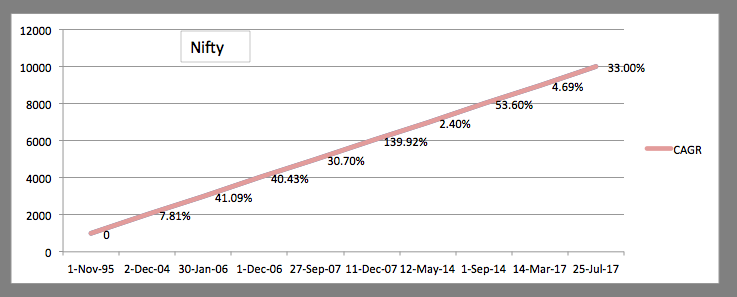
While Nifty took 21 years to increase from 1000 to 10000, here's someone telling us that it will increase to 100000 sooner than that. Well, it might as well be. At the same time, we cannot stop people from saying something, right? When there is demand, supply comes naturally. There is a lot of euphoria these days; so anything that attracts headline is game. 


Of course, both political and economic environments are far better as of now. So returns from the Indian equities are going to be much better than any other alternative investment opportunities. Nevertheless, we need to be aware of the pricing game and the value game; both are different. 

How about making an annualized return of 139.92%? Nifty increased from 5000 in September 2007 to 6000 in December 2007. This happened even while the index was 22.49 times earnings and 5.33 times book equity. Extrapolating, or hoping for the repetition of historical returns, there is an expectation of similar returns now. That's because Nifty is trading at more than 25 times earnings, and more than 3.5 times book equity. 

Well, the story is not complete. What happened after December 2007 is important. Another 1000 points increase to 7000 happened only in May 2014. The annual return over more than 6 years was 2.40%. Yeah, there was the great financial crisis in the middle. But then at 6000, the index was quoting at more than 26 times earnings, and more than 6 times book equity. If you know that your returns are hugely dependent upon the price you pay, you would realize what it means to buy in December 2007. 

Of course the buyer in May 2014 at 7000 was hugely rewarded leading the index up to 8000. But not the one at September 2014, who thought 8000 was a bargain at less than 21 times earnings and less than 3.5 times book, for the annualized return was only 4.69%; even after holding it until 10000, the annualized return is only 7.89%. 

During boom times, as it is now, there will be a number of idiots talking about, what else, boom. The exuberance tends to be irrational. As someone said, it is only when the tides are gone you will know who is left naked. I reckon, these days there are more men and women naked than those who are not. We will only find that out much later after the bulls are tamed, and bears march in. 

It is also good to know that change from 1000 points to 2000 is a 100% increase; and from 9000 to 10000 is an increase of just over 11%. Yet, people talk as if both increases are similar. The optimism in the tone is apparent. The index took only 4 months to increase from 9000 to 10000 in July 2017; that's an annualized return of 33%.


Unfortunately, people don't see the fundamentals underlying the index value. You cannot make more than what the business behind the stock makes in the long run; and equity investing is for the long run, for businesses are meant to be run for long. If the business is making say, 15% on capital in the long run, any expectation of more than that from the stock market is unrealistic. Stock prices follow business eventually. Of course, anything can happen in the short run. Yet we have people putting their hard-earned money into things that they don't understand. They will take time to check smart phone prices, but not stock prices. Heck...

Some perspective: To bring the earnings multiple down to say, 20, the Nifty earnings will have to increase by 25%, and its value will have to remain at 10000. Will that happen in the near future? I don't know about that; but, what I know is that the earnings will have to go up more than the index itself in the coming years in order to give a reasonable return to the buyers at the current level. 

It's time to get real, I guess. 

Thursday, July 20, 2017

life lessons; it's all for good

It's an old story; but I have to do this. I had sent an email to someone, who I thought I had admired, but it turned out I did not, in November of that year. The response was immediate on the next day. Happily I wrote on the same day mentioning how I admired his approach to investing, and noted my plans of leaving the job and starting investing as a career choice. I asked a few questions and sought some clarifications. 

Fourteen days later (yeah, I did not note the signs) I get a response saying that he was quite busy at that moment to guide me individually, but was happy to answer my questions in January next year. He also graciously extended his offer to meet him in his city if I wished to. I mentally noted that I had not sought individual guidance as he perceived it, but had only sought some clarifications on his approach to investing and my journey as such. Anyways that was that. 

As was my wont, I promptly replied on the same day. I mentioned that I would be happy to meet him, and also that I would be happy to call him in January as he preferred. I also sought some information on reaching his city since I was working elsewhere. 

Four months later (yeah, I should have noted the signs this time) in March I get an apology (I give it to him for that) for the late reply and asking me to call him the next day at his number that he supplied.

A week later it was my turn to apologize as I was tied up with work and could not check mails. I sought another date and time for the call. Five days later I wrote again to tell him that I would be out of station and would not be in a position to check mails for a week. A week later I promptly wrote again asking him to give a date and time convenient to him. Eight days later in April I again wrote to him. A week thereafter I wrote again. 

Finally the next day of my previous mail I get a response (effectively a month's delay, and no apology this time) asking me to call him the same day. I said fine as it was my problem, not his.

The fun and games began on the call that I placed in April. I mentioned about my plans to leave the job and start investing as a career choice managing my own money. The conversation was so embarrassing that there was no time to ask questions and seek clarifications I had noted in my first email. He vaguely said something. Then he said that I was a professional and how I could talk about specific stocks. I mentally noted how the heck he thought that I was seeking stock advice. Was he out of his mind, I mean, was his mind somewhere else? Was it lack of interest? There wasn't mention of a single specific stock. I neither give, nor seek stock advice. It was my turn, obviously only in my thoughts, to note that he also was a professional and I did not expect such a sloppy response from him. Then I had to close the call as he appeared to be in a hurry. Man...Neither any of the questions I had in my mind were asked, nor any of the clarifications were sought. It was one such waste of time. 

All my working life I was with the biggest of consulting firms in the world. I met strangers often both in life and profession. If there was a call, there would be a response. If there was a mail, there was a reply. Nothing great about it; every professional did this. More importantly, if there was no interest in communication, there was an apology to that effect. No stretching, dragging, and crap. That's professionalism both in life and work.

Yet I wrote to him on the same day thanking him for his time. I also thanked him for the encouragement although there wasn't any. I mentioned that I would write to him in August as he had preferred regarding meeting him in his city. In fact, as I had no such plans at all, may be I should not have mentioned about meeting; never mind. 

Any other gentleman would have responded immediately wishing me regarding my decision to move on with a new career. Nope, none of such. Was I expecting, after all of this? Man...

As I reflected on the whole later, I realize that I need not have contacted him at all. I need not have flattered him at all; I need not have admired him at all. I had been investing in stocks long before and had reasonable success. My thought process was already evolving based on my quest to learn. There were books that I had read and was reading. I was tracking life and times of investors I admired. The knowledge was building up, and I was already aware that investing was a life long learning process; and lots of fun too.

More importantly, I had already informed my office regarding my decision to relocate and set up my business of investing. This was long before I first wrote to that person. It wasn't even that he changed my course of sort. My decision to move ahead was independent and irrespective of the results of my communication with that person. All arrangements for relocation had already been made much, much earlier.

Yet these things had to happen, and teach me some valuable lessons. I learned a little more about human behavior. There was reinforcement on how people wear masks all the time. There is no regret of course because I did not know what was about to happen. I find it all funny now because I realize that there wasn't anything special about that person in the first place. Perhaps, I got a little carried away since I was to start this very interesting journey that had been my favorite pastime. 

I had put in my papers already and had announced to everyone in office about that. I was to leave office and relocate. I had made that decision. Yet I had to write that email and place that call. Heck. But then life is like that, isn't it?

Well, I have moved on. I have been investing. I have been learning along; I have been reading. I have been doing exactly what I had planned for myself; Investing as a business has been good for me and my temperament. And more importantly, I have been having fun. 

How about that someone, that person? I don't know, and I don't care. Man...

Sunday, July 16, 2017

deutsche goes to lunch with warren

We all know that each year there goes a bid to have lunch or dinner with Warren Buffett, and the proceeds are graciously contributed to a charity. Diehard fans have and are willing to pay up millions just to sit next to Buffett and listen to him. They always come back saying it was all worth it, and why not?; they are the biggest of fans. 

Recently, I came across a report, though, that says $2.7 m that was paid for the lunch was actually worth it for anyone. Bizarre as it sounds, its argument actually is bizarre. 


There are several problems with this argument. First of all, it is stupid, just that. Now we can move on with other.

If someone with just $92,500 to invest should spend that much for lunch, assuming Warren accepts that bid, and also assuming that someone will return with 19% secret, that someone will have no cash to invest any further. Duh!

In 23 years, $92,500 earning 7% annually becomes $438,500. To estimate how much it becomes in real terms, we need annual inflation rates. The report says it becomes $284,000 in real terms, which means it assumes an annual inflation rate of 2%. It's not too much, but the report does not mention about its assumptions. Too bad, aargh!

At 19% annualized rate, $92,500 becomes $5.05 m in 23 years. And assuming the same inflation rate of 2%, at a real return of 17%, the investment value will be $3.4 m, not $3.8 m as the report says. In order to get $3.8 m, the rate of return will have to be about 17.53% annually. Assuming that it is in real terms, for the report misses to mention that, the implied inflation rate is 1.47%. Isn't a bit unfair to use 2% inflation for someone not having lunch, and 1.47% for someone having lunch with Warren? May be the food will have some magical powers to tame the macro. Even when you calculate the nominal, real and inflation rate equations on a compounded (which is more accurate) basis, we note the same shit!

And then. When Warren whispers that secret to 19%, is there an assurance that someone will imbibe the whisper and earn 19% over 23 years? Well, the report assumes that crap.

Finally, that secret whisper isn't 19% as the report notes, rather 20.8%. In the last 50 plus years, Berkshire Hathaway's book value increased by 19%, and its market value per share increased by 20.8% annually. 


It looks like Deutsche not only wrote some stupid report, but also failed to do some homework. What a pity!