Pages

Tuesday, September 18, 2018

lehman, financial crisis 2008, and more

Lehman's history
Lehman Brothers was founded in 1850, and became an important trader in cotton during those times. Later it focused on trading and brokering of commodities. The firm dealt with great depression, and came out having survived. The business of venture capital and underwriting of capital issues was steady and successful in the subsequent years. By 1975, Lehman had became a prominent investment banker for the American businesses. 

American Express acquired Lehman in 1984 for $360 m to form Shearson Lehman American Express. In 1988, the firm merged with EF Hutton stock brokerage to form Shearson Lehman Hutton Inc. 

Before the initial public offering, the banking and brokerage operations were divested of, and retail brokerage and asset management business was sold by American Express. Lehman Brothers Holdings Inc. became a publicly traded firm in 1994 with Richard Fuld as its CEO. His 14-year stint as CEO had to end with filing for bankruptcy on 15 September 2008. Before that, the firm fended off rumors of cash crunch due to the collapse of Long Term Capital Management in 1998 as fake news. By 2007, Lehman had posted record revenues, earnings, and earnings per share for four consecutive years. Fuld became a hero after leading the firm to post 14 consecutive years of profits after it had reported a loss of $102 m in 1993. Little did the market know of the amount of leverage used to drive returns on equity. The asset management business was revived in 2003. In 2007, Lehman had revenues of over $19 b and posted record high earnings of $4.2 b. 

Perhaps things would be fine had it not ventured into the lower grade mortgage lending business. Of course it was lucrative, and seemed like a good idea at that time. The Alt-A mortgage, considered lower than prime but better than subprime, began after Lehman acquired Aurora Loan Services in 1997. Later in 2000, BNC Mortgage LLC was acquired, and Lehman became a subprime mortgage lender. These lower grade, higher risk mortgage lending operations had a stunning growth story: Lending in 2003 was $18.2 b; in 2004, it was $40 b; and in 2006, both Alt-A and subprime loans comprised more than $40 b per month. Quite naturally, Lehman started 2007 with too much of risky assets supported by too little of equity. Any good year with this capital structure would yield enormously high earnings for common shareholders; and it did, in 2007 of about $4.2 b. Any bad year would be of enormous losses. And a very bad year, would let the course to bankruptcy; and it did in 2008. 

2008 operations
The winding down of BNC subprime operations in August 2007 perhaps came a little too late. Consider this: Lehman posted profits of $489 m in the first quarter of 2008. Citigroup posted losses of $5.1 b, and Merrill Lynch had $1.97 b losses. In the second quarter though Lehman reported record losses of $2.8 b which came after a very long time. Revenues for the quarter ended May 2008 were $6.240 b, and interest costs alone were $6.908 b. It had $6.513 b of cash available for operations. Total assets were $639.432 b, of which $13 b was cash deposits mainly with the regulatory authorities. In effect, its net operating assets were: Financial instruments and securities of $269 b; Collateralized agreements of $294 b; and receivables of $42 b; totaling $605 b. You couldn't do much with property and equipment ($4 b), intangible assets ($4 b), and other assets ($5.8 b). During the quarter, Lehman lost $17.899 b of cash from operations which was made good by debt.

In June 2008, Lehman raised $4 b of common stock at $28 per share, and $2 b of non-cumulative preferred stock carrying 8.75% coupon, which had a mandatory convertible clause. Apparently, this capital raising was not good enough because its statement of financial position as of May 2018 looked like this: Assets ($639.432 b) financed by common equity ($19.283 b), preferred stock ($6.993 b), and debt and other payables ($613.156 b). Just 3% common equity meant that asset losses of only 3% would wipe out entire equity; a very vulnerable situation to be in.

The auditor's report dated July 2008 based on their review of May 2008 (quarter) operations, and the report dated January 2008 based on their audit of November 2007 (year) operations, expressed unqualified opinions on the financial statements. There wasn't a note on Lehman's going concern issues.

Lehman reported Tier1 capital ratio of 10.7% and risk-weighted capital ratio of 16.1% as of May 2008. This wasn't reflective of the risks that the firm was up against. As long as property prices remained high it was fine. If prices were to fall, Lehman would need cash to make good on margins to its lenders. When prices came crashing, the firm would need significant amounts of cash on short notice. Inability of the original individual mortgage borrowers also had a role to play which had cascading effects on property prices and consequently on the bundled mortgage assets prices; there was a reason they were called subprime.

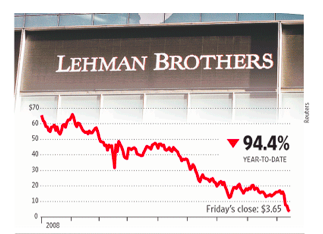
Lehman stock prices started falling, and the subsequent downgrades on Lehman by the rating agencies meant its derivative contracts demanded billions of dollars in collateral. By 9 September 2008, Lehman was worth only $6 b while it began 2008 with a market capitalization of over $35 b.


Nevertheless, here's the thing: If the markets trusted on Lehman's ability to recoup, even if it were to take a long time, it would have been ok. However, it was not to happen. Lehman lost on its credibility to raise short term cash, and there was no other choice. 

No bail out
Even the government turned the other way. It would rescue Fannie Mae and Freddy Mac; both firms had owned or guaranteed about $6 t of the total $12 t US mortgage market. It bailed out AIG. It also facilitated the $50 b Merrill Lynch buyout by Bank of America. But not Bear Stearns and Lehman. The first to go was Bear Stearns when the government let JPMorgan Chase buy Bear Stearns for $2 per share. Warren Buffett bailed out Goldman Sachs by investing in its $5 b preferred stock carrying 10%, which helped boost the firm's credibility and made its capital raising easier. All the firms that survived were beneficiaries of the government's $700 b troubled assets relief program bailout. 

Of course, the government thought Korea Development Bank would rescue Lehman. When it did not, the stock price crashed below $8 per share. It also hoped that Barclays would buyout Lehman which did not happen thanks to the veto of the UK regulators. 

Then the bankruptcy was made inevitable; 15 September 2008 and Lehman became part of the history being the largest bankruptcy of all time.


The S&P-500 fell more than 4.5% (source: Yahoo finance) on the day, and so did the Dow Jones which fell from 11421 to 10917.

Bankruptcy meant $0 stock prices, and this is how they panned out.


Subsequent to the filing, Barclays bought selected US assets for $1.29 b, and Nomura bought Lehman's Asia operations for $225 m, and parts of European operations for nought ($2 nominal). 

What if
I sometimes wonder what would have happened to Lehman and the financial markets if the US government had bailed it out. That is to supply cash and fill liquidity, and own equity until Lehman was able to get back on its feet. When asset prices and markets recovered, as they did, Lehman would repay its debt (equity) back to the government, and either remain a privately held firm or issue shares to public to operate as a listed entity. Alas, it wasn't to be. And we have a number of lessons to learn. 

Lessons that markets don't learn
The first and foremost is never to be at the mercy of someone else. This position of weakness is almost always caused by excessive leverage compared to own capital. The second is never to trust the governments to come and support during desperate times even while they choose to discriminate. The third is never to be in a business that is mainly dependent upon hope, greed, and the greater fool; most likely, the business itself would end up being one such fool eventually. Lehman, along with other firms that fell, unfortunately did not have the time to learn these lessons. Yet, I hope that those firms that did survive have learned. But then, don't we know that what we learn from history is that we don't learn from history?

Thursday, September 13, 2018

stocks for long

The Indian markets have had downward movements in the last few days mainly due to the fall of rupee relative to dollar; but there are always other factors too. The media, as usual, has been going crazy, and naive investors are wondering whether to buy, sell, or keep quiet. Someone said it long back: it is human nature not to be able to sit quietly in a place. There is nothing new here, or elsewhere. The US markets have not been any different. 

While I note that it is possible to find stocks to buy in every market, bull, bear, or volatile, there are times one could do well if one was able to sit quietly for sometime. In investing, there aren't exact rules to follow other than this one: buy low, sell high; or sell high, buy low. There are many ways to achieve this. The game is therefore more of an art than science. 

People think that they can make money by always being active in the market. Yeah, they can, but the chances of consistently being successful in the long run is much limited. That's the reason why there have been very few successful traders and speculators. If we check investing patterns of the rich, we can find that most of them did well by staying in the game for a long, long time. Many of them have had almost all of their wealth tied to one or two businesses, and yet the outcome turned out to be quite good. The reason is simple: they focussed on their businesses rather than anything else. 

It is stupid to argue about things that are not in our control. For instance, oil prices and currency fluctuations. We have witnessed these things, and more weird ones, in the past. Yet, businesses have prospered. It is therefore much better and easier to concentrate on the businesses we like, pick the stocks, and be part owners and enjoy the ride as long as we continue to like those businesses. Let the managers worry about how to deal with: the operating, financing, and dividend decisions. When businesses are good and managers are honest and able, there is little we can and should do to alter. Buy right, and sit tight: There is much money to be made when we don't interfere with the compounding math. 

Alas, not many can understand this simple, yet powerful game. Get rich quick is what lures them; nothing can be worse than one's neighbor getting rich. Even Gekko would have probably agreed that envy is worse than greed. 

When markets are overpriced, it is better to pick a book or go out. When they are underpriced, it is better to buy our favorite businesses at prices that we like. When markets are volatile, either sit quiet, or simply set up a program to buy the index itself periodically. In fact, index buying is great for people who do not understand the game. Such buying will ensure that prices are averaged out and returns are satisfactory. The only condition is that the index buying period should be continuous and for a very long period. 

Of course, there are times when I like to indulge in trading. After all, I find markets fun all the time. The capital allocated to trading is tiny, but it lets me have fun. And that's the key. We should not allocate a significant amount of capital to speculation; that will be silly. 

It is easy to summarize: Select the businesses that we like to buy. Wait for the right price; let the wait be for long, no problems; there aren't penalties. Keep a good portion of capital for this. In the meantime, set up a program to buy the index each month irrespective of market prices. That way, we are in the markets all the time. When the price is right, buy the stocks, and hold for as long as the businesses are sustainable. The idea is to hold both stocks and index for a very long time, preferably more than a decade. Sell stocks when the underlying businesses no longer possess long term competitive advantages. When the selection is proper, such situations should be rare. Do not look for hot tips; do not follow anyone's stock portfolio. These are stupid ideas. Someone else's conviction will not do any good to us. Being in business is a long term game; so is being in stocks. 

Want to have fun? Go out and enjoy. Pick a book and read. Indulge in hobbies that make you happy. Want to trade in markets? Allocate an insignificant portion of capital, and speculate to glory. 

To make decent money from markets is not very difficult with right behavior. There isn't complicated math here. Think long; think long term, and it should be fine. And if we stop comparing ourselves with others, we should be fine too. 

Tuesday, September 4, 2018

how much can you make on nestle

Nestle India is worth Rs.1,060 b now. Based upon its reported earnings of 2017, never mind the subsequent nine months, of Rs.12 b, it works out to a pe multiple of over 85. It has never been quoted that high at least in the last decade. Sorry, it did once in 2015 when it was priced at a high pe of 128, and a low pe of 94 during the year. Even from a market price of Rs.723 b (high) in 2015, the annual market return to date is more than 15%. And it has effectively doubled in market value from its low price of Rs.530 b in 2015. 

Of course there was an anomaly because 2015 was an exceptional year for Nestle. There was a charge of Rs.5 b to its income statement due to the Maggi episode. If we remove this as one-off, the net earnings for 2015 would be Rs.10 b, and the high and low pe multiples fall to 68 and 50 respectively. That means, investors who bought in 2015 and sold now made money thus: buy at pe 68 or 50 and sell at 85 after a 15% rise in Nestle's earnings. Cool deal. But the catch is that if the pe multiple now is same as it was in 2015, i.e. 68, the returns would be paltry if bought at 68 times, and more than 15% if bought at 50 times.

I call this hope-based investing. When we rely entirely upon the multiple expansion rather than earnings and cash flows expansion, we need to sit and pray. 

Let's talk about good part of the story first. In 2007, Nestle's market cap was Rs.160 b (high) and Rs.84 b (low), and earnings were Rs.4 b. In 2012, it was Rs.484 b and Rs.378 b, and earnings were Rs.10 b. Investors benefited twice: earnings more than doubled during the period; and the pe multiples expanded from 38 (high) and 20 (low) to 45 (high) and 35 (low).

Now look at what happened during the subsequent five years. Earnings increased from Rs.10 b (2012) to Rs.12 b (2017); that is an annual increase of 2.79%. But the market value of equity more than doubled from Rs.484 b to Rs.1,060 b now. Nestle distributed about Rs.30 b in dividends in the past five years. 

Revenue growth has been 3.73% (5-year annualized) and 11% (10-year period). Earnings per share growth has been 2.79% and 11.47%. 

Let's make a bull-case scenario for Nestle. Let's assume that eps and dividends will increase at 12% per annum over the next 5 years; then eps would be Rs.224 per share in 2022. Dividends per share in 2017 was Rs.86. At the current price of Rs.11,277 per share, investors will lose close to 12% annually if we price the business at a pe multiple of 25 in 2022. There has to be some premium to the business, after all it is Nestle. Let's keep going. Even at the multiple of 45, investors will lose 1.20% annually over the 5-year period. At 50x, they will make less than 1%. At 60x, the investment returns will be less than 5%. Even at 80 times 2022 earnings, the returns will be 10.50%; the market index should be able to give that probably. If the expected return is say, 12%, the business should be priced more than 85 times earnings. 

Nestle's operating margins have been 17%. It also enjoys a very high return on equity and return on capital. The business does not require a lot of capital to operate. There has been no dilution in equity: 96.415 m shares have remained constant for a long time. Yet there is a moral in its story: A great business isn't always a great buy. There is a price for everything. Price is what you pay, value is what you get. 

Nestle has been generating solid free cash flows; for 2017, they were Rs.17 b. Nestle has not spent big on its capex other than in 2011 and 2012 for plant expansion. It is safe to assume that Nestle has the capability to generate average fcff of Rs.15 b annually. Although the growth rates in the past have been higher (5-year 20%; 10-year 17%), let's assume that fcff will grow at 12% over the next 5 years. If the expected returns are 12%, Nestle will have to be priced 70 times its 2022 fcff to get the present value of the 5-year cash flows equal its current market price.

Is it possible to earn decent returns from Nestle? Of course it is possible. But for that, investors will have to say prayers every day during their investment period: Oh, Lord, keep the pe up, and up. Is Nestle an exception? Of course not, there are lots of fantastic businesses priced egregiously by the market. Was it a buy in 2004? Heck yes.

Monday, September 3, 2018

buffett's peekaboo with technology

Warren Buffett has always said that he does not understand technology, and that's why he does not invest in that business. More famously he has mentioned that if anyone puts a value to an internet company, he would flunk. Well, times change, don't they? 

Buffett has invested in Intel and IBM in the past. And now he is too enthusiastic about Apple. Recently, Berkshire Hathaway bought a 3.5% ownership in the Indian technology company Paytm for $350 m. He had his standard response: he was not involved. There was a similar response when the company first purchased Apple shares. May be Buffett is slightly embarrassed to have backed out of his own cooking. After all, he is human too. In fact it is time, the world acknowledges that he is all too human. 

Buffett's justification these days for buying Apple is that iPhone as a product is sticky, and therefore it is quite underpriced. He never realized Microsoft's windows and office have been the stickiest for a long time, and he could not figure this out despite Bill Gates being his close buddy. He said in the past that he does not understand technology, therefore Microsoft. I don't see any change in facts in the past, now, and the future regarding the internet and technology businesses. Even Keynes would have noted that no facts changed, and therefore, there was no need to change mind. Yet, Buffett did. It is always difficult to predict the future of technology. You can't even do it with a broad brush. If he is playing peekaboo, well, we got him.

I reckon the real reason Buffett did not buy Microsoft in the past, and is buying into technology now is this: Earlier he had plenty of other undervalued businesses to buy, and there was no need to look at the technology firms. His cash was fully allocated. Technology stocks were for the dumb. Today the story is different. There aren't too many businesses he can buy considering the size of his capital. This is troubling him, and he is under pressure to stand up to his reputation. He doesn't want to distribute cash. How can he continue to earn excess returns? Voila, let's enter the uncharted territory: the technology, and let's make a validating story. Suddenly the technology stocks are for the smart. 

I have seen different versions of Buffett over the years. He is a very smart man is indeed an understatement. His investment records show what he is capable of. But if he feels that he can tell a story that people will soon forget to hear a different version of it, he is mistaken. I have been his admirer, no doubts about it. But I know what to pick, and what not. He has been making and unwinding stories in the past at least on four occasions: In 1955 when he wanted to retire at 25. In 1969 when he closed the partnerships saying stocks were too expensive, and sighted personal goals as incentives. Immediately thereafter when he took control over Berkshire Hathaway and made it into an investment holding company. And the fourth time he made his story believable was when he started buying technology companies. Oh yeah, he has also been advertising for soda and sugar; people who completely surrender to this thoughts believe that coke is actually good for health. When you are a shareholder of coke, you will find incentives to promote it. Well, to each his own as they say. 

As per this report, Paytm had revenues of Rs.8.28 b (2017) compared to Rs.5.97 b (2016), and incurred losses of about Rs.12 b in each of the years before exceptional items. As a technology firm operating in digital payments and retail business, it will continue have heavy expenditure on research, technology, and advertising. It also has a solid backing from Softbank and Alibaba. When it raised $1.5 b from Softbank in May 2017, Paytm had an implied valuation of $7 b. Now Berkshire's investment puts a value of $10 b for the firm. 

Paytm was founded by a smart person, and probably has the ingredients to scale up, and do well. It has also got the funding available from the global investors. But how much the firm is worth as of now, or how much it will be in the next decade or so is anybody's guess. Should we say, Buffett flunked his own test by implying a value on the technology business?

Wednesday, August 22, 2018

amazon and apple

Amazon is worth $908 b now, and Apple, $1 t. I am not sure anyone had predicted this five or ten years before. What we should be asking now is whether it is market hype and exuberance, or has any fundamental reasoning behind it.

Value of a cash flow producing asset is the present value of its lifetime cash flows. It is very difficult to estimate how much free cash flows a business will generate during its existence. A business itself changes from its early stage as a newly incorporated, later as a high growth firm, then facing lower growth, and finally as a matured business. These changes take place due to a variety of reasons, first being the nature of business it is operating. A high tech firm will have tremendous challenges for its existence early in life. The technological change is fast-paced. Every business will have to face the macro economic factors and competition. A high profit business will attract competition. Competition will force bring down excess returns. Often, it is the quality of management that will define the course of a business. Sometimes even a poor quality business is steered by an able management, although economics of the business tend to prevail in the long run.

Market price of a publicly traded business is determined by the market forces: demand and supply. Yet, demand will be higher for a high quality business with demonstrated metrics. The market price of a good business is usually higher than that of a bad business. If for instance, the revenues, operating profits, and earnings growth are higher than its competition, the firm will be priced higher. Return on capital and equity tell us how well the capital is being employed in the business. Earnings per share are indicative of how shareholders are rewarded. The higher the growth in eps, the higher the prospects of the business. 

Free cash flows generated by the firm are key to the quality of business. As noted earlier, the value of a firm is the present value of its cash flows. If we cannot estimate perpetual cash flows, at least past cash flows should be able to give us some idea about what they would look like in the next five or ten years. So there must be something to Amazon and Apple to have been priced by the market at trillion dollar levels. Let's find out their past. 

amazon
Amazon had negative free cash flows for 2017. Its operating earnings were $4 b, but Amazon spends huge amounts on research and technology, which are sort of investments for future growth. However these are charged to the income statement when incurred. Similarly it spends on advertising and sales promotions, which tend to benefit the firm over the years. Amazon also has a fair amount of non-cancelable operating leases which operate like debt, but are kept off books. When we make adjustments to the income statement for these costs, we get operating earnings of almost $16 b. Suddenly we find Amazon's operating margins (9%) and return capital (28%) at pretty decent levels. In addition, the advantage Amazon is getting by charging off these costs is that its tax liability becomes lower. 

However, they do not affect cash flows since these are only book adjustments. Amazon's acquisition of Whole Foods for $13 b along with its reinvestment requirements meant negative pretax cash flows of $10 b for 2017. Let's not penalize it because of one year. If we take a look at its previous ten years, we get a cumulative pretax free cash flows to firm of $20 b, or $2 b per year average. Make it previous five years, and we get $2.5 b average. If there was no acquisition in 2017, its pretax fcff would have been $3.5 b for the year. If we deduct its $10 b negative fcff of 2017 from the prior decade's total of $20 b, Amazon as a business has actually had an aggregate (2007-2017) pretax fcff of $10 b. With an effective tax rate of say, 25%, the fcff would be a total of $7.5 b during the past eleven years. 

Yet the market value of Amazon's equity has increased from $42 b (high) and $ 15 b (low) in 2007 to $908 b now. Now to justify its market value, its true cash flow generating ability should be significantly higher than what it is now. Heck, we can't even take its highest fcff so far (2016) of $4.8 b aftertax, for that would mean paying 188 times. Even if we assume 25 times is a fair multiple, market's assessment of Amazon's free cash flows ability will be $36 b. How can Amazon generate $36 b of free cash flows to firm? Alternatively, market must be assuming significantly higher fcff coming in the next decade. That will be possible if Amazon's operating earnings go up, and capital spendings go down. In 2017, its capital spending was $12 b, and the five-year average was $6.3 b.

If we start with $6 b fcff, and project it go grow at 25% annually during the next decade, they will be $55 b in 2027. This is the idea: Revenues $933 b, operating margin 9%, ebit $84 b, tax rate 25%, and $8 b reinvestment will get fcff of $55 b. If we price 2027 fcff at 25 times, and calculate the present value of all cash flows at an expected return of 10%, we will have a value of $632 b for Amazon. But it is worth $908 b now, which means market has different expectations: either the cash flows or fcff multiple will have to be higher. Or perhaps the expected rate of return should change, after all ten year treasuries are currently yielding only 2.823%. Amazon is a high growth business, and growth needs reinvestment, which lowers free cash flows. Isn't the game a bit tricky?

apple
Apple had pretax fcff of $52 b in 2017, and $82 b in 2015. In the last eleven years, it generated fcff of $424 b pretax. With a tax rate of 25%, close to what it has been paying, free cash flows will be over $300 b. Compare that with less than $10 b for Amazon. If we take $60 b pretax, Apple can generate $45 b fcff at least in the near future. Of course, the growth rate for Apple is much lower than that of Amazon's. That is one reason Apple's reinvestment requirements are lower, unless of course, its aspirations for i-Car, et al are going to come alive.

If we start with $45 b fcff, and project it go grow at 7% annually during the next decade, they will be $88 b in 2027. If we price 2027 fcff at 15 times, and calculate the present value of all cash flows at an expected return of 10%, we will have a value of $900 b for Apple's operating business. With net cash of $150 b, we have the market price of $1 t for its equity. The key risk for Apple is its expected growth rate. How long can iPhones shield it?

market
Different cash flows, different growth rates, different set of risks, and yet both Amazon and Apple are priced similar. The markets have reasons that reason cannot understand.

Monday, August 20, 2018

berkshire, apple, and some fiction

Here's an interesting post that talks about Berkshire's acquisition of Apple. I know the work is of some fiction, but still, I don't know why Berkshire should buy 100% of Apple, and not the other way around. Well in fiction, anything is possible, I suppose. As per its latest proxy statement, Vanguard group and Black Rock owned more than 6% each of Apple. After Berkshire's latest quarter filing, it owns about 5% of Apple; and unless it bought more after June 2018, that makes it the third largest owner of Apple. Buffett seems very bullish on Apple, and everyone is going gung-ho after his statement. 


The man doesn't know what to do with his cash. He is adamant about not distributing through dividends or buybacks. What else he could do than stick to some maturing business giving him just about or slightly more than the market returns? 

The post that I referred to says that Berkshire's current cash flows are $45 b and that of Apple are $65 b, and continues to believe that these are going to be their future cash flows too. The author has promptly referenced the workings to Berkshire and Apple here. Well, one reason I don't rely on the third party's numbers are that they can be inaccurate. Even for some fiction action, we need the right numbers, which the post misses. Here's why.

Berkshire's net earnings were $45 b, $24 b, and $24 b respectively for 2017, 2016, and 2015. Earnings aren't free cash flows, remember. Berkshire made some adjustments to its net income, removed the effect of taxes and changes in working capital, and showed operating cash flows of $45 b, $32 b, and $31 b for the three years. Again, operating cash flows aren't free cash flows, remember. For any business, reinvestment is required for two reasons: One, to be where it is in terms of inflation, competition, profitability, and cash. Second, to feed its growth. This is more important. If not for growth prospects, the market will price the business as a no-growth business. If that were so, Berkshire would not be a $500 b business, it would be way less. That means, there has to be some meaningful reinvestment of cash back into the business, which Berkshire has been doing: $11b, $12 b, and $16 b. Then there are acquisitions which are a sort of reinvestment, but may not be required. Berkshire spent $2 b, $31 b, and $4 b in the past three years for acquisitions. It may not spend $30 b for precision castparts like acquisition, but there will be some. To say that Berkshire's free cash flows are $45 b is just hilarious. 

This is what I would do to arrive at Berkshire's free cash flows. The operating income: $25 b, $35 b, and $38 b for the past three years. If you want to include Kraft-Heinz as part of its operations, add another $3 b to its current operating profits. Berkshire had one-off gains in 2017 due to changes in the recent tax laws. Let's just forget it for the moment, and assume an effective tax liability of 25%. That brings down aftertax operating earnings to $20 b, $26 b, and $28 b. Depreciation ($9 b, $8 b, and $7 b) is a non-cash charge, and therefore gets added to the earnings. But then as we noted earlier, Berkshire's capital spending requirements are imperative to its future growth; so they get reduced from earnings. Now we have the adjusted numbers: $18 b, $22 b, and $20 b. We need to make two more adjustments before we arrive at the free cash flows of the operating business. Berkshire took $25 b as positive cash due to its losses and loss adjustment expenses for 2017. I see it as exceptional because they were not as high in the previous years. They were like $4 b, $2 b, $7 b, and $0.5 b for 2016, 2015, 2014, and 2013. In the absence of linearity, we are left to be judgmental. I would take $2 b positive adjustment change in non-cash working capital, which works out be average of the previous few years. I would also keep $2 b as average spending on acquisitions, for these may be required to feed some of the operating businesses. 

In summary, for Berkshire, we have operating earnings adjusted for taxes, depreciation, capital spending, acquisitions, and working capital before we arrive at the free cash flows for the business. And they work out to $18 b, $22 b, and $20 b for the years 2017, 2016, and 2015 respectively. More importantly, they are not $45 b as the aforementioned post likes to have.

For a normal business, to arrive at the free cash flows to equity, we should be adding income from cash and marketable securities, and deduct finance costs, and net cash from debt financing. But Berkshire isn't a normal business, and its income statement reporting is also somewhat not normal, may be because of its insurance business element. Because of this, I have already included income from investments in the earnings, but have not deducted finance costs. Berkshire's finance costs for 2017 were $5 b. There it goes from our free cash flows to firm of $18 b calculated earlier. Nevertheless, I would like to keep financing cash (interest, new debt, debt repayments) separately, and use fcff rather than fcfe. Ttherefore, my estimate of Berkshire's fcff is what I looked at before: $18 b, $22 b, and $20 b. Let's keep it that way.

I can also argue that Apple's free cash flows capacity is not $65 b, but $45 b. Now we need to have another look at Berkshire's fiction of Apple acquisition. Can a $20 b free cash generating firm, and having $200 b of cash, $123 b of investments, and $102 b of debt, be in a position to buy Apple? In fact, Berkshire also has some operating lease debt of $7 b not included in its books. 

Buffett may be exuberant, and he has reasons for that: He is looking for growth somewhere. Even a teeny bit more than that of market's is good for him. That does not mean he will be in a position to buy the whole of a business having $250 b cash, $130 debt (including leases and non-cancellable purchase obligations), and having an equity market value of $1 t. Buffett must have mentioned it on a lighter note, let's just take it that way. In fact, Apple could look to buy 100% of Berkshire if it wants some growth. Again I am talking fiction, am I not? Fun is good.

Friday, August 17, 2018

diverisifcation, or just geico, is the question

Someone asked me about the number of stocks good enough to own. That's about diversification. There isn't one good answer to it, for as low as just one stock can lead you to riches if the knowledge about the business behind it is good enough. But that will also expose you to some extreme concentration. If you owned more than say, 15 stocks, you will likely have diversification problems. If you cannot remember the names of businesses you own without referring to your books, you have some diversification issues to deal with. These are just general thoughts. There aren't right or wrong answers here though. There are more ways to make money than you and I can think of.

Graham-Newman Corporation had always owned more than some hundred securities, which were well diversified. The hedge fund managed by Ben Graham did quite well during the post-depression period comfortably beating the market. Graham published the Intelligent Investor in 1949, but a year before that in 1948, he bought 50% ownership in Geico for $712,500. This represented 20% of the fund's assets, which was remarkable considering the manager's mandate regarding adequate diversification.

The investment itself and the fund assets may not look large at about $7.5 m and $37.5 m at today's values. But a large part of the fund was exposed to the prospects of just one business. Ironically, even when the SEC had issues with the fund owning the insurance firm, Graham did not back out. He felt the price was moderate in relation to earnings and assets. Geico wasn't even a bargain for the master investor who researched for undervalued securities with adequate of margin of safety. Even when the stock was later priced much higher than what Graham felt as a fair value, he did not sell it, for he considered Geico, a family business. This was unusual for Graham to have developed a biased fondness to the stock. Heck, who cared? The stock did very well.

By 1972 though the value of that investment had reached $400 m which had to be distributed to the fund's shareholders as per the directives of the SEC. Nevertheless, there was an important result of this investment by Graham's own admission: The aggregate profits accruing from this single investment decision far exceeded the sum of all the others realized through 20 years of wide-ranging operations in the partners' specialized fields, involving much investigation, endless pondering, and countless individual decisions. More importantly, he also acknowledged the role of luck: One lucky break, or one extremely shrewd decision - can we tell them apart? - may count for more than a lifetime of journeyman efforts.

In 1951 Warren Buffett as a 21 year old put 50% of his capital at the time in Geico. By next year he made a cool profit of about $5,000: 350 shares bought at $29, and sold at $43. The cost of investment in today's value is nearly $100,000; Buffett was an able investor early in age. Later as the stock fell to $2 in 1976, he again started buying Geico, and by 1985 had raised the ownership to 50%, and by 1995, Geico became Berkshire Hathaway's 100% subsidiary. The maximum courage he demonstrated was in 1976 when the business wasn't doing well at all and was facing huge trouble in terms of growth and survival.

The thing is if your work is investing, and even if you are shrewd or lucky enough to put your entire cash into one or two businesses, and they do very well to take care of your life's money needs, there is another problem that you will have to tackle: What will you do while your cash is passively betting on these two extraordinary businesses? You gotta have another exciting calling to spend your life. Being a couch potato is fine if you find it a lifelong fun, with nothing else to do. For the rest, there has to be something else.

A five to ten stocks investment portfolio is what I like and find exciting. That keeps me busy at work, and also entails me to have fun.