Pages

Sunday, January 11, 2015

market signals

I am going to list down some facts, assuming they are, since most data came from the NSE website. We can argue, and draw our own conclusions based on this data. 

The long past years
Nifty started with 890.80 points on 1 January 1999, and its values at the beginning of each year have been showing an upward slope. I have ignored intermediate values to avoid clustering. As of 1 January 2015, it was at 8284 points. For an easygoing but rational investor, it would mean a return of close to 15% annually, beating probably most of the professional (institutional) advisers. It's far better not to let someone else control our affairs, finances in particular. .


Earnings of Nifty grew every year too, except for 1999 and 2009. The annual growth in earnings over the period was 10.73%. Not bad when we had at least five years of bad governance. 


In fact, 2003-2005 were the best years of earnings growth. After a not-so-good 2013, we had a much better 2014, and now, we can only hope that corporate earnings will be able to sustain a decent growth rate in the coming years.

Of course, we had a high interest rate (and inflation) environment in the past. This has the effect of giving on one hand (higher growth) and taking from another (higher cost of capital). I don't like to give ceteris paribus propositions, which look nice only on research papers.


Return on equity has been in the range of a low of a little less than 16% and a high of a little over 25%, and a little less than 19% on average.


We have a return of equity of about 16.49% now. Based on the fundamental variables, we can also have implied growth calculations; heck, when compared to the actual growth, they invariably vary.


For the sake of pricing estimates, I also list the PE ratios over time. As of 1 January 2015, we had a PE of 21.16, against a long term average of 19.20.


What do they tell us
What conclusions do we draw from these values is debatable. However, my take is as usual. I don't like to rely on market pricing as a tool for business (intrinsic) valuation; although, for buy-or-sell decisions based on price-value comparisons, pricing aspect cannot be ignored. However, I like to challenge market pricing variables, and ask whether these are justifiable. Intrinsic valuation, though, is based on estimates of cash flows, growth rates, and risk involved, none of which can be estimated accurately. For that reason, it is only easier to check market estimates to assist in decision making. It is possible to keep all variables, but one, constant, and challenge that implied variable. I find growth rates in the case of individual businesses, and equity risk premiums in the case of the entire market (index) best suited for questioning, though.

Market's own estimates, and its signals to us
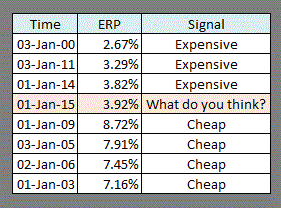
Given the information on earnings, reinvestment rate, return on equity, growth rate, and the government bond rates, we can calculate the equity risk premium implied in the market price of the index. The higher the premium, the higher the comfort level in buying, and vice versa. From an outside point of view, this is what I see:


The lowest equity risk premium implied in the market was in January 2000 implying that market prices were expensive compared to the fundamentals, and the highest was in January 2009 suggesting that prices were least expensive. On 1 January 2009, the Nifty was at 3033.45 points, which would have given an annual return of 18.23% by now. Instead, if bought in January 2000 and held on to it until today, the annual return would have been 11.62%. In January 2011, the markets were expensive again with the second lowest equity risk premium, and would have given an annual return of 7.70% as of now. 

As I see it, the index buy and sell decisions across the past years could have been made based on the information, which was available to us at each point of time.

I wouldn't want to buy into the market at these levels is obvious to me. For those who have a systematic investment plan, it is a simple process; but, for higher returns, having a look at what market prices are telling us is worth it. If there is significant cash to be committed, this may not be the time.

Markets will correct to the levels we would like it; however, for that to fructify, we need the right behavior: shun greed, fear and envy, and have patience.

Sustained business profits are not made in a short time, but over a long period. 

Tuesday, January 6, 2015

market crash, crude oil, and greece

The global markets took some toll, and have been giving some signals. That is, crude oil is going to fall further, Greece is going to exit the Eurozone, and the markets will get into some sort of recession in the coming months.

Anticipated supply in excess of demand is taking oil price lower by the day. OPEC has been pushing for supply, Europe, China and the rest are keeping demand lower; and presto, you have low prices. The price war is imminent; but who is going to win it is unclear. OPEC nations, dominant ones in particular, have lower cost of production compared to the US shale phenomenon. Those who have the capacity to endure lower prices for long are the ones who are likely to last longer. However, whether all this was really required is a matter to ponder over. A few energy companies might tumble in the process. But hey, isn't all is fair in..., or is it? Here's a prediction, though: in the long run oil prices would set themselves right. 

Europe may not be ready for another Greek crisis is alright, was it really ready for a common currency without control and accountability is another matter. Some deep thinking would have discouraged the Euro in the first place. Here's a prediction again: Greece might or might not exit the Euro, it might or not affect others in the Eurozone, Italy or France, or any other, nevertheless, in the long run the Europeans would earn more, spend more and save more.

As investors, all we want to know is which businesses are good enough to endure short term onslaughts, and yet be around to do business in the long term. If longer term cash flows and growth potential are not affected too badly, there is a case for buying into those stocks. Increasing interest rates may not threaten the US stocks as perceived to be, while falling rates can provide solace to the Indian stocks

Go look for the businesses that have been around for a long time, have capacity to wait and call shots, sell products that consumers cannot say no to, and have little or no debt. Wait for the markets to crash, pick those favorite stocks, and wait again for the markets to recover. In the meantime, do what you enjoy doing, whatever that is. Don't fret over stuff that does not matter in the long run.

Again, it comes to behaving right.

Wednesday, December 31, 2014

commodity, cyclicals, or pricing power

It's time for many to assess how they fared in the game of investing. I have selected some of the largest market-cap stocks from India, and some other randomly in order to check out their performance over the years.

The longer term
Since I usually do not look short term, let's start with the five-year period, where the markets returned 57%. Take TCS, India's largest company in terms of market-cap. It has returned 233% over the last five years, while Reliance lost money (negative 18%). However, it performed much better than NTPC which lost 40%; how pathetic, and how relative. So much for the previous government's promises of reforms, especially in the power sector. ONGC is up 16% in five years. Tata Steel is down 35% (blame it on bad acquisitions and more). And then there is Asian Paints, which returned 304%, and Nestle which is up 1019%.

A look at the picture below, and we get the picture, I reckon. 


I am not much interested in the year-on-year performance particularly, but some things do stand out, and tell us.

For the year 2014

For the year 2013

For the year 2012

For the year 2011

For the year 2010

The lessons
There are commodity businesses, and there are cyclical businesses, and then there are businesses which due to something about them that give them the pricing power. That is, they are able to increase prices of their products when they want to without worrying much about volume of sales. While the former categories rarely make investors rich, the latter category when purchased at the right market prices often rewards them sufficiently.

Obviously then it makes sense for us to watch those businesses which sell less discretionary products, have lower operating leverage, and not much of debt. These are the ones that have durable competitive advantages, and therefore, can sustain higher gross margins, and higher return on capital over a long period. Pick them at the right price (when markets have fallen off the cliff) in meaningful quantities, and wait for the price and value to converge. Have fun, get rich in the coming years ahead.

Monday, December 29, 2014

how instagram is worth more than $35 b

Instagram, an online photo-video sharing social media business was acquired by Facebook in April 2012 for $1 b in both cash and stock. Now it is being valued at $35 b. That is 35 times payoff in 2 years. 

Was the buy a bargain (sellers that foolish, and buyers that smart), or is this just another of analyst's fantasies?

With social media companies one cannot tell as the euphoria that was there during the late 1990s regarding information technology companies seems to be rubbing off regarding the social media companies now. Human behavior is the same at all times. Greed and Fear are the easy masks people like to wear.

I am not saying that Instagram is not worth $35 b; what I would like to ask is how do we know? It could be worth any value. There isn't any rational basis at the moment to justify with confidence that it is worth something.

We haven't got the revenues and margins; we don't know the growth rate; we haven't got the reinvestment that is required to sustain the level of growth that is expected.

We can definitely have a set of assumptions about these, and come up with a value. However, I can guarantee that the intrinsic value of Instagram as a business would be anything, but that value. The reason is simple: with technology businesses, it is almost impossible predict the future course. We might want to see a level of growth, but to achieve that growth, reinvestment of capital is required; information about market size and market share is required; we should know the sustainable margins which leads us to understand the market and predict competition.

One way to go around this is to have a distribution of assumptions and come up with probabilities, and then the expected value. Heck, it doesn't work that way. There could be probabilities, but then, in reality the actual value is not based on probability, but on a single set of fundamentals. Which of these assumptions will hold true, you never know. We can use probabilities only when there is a very high probability of an event occurring. Rest is pure academic.

Isn't then valuing a technology business a futile exercise? What is the point in valuing a business just for the sake of it? We should be able to make a buy or sell decision based on our valuation. If we are not able to do that, I find the exercise only academic. Not too bad for a class of students, though.

Hypothetically, if Instagram is worth $35 b, it is a better business than say, Hershey ($23 b), Sony ($22 b), ICICI bank ($33 b), Kellogg's ($23 b), State Street ($33 b), Southwest Airlines ($27 b), and Cognizant ($32 b). Is that so? I don't know. I am not saying that these market values reflect their actual worth. At least these firms have established revenue models.

Instagram does not have meaningful revenues at the moment. It might have a revenue model, but we are not privy to that information. I would argue that even the managers would be wrong in their estimates for a start-up business like this one.

Instagram's value could even be higher than $35 b. What I mean is that at this moment we cannot know this for sure.

With all this behind, I might as well give my estimates of Instagram.

If Facebook is worth $222 b and has 1.35 b users, we can use this information to price (not value) Instagram.

Here we go, Instagram is worth $49 b.


We can use price-to-sales ratio of Facebook to price Instagram to $53 b.


I can use a set of assumptions on revenues, operating margins, growth rate, reinvestment rate, return on capital, and use that to estimate the value of Instagram. But, I will keep that for another time.

I have had fun with these exercises in the past (TCS/Infosys, Facebook, Twitter, Twitter, Nokia, TCS, Blackberry, Google, FB/WhatsApp, TCS, Apple), but have never used that for any investing decisions. In fact, my concluding thoughts have been similar; we cannot value technology businesses accurately.

Yet, who stops us from having some fun? Let's play along...

Friday, December 19, 2014

oil buyer, or oil seller, that is the question

Back in 2012, I argued that value of an oil producing business depends upon two key factors: oil reserves and oil prices. While I wrote about the significance of being realistic about oil reserves, I did not much deal with oil prices as they are not within anybody's control.

Alas, we are left to deal with it in these times. With oil prices falling just like that, there are at least two groups who are affected. Those who produce oil, and those who consume oil. There is no prize for guessing in the current times who you would like to be. 


Naturally, oil producing businesses have been hit and oh boy. At less than $60 per barrel, suddenly the time is to be the buyer of oil rather than the seller. I wonder why then the stock buyers go gaga over rising stock markets rather than falling. That post is for another time though, let's come back to our current story line. 

Oil sellers
The right thing to do for the oil producers now is to cut back on production and let market prices of oil rise to the levels required to give them the required rate of return. Unfortunately, producers with lower financial flexibility (having high debt, and low debt capacity) should panic, and have higher chances of bankruptcy. These firms might not have time to wait for the prices to rise. A sorry situation reflecting probably poor managerial skills (financing decisions). Those who have the financial flexibility would be able to cut the production, and wait for the prices to correct. There is no time frame in this respect as the prices tend to be unpredictable, and to a large extent not controllable. 

Then there is another class of oil producers whose dynamics are decided by the state rather than the owners. Take the example of ONGC whose hands are tied regarding both production and pricing. Firms like this will have no option, but to rely on the state's (rather than the firm's) economic considerations. History suggests that the state has not taken the right decisions on behalf of the owners. Therefore, ONGC has not performed the way it would have if it were a private firm.

Oil buyers
The story is quite different for the oil buyers. Businesses who consume oil in large quantities as their raw material, and having pricing power on their finished products, are likely to be key beneficiaries of low oil prices. They should be able to increase their operating margins other things being equal. Businesses selling less discretionary products to the consumers are best placed to increase their value. 

Investors
Investors will be well placed to buy stocks of oil buyers having pricing power. And those interested in buying stocks of oil sellers should consider buying those who have low debt, large reserves, and control over the timing of production. Privately owned or publicly listed oil producers are better placed in this category rather than the state owned.

Needless to say that the price of the stock compared to its value should be the primary consideration before making any buy decision.

Saturday, November 22, 2014

kotak - ing vysya - and the winner is...

The merger of ING Vysya Bank with Kotak Mahindra Bank was announced on 20 November 2014. The next day the stock price of both the banks rallied suggesting that the market liked the deal.

On 21 Nov, ING Vysya closed at 7.83% higher than 19 Nov price:


 And Kotak closed at 11.59% higher:


It looks like the market liked Kotak better than ING Vysya. Is that fair? Do ING Vysya shareholders feel let down?

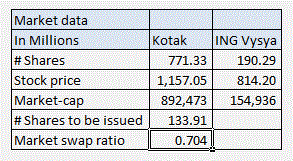
At the time of my analysis the market data was as follows:


Based on the market information Kotak would have had to issue 133.91 M shares to acquire ING Vysya, and swap ratio would have been 0.704 Kotak shares for each of ING Vysya shares. The actual swap ratio is 0.725:1; Not too far off. Again, is this a fair deal?

Kotak is retaining almost all of its income:


While earnings per share of both the banks have increased at a similar rate (about 14%) in the last four years, Kotak has not been that generous in terms of dividends payout, which implies that it is considering high growth potential for its business.

In order to check whether this deal is value accretive to the shareholders of both the banks we have to value each of them on a stand-alone basis first, and then on a combined basis.

With an expected annual growth rate (10-year) of about 15%+ for Kotak and about 11%+ for ING Vysya, we can value individual banks independently based on dividend-discount-model. Both banks are expected to have stable payout ratio, return on equity and growth rate after ten years.

Caution: Since I have used dividend-discount model for valuation, regulatory capital requirements are not separately considered. Probably, it makes sense to do another valuation based on capital adequacy required to achieve the target growth rate, although capital adequacy and Tier 1 capital ratio at present are at comfortable levels for both the banks.

Based on the valuation, both Kotak and ING Vysya appear to be highly over-priced by the market. That is, Kotak is using its expensive currency (high stock price) to buy another expensive currency. Since the actual swap ratio is close to the market-swap ratio, the first impression is that Kotak shareholders are benefiting more from this deal.

Even without considering any benefits from synergy, I reckon the swap ratio should have been about 0.879 Kotak shares for each of ING Vysya shares. Kotak should have issued 167.36 M shares assuming that market prices would correct to their rational (lower) levels in time to reflect the true fundamentals. Alas, market prices are higher, and as noted above, based on those prices Kotak should have issued 133.91 M shares. The actual swap ratio is much lower.

But then as talked about in every acquisition, there are synergy benefits.


If there are any synergy benefits from this merger, surely Kotak shareholders must have an upper hand over ING Vysya shareholders. The actual swap ratio of 0.725 Kotak shares to each of ING Vysya shares is much lower, and hence value-accretive to Kotak shareholders. 

Based on the terms of the deal, the implied numbers are as follows:


The implied value of this deal is Rs.159 B, and the implied price of the stock of ING Vysya bank is Rs.838.86 per share. There is hardly any premium on acquisition; sounds so unfamiliar, doesn't it?

Why is ING Groep, the largest shareholder in ING Vysya, letting this happen to itself? Is it because it is in need of cash? If so, what about the minority shareholders?

Monday, November 10, 2014

it's apple again - on sale, or wishy-washy

I did not plan to keep talking about Apple; but then, there is so much going on these days, I can't help it. I wrote about large cash Apple has been piling up; I also had my own advice on its use of cash. Heck, there is more advice too. Carl Icahn is not an ordinary guy of course, although he has been likened to a four-year old and to a six-year old. Icahn's history speaks of his capabilities as a successful investor what with billions in net worth. Not surprisingly, the subject matter is Apple again. 

I had argued in October 2012 that innovation was imperative for Apple to continue to be in the growth territory. At that time Apple stock was trading at about $600 per share (pre-split) giving its entire equity a market value of $570 b. Today it is $639 b. 

Optimism in 2012 
I had also supplied some contrasting opinions about where Apple might be headed. One of the arguments was that it would trade at $1650 per share (pre-split) by 2015; that is, its equity would be worth $1.5 trillion. Well, that argument was supported by robust revenues and margins that Apple would be able to sustain due to its ability to innovate and maintain its superior technology. The numbers looked like this:

iTV was estimated to be a $100 b business by 2015, and the argument went further: Apple would be a $610 b revenue company by 2015 as all its key markets start to experience hyper growth.

Whether these estimates will actually come to fruition is something that only time will tell. Nevertheless, $1500 b market value is huge, really unheard of.

By the way, Apple's revenues for 2014 reached $182.79 b. For it to clock $610 b revenues in 2015, they would have to grow by....well...you get the point.

$1 trillion as of October 2014
How about a little less optimistic, say, $1000 b market value? Carl Icahn is at it again; he is arguing that Apple stock which is trading currently at $109 per share, is actually worth $203 per share. He is supplying his estimates which look like this:


Icahn's estimates might appear to be much lower, but, in the context of Apple's recent performance they too seem to be far-stretched. While he is estimating large investments in research & development, he is also giving simplistic arguments that net earnings equal free cash flows available to equity shareholders. This assumes that depreciation equals capital spending and working capital requirements in future which may not be realistic.

Historical performance
Apple's revenues for 2014 reached $182.79 b, and the growth rate for the year was 6.95%.


Going by its history, it looks like the law of large numbers is showing up, and growth rate is coming down.

If we assume that Apple's revenues will increase by 6.95% (2014 growth rate) annually in the next 10 years, they would be $358 b by 2024. If they grow by 9.20% (2013 growth rate) annually they would be $440 b, but not until 2024.

For revenues to reach $610 b in 2024 (not 2015), they would have to grow by 12.81% annually in the next 10 years.

Icahn believes that Apple is dramatically undervalued; and accordingly, is pushing the CEO to use cash for large stock buybacks with the promise that he will not tender any of his 53 million shares (worth nearly $6 b). At least he wants to eat is own cooking; let's give him that credit.

I had a different idea, didn't I? Tim Cook won't listen to me though.

What is it
Is Apple really on sale, or all this is wishy-washy?