Pages

Showing posts with label macro. Show all posts

Wednesday, February 6, 2019

the purchasing power, and its parity

The long term purchasing power of an individual depends upon two things: earning capability and inflation. The time value of money tells us that a dollar today is worth more than a dollar earned a year hence. There are at least 2 reasons for that: inflation rate and uncertainty. If you want to borrow a dollar from your friend, your lender friend will look for compensation in terms of inflation. If you go and ask money from the market, however, the lenders will look for compensation in terms of both inflation and uncertainty. They will perceive present as sacrosanct, and future as uncertain. And because their money is only going to come in future, they will seek compensation for that. Consequently, the interest rate implied on the debt will include 2 elements: Inflation rate and a premium for default which represents uncertainty risk. 

Inflation is an implicit tax on every person's cash flows. If $100 is kept under a mattress for a year, and inflation rate during the year is 5%, the purchasing power of $100 is reduced to $95. That is why mattress is not a great idea, and it is important for the investor to at least make returns equal to the inflation rate. This will keep the real returns (the purchasing power) in tact.

The same rule applies to the exchange rates under the purchasing power parity. The exchange rates of currencies are determined by markets based upon their demand and supply. Both demand and supply depend upon a variety of factors. As of now the Indian rupee is trading at about Rs.71.50 per dollar. By end of 2017, it was Rs.63.84. These are of course determined by the free market. 

However in the long run, fundamentals of the country will take precedence, and the exchange rates will settle based upon those factors. Under the purchasing power parity, the exchange rates are influenced, therefore determined, by the long term inflation rates in the two countries. For instance, let us begin with the 2017 exchange rate of Rs 63.84 per dollar. If the long term inflation rates of the US and India are going to be 2% and 6% respectively, in the next 5 years the exchange rate should settle at Rs.77.38. That represents the rupee depreciating about 4% each year against the dollar. 

As of now, the US is the biggest economy with a GDP of $20 t, and China is behind with $12 t. India's GDP is $2.6 t. But when we apply purchasing power parity to the GDP, the numbers change drastically. China becomes number one with $26 t GDP, then the US ($20 t), and India comes third with $9.5 t. That is because instead of using market rates, we apply inflation-adjusted rates to the currencies. 

The purchasing power parity theory compares the two currencies using a basket of goods and services, and concludes that the cost of an item in country A should be the same in country B in real terms. And the real values are calculated after removing inflation components attributed to them. The idea is to include a variety of goods and services, instead of one or two items, that are representative of the economy. 

If the price of a pizza is $10 in the US and Rs.500 in India, the PPP exchange rate would be Rs.50 per dollar, considering both pizzas of equal quality. While market exchange rates are also influenced by factors not fundamental to the economy, such as perceptions and bias, PPP rates are considered more intrinsic. 

As easy way to calculate the PPP rates between the two countries is to look at their PPP and nominal GDP. Here's how it is done: We know that India's GDP is about $2.6 t. At the prevailing exchange rate of about Rs.70, that is Rs.182 t. We also know that in terms of PPP it is $9.5 t. That means the implied PPP exchange rate is Rs.19.16. In 2017, it was about Rs.17.74; in 1990, it was Rs.5.76; that implies over 27 years the inflation differential has been about 4.25% which appears to be fair. 

One thing comes out clear: The market exchange rates are not useful all the time. 

Friday, January 18, 2019

biggest markets forecast

According to this report by Standard Chartered, emerging markets will flourish by 2030, and the US will be the third biggest in terms of GDP measured using the purchasing power parity.


As of now, China is the leading economy with $26 t GDP measured in terms of PPP, and the US comes second with $20 t. India is much ahead ($9.5 t) of Japan ($5.4 t). So the three leading economies will still likely be the same.

market exchange rates
The current GDP of the US is about $20 t, and it has never grown more than 3% since 2005. If we assume 2.5% growth rate, the GDP will be $26 t by 2030.

At the prevailing exchange rates, the Indian GDP is $2.6 t. If it grows at a respectable rate of 7.5%, it will barely reach $6 t by 2030. Even a 10% growth rate will not take the GDP to more than $8.5 t by that date.

Now for China, from the current $12 t, the GDP will grow to $21 t at a rate of 5% over the 12-year period. 

Based upon the market exchange rates, though, the US will still probably be the biggest economy followed by China and then India.

Someone said, it is difficult to forecast, especially about the future. Time will tell us the reality, but until then, what's the harm in fooling around?

Wednesday, August 15, 2018

dollar or rupee, where to invest

The Indian rupee has touched Rs.70 per dollar now. The price of everything is determined by its demand and supply. It's that simple. If the demand for dollar goes up in relation to rupee, obviously the dollar's price relative to the rupee will increase. There may be a number of reasons why demand is up or down: trade requirements, inflation, interest rates, or even speculation, or just anything for that matter. But the basic premise does not change. Currently there are more buyers of dollar than rupee. Until the equation changes, the exchange rates will be in favor of the dollar.

But then, the equation has not changed for a long time. By the end of 1990, a dollar cost Rs.18.136. By the time 2017 ended, rupee was down about 71.59%; that's what happened in a 27-year period. To put into perspective, Rs.1000 bought $55.14 worth of products and services at the beginning of 1991; and by the beginning of 2018, it could buy only $15.66 worth. If you are one of those who needs dollars periodically to make payments, you have been in trouble. Reverse is true for those who have been receiving dollars for their services.

The rupee has always been beaten by the dollar. By 1995, its loss was 12.40% on an annual basis since 1990; by 2000, it lost 9.02% per annum; by 2005, 5.88%. Its first notable gain (5.10%) against the dollar for the year was in 2003 when it ended Rs.45.625 per dollar. The next year it gained 5.49% again. As 2007 ended, rupee seemed to be in demand closing at Rs.39.405. It was to however see its biggest fall in a year (18.95%) in 2008 at Rs.48.620. The rupee gained somewhat in the subsequent two years. But more than 15% loss in 2011 and more than 11% loss in 2013 brought the rupee to Rs.61.810. In fact, it gained 6.45% in 2017 only to stare at Rs.70 per dollar now.

Although the year on year changes have been erratic and non-linear, it is fair to say that the rupee gets rated downward in relation to the dollar every year by about 5% over long term. That's the cost of being in rupees as opposed to dollars. Inflation is a real tax on currencies. If the purchasing power of rupee goes down 7% each year because of inflation, and that of dollar by 2%, the relative prices of both currencies should reflect that. If they don't, eventually market forces will ensure that. That's what has been happening for the last two and half decades at least; remember the rupee's fall of over 70%. 

If an investor put money in the Nifty-50 as 1991 began, the annual return over 27 years would be 13.64%. If the investor was based out of India, that should suffice. But if someone based out of the US had invested when the exchange rate was Rs.18.136, the annual return would be 8.46% because of the 2017 closing rate of Rs.63.840. A similar investment for the US investor in the S&P-500 earned 8.06% over the 27-year period. If an Indian investor was able to invest rupees in the US index, the return would be 13.21% adjusted to the exchange rates. It is probably fair because the investment return largely makes up for the difference in inflation rates in both the countries.

In short, the US (dollars) investor in India should look at making at least 5% more than what is possible back home. And the Indian (rupee) investor in the US should be ok if the returns from the US investments are 5% lower than what is possible in India. That is an even-steven situation. The interest rate parity explains it. However, investors cross boundaries and take additional risks to make more than what is otherwise possible. Therefore, I think factoring in a 5% depreciation of the rupee against the dollar on a yearly basis is helpful. Of course over shorter periods anything is possible, but it is not possible to predict it.

For rupee to strengthen against dollar, Indians will have to collect more dollars (through trade and business) than they have to pay. The net dollars collected are then sold to convert into rupees increasing its demand. Reducing inflation differential will be useful in the long term. Two possible, but not plausible, scenarios are reducing gold and oil imports. The first one is a habitual problem, and the second one is not controllable. So 5% is what I am willing to go with. 

Thursday, February 8, 2018

capital gains tax changes

In the new budget, the government made impactful changes to the way capital gains on equity are taxed in India. 

The past
Until now all short term capital gains (held for less than a year) were taxed at a flat rate of 15%. All long term capital gains (held over a year) were fully exempted from tax; Security transactions tax was being paid on each transaction. All dividend income up to Rs.1 m was exempt at the hands of the investors. Dividend distributions tax was being paid by the corporates announcing dividend payouts. 

What's new
Long term capital gains are going to be taxed at a flat rate of 10% on all investments made with effect from 1 February 2018; all gains up to Rs.100,000 are exempt. All gains made up to 31 January 2018 continue to be tax exempt. This means to calculate gains in future, the cost basis is considered as the higher of the actual price paid and the highest market price as of 31 January 2018. These nuances apart, what it means to the new investors is that they will have to pay long term capital gains at 10%. 

What doesn't make sense
There are a few things I find don't make sense especially when you want to look at direct taxes as progressive which they should be. I see at least five problems with the new rules:

Short term capital gains: are being taxed at a 15% flat rate. For those who are in the marginal tax rates of less than 15%, this does not make sense. Someone with marginal rate of say, 10%, will have to pay 5% more just because of equity transactions. Yet, someone with marginal tax rate of say, 25%, is going to have fun playing short term with equities. This is absurd when you want to take care of the small, retail investors. The ideal rule should be to add the short term capital gains on equity to the ordinary income, and tax at the marginal rates. 

Long term capital gains: up to Rs.100,000 are made tax exempt. And the logic is that the government will have to take care of the retail investors. This defies logic though, for Rs.100,000 in today's times is not a meaningful amount for those coming to the equity markets. To make any impact on small, retail investors, the exemption limit should be say, Rs.500,000 to Rs.600,000. Gains made in excess of this value are usually by the bigger investors, and tax there should be fine. 

Another problem with the flat rate of 10% on long term gains is that there is no regard for the inflation component. Equities are considered to be hedges against long term inflation. That's the primary reason for equity investments. By not allowing for some sort of indexation benefits, long term investors are left out. There isn't any reward for the truly long term investors.

Security transactions tax was introduced in lieu of the long term capital gains tax. Now both taxes are being retained at the cost of investors. 

Finally, investors do not find any major advantages of long term taxes (10%) over short term taxes (15%). As I noted there isn't any reward for the truly long term investors. If you do the math, it is still better to play the long term game, rather than the short term, but the distinct advantages which were there earlier are gone. For all I can see, the new rules encourage short term trading as opposed to long term savings and investments. 

A better way forward
Of course, the joyride on the long term capital gains should be over. After all, all income earned should be appropriately taxed. Here are my suggestions though:
  1. Add short term capital gains to the ordinary income, and tax at the marginal rates.
  2. Increase exemption limit to Rs.500,000 on all long term equity capital gains.
  3. Remove security transactions tax. 
  4. Bring in indexation benefits to deal with inflation on long term gains.

An investor-friendly market is in the best interest of both the investors and the government.

Sunday, January 14, 2018

treasuries, inflation, and stocks

Treasuries barely give inflation-adjusted returns. To the extent that they fall short of inflation rates, they cannot be called risk-free in its fullest sense. There is the consolation that it happened only twice in the past 18 years, in 2011 and 2012; but not much because there is another evil called tax. Excess of post tax return from treasuries over inflation is the real return earned by investors. That is why treasuries or any other fixed currency investments are not attractive over the long run. Also, they carry reinvestment risks unless you find zero-coupons. Yet for all practical purposes, they are indeed risk-free. 

And they do track inflation rates; well, sort of. Prior to 2008, things were not that bad; I mean things were normal. 10-year treasuries yielded 5.24% in 2000; they were 4.10% in 2007 just matching the inflation rate. Everything changed in 2008 reacting to the financial crisis, and never recovered completely since then. Long term treasury bonds quoted 2.42% in 2008 and reminded us of 1954 when they were 2.51%. During both the years, inflation rates were nearly zero. The difference is that from 1955 onwards the treasury bond rates steadily increased thanks to the buoyant economy; and by 1979 they reached double digits. From 1985 onwards, bond rates started falling, and stood at 5.24% in 2000. 

Inflation was higher during the 1973-1981 period, and started cooling off subsequently. It was 3.44% in 2000; but by 2008, inflation came down to almost zero. In 2009 and 2010, both treasury and inflation rates started showing sparks, but that was it. In the last five years, interest rates have been less than 2.50%, and inflation has only moved to 2% in the last two years. 

As of now, both treasury bond and inflation rates have started moving upwards at 2.40% and 2.10% respectively. 


One of the reasons for the booming stock markets has been lower interest rates. When alternative opportunities are unable to exceed hurdle rates, investors look for greener pastures. What is greener than equities? If bond yields of 2.40% are not good enough for investors, they will continue to back equities. Dividends and buybacks are still better than these bond yields, and there is the added attraction of capital gains from stocks. Furthermore, there is also more buzz due to the revamp of the tax codes. Otherwise stock markets appear to be quite pricey. 

While the value of stocks is the present value of their cash flows discounted at the cost of equity, it will remain higher as long as interest rates remain lower. For 2018, two reasons will keep them afloat: higher earnings leading to higher cash flows, and lower interest rates. We don't know whether earnings will increase as they did in 2017. Fed's struggle with increasing inflation and thus interest rates has been rendered futile so far. Most of its tactics have led to the headline statements rather than being effective. Now the Fed is entering the new year with an intent to increase interest rates; and it appears to be more intense than before. Whether investors will shift to bonds from stocks is a matter of expectations, and only time will tell. 

The danger with the stock markets though is that stocks can fall abruptly without notice, caution, and reason. But that does not mean investors should throw all cash to yield only 2.40%. That said, I reckon some allocation to bonds is inevitable at all times; rather more so now.

Wednesday, November 29, 2017

the bitcoin puzzle

Bitcoin is a cryptocurrency and worldwide payment system. It is the first decentralized digital currency as the system works without a central repository or a single administrator. Bitcoins are created as a reward for a process known as mining. I have not come up with this definition. 

Since it is accepted as a medium of exchange by a fair number of buyers and sellers of products and services, and is being considered as a store of value too, it is a type of currency. I am not too sure if it is a legal tender though. Who's backing bitcoins? Where's the promise to hold it as a valid medium of payment under the legal system for meeting financial obligations? Bitcoins are not issued by the government of any country. Sure, it is a type of digital currency, because it is not a physical currency. 

All major currencies are traded on the foreign currency exchanges. Bitcoins too are being traded on the digital currency exchanges. What's the big deal about it? That its price reached $10000 recently? Yeah, it is a big deal. 


From nowhere the price soars to $10000 within no time. It actually has become everyone's envy. If only one had bought it in April 2011 when it was priced $1, or in June 2013 when it was $100, or in November 2015 when it was $500, or when, heck, one could go on. Little does one realize that envy does not take us anywhere; it only puts us down. 

You can see the levels of greed and envy from bitcoin's price history. Yet, for those who are eternally greedy and envious, there's no need to be disheartened; the price of bitcoin is only going to go up, for $40000 price is very near as per this prediction. Volumes are going up, and prices are going up. Everyone is happy.


No, not everyone is happy; we just noted earlier that those who did not buy it are not happy. But they too can be happy if they bought at $10000 and are able to see $40000. Bitcoins are happiness quotients, aren't they?

I am not bothered by the surge in bitcoin prices. People trade in all sorts of things in life, from wood, shoes, and paintings to currencies, oil, gold, and other commodities. They trade in bonds and stocks too. These are the traders' paradise. Speculation is fine if people know that they are speculating. The tragedy though is that most do not know that they are speculating the prices of things they trade. They think that they are buying (or selling) something that has a fundamental value which is going to go up (or down). And this is a dangerous psyche; a recipe for disaster. 

Only assets that throwout cash can be valued. For instance, real properties, bonds, and stocks. Obviously then assets that do not bear cash flows cannot be valued. For instance, gold, silver, and currencies. They can be traded and priced. The price is then purely based upon demand and supply. And demand and supply are clearly based upon the traders' perceptions. They are not backed by the intrinsic characteristics of the underlying asset. For instance, prices of stocks are of course defined by the movements in demand and supply. But demand and supply are based upon the quality of the business behind the stock. That means, when the business does well, the prices go up, and vice versa. That is true on a scale of long periods of time. However, there is no such scale for assets that do not have any underlying (and cash flows). Their  prices move on whims of speculators. Nothing wrong, but nothing much for someone in the right mind, who wants to make money on a probabilistic note.

Now, bitcoins do not have any cash flows associated with them. There isn't any business or an asset behind it. In such cases, how do we know the intrinsic value of bitcoins? Well, we cannot. We are then dependent upon someone else's perception. One fool buys in the hope that there will be another fool to buy at a higher price. The second fool is in the hope to sell to another for profit. And it goes on...until there aren't any fools around to buy. This is when we say that the bubble has burst. The greater fool's theory is an interesting one, for it has been witnessed in the past many times, but lessons are never learned. There's also a reason for that. The early fools usually get away with substantial profits; and everyone wants to be the early fool during every bubble in the making. 

If one of the sharpest minds we have seen could not control greed and envy, how could lesser mortals make do with it?


I have been talked to in the past few months to buy into bitcoins. I resisted like I always do when it comes to speculation; I am no good at it. When you are likely to fret over things, you rather stay away. In fact, I am not even sure if bitcoin is able to sustain as a store of value for long; to that extent it might even fail the currency test.

If your neighbor is driving a fancier car, and you fret over it, there's something wrong with you. And if you chase the neighbor's car, there's seriously something wrong with you. The earlier you realize this, the happier you will be. 

What I know for sure is this: there is an easier route to riches, rather to being financially independent. That is to play the investing game, for long. You could do index investing, or you could do the business of investing. There's a choice. 

Let the bitcoins be. 

Thursday, May 4, 2017

news: of course it's fun

I have heard some investors boasting about how they don't read the news; they consider that it is quite cool to say that they shun it. They call it the noise, and go about giving reasons why it is uncool to actually read the news of the day. I reckon the chances are that they belong to this or that camp.

Well, I find them crazy; they could even be perverts obsessed with certain philosophies. Why do I care? Heck, I find it funny that since they have cultivated naive followers, they are able to exercise certain influence on them; and that is pretty bad. 

I don't understand why it is wrong to read the news; there are several newspapers that talk about various aspects of life, be it politics, business, sports, or even daily events. I religiously read topics of my interest every day. Shouldn't one be appraised of the events shaping our city, state, country, and our world? And the funniest part is that the same people who bash news items are the ones who choose to give their thoughts on them on their blogs and twitter accounts. If they don't like news, why do they mention about a particular news event? They do it because they don't preach what they do, a reason good enough to shun them rather than the news.

I almost find it fun to read news, whether from the newspapers, magazines, or generally from the Internet. It is another matter that I do not usually read opinions about stocks. I would rather read the source documents such as annual reports, etc. than hear someone giving any shit about a business. My stock picks are based on my own analysis, rather than someone else's thoughts. It is easier to blame or appreciate yourself than others for results of your actions. 

Opinions on any matter other than stocks, and I am game to hear. I think these people who propagate shunning news and making it a big deal are actually paranoid. I wish I could address all those simpletons who follow their favorites without some thinking. They got to wake up, and start pondering. And above all, they should start reading some news of the day.

The news stories spice up our life. I sometimes even read blogs of those clowns, and entertain myself. Howzat!

Sunday, January 29, 2017

demonetization of property and gold

There is still talk of demonetization; some in favor and some not. Cracking down on corruption and black money is a good idea. Whether demonetization will bring about the required change remains to be seen. That said, Indians no longer hoard most of their cash in the form of cash; both storage and security issues have caused them towards property and gold; of course, they were always the conduit. Yet, the proportion representing hard cash has significantly reduced, and that representing property and gold has significantly increased.  

So property and gold it is for the Indians. How to deal with that pretax cash diverted to land, building, and gold? Asking them to use aftertax cash rather than pretax is not useful; remember, it has not worked. Will asking them not to pay tax on capital gains work? I don't think it is a good idea. 

Why should people who deal in property and gold be treated differently from to say, a business owner? It would be like if you start a business, profits will be taxed. If you buy and sell either property or gold, profits will be exempt. Little funny, wouldn't it be? 

Investing is a serious business, whether in equities, debt, property or precious metals. The intention is to make profits out of the transaction; so that should make it a business. And it is a business, not any different, even for those who transact occasionally. When a home buyer for primary residence sells it after a decade or so, profits made are investment profits, albeit long term. 

Lack of regulation and bad intent of people have been the cause of this massive hoarding of black money in the form of property and gold. Crackdown on this is really important.

I haven't got nice things to say about gold; but have four suggestions, though. One of the best ways to stop corruption in gold is to tax it heavily; make it more expensive. It would also be additional income for the government. If people still want to buy gold, so be it. Second, every transaction on gold should be based on the PAN of the buyer; No PAN, no transaction. Third, increase the tax rate on capital gains. The idea is to pay heavy penalty by those who buy and sell gold. Fourth, all transactions should take place through banks such as cheque, net banking, and transfers. If someone does not have a bank account and wants to buy gold, that person got the priorities wrong. Needless to say, the authorities should keep an eye on the income of the buyer and buying pattern. 

It is a little different for properties. Investing in properties is a good deal. But in India, rents are not aligned to the market prices of properties. Due to this, the investor is brought to hope for increase in prices to offer reasonable returns. Excessive dependency on prices has made property transactions similar to that of a not-cash-generating asset. The investor will make money only when a greater fool is found. It is pathetic as investors are forced to overpay; blame it on the regulation. As prices seem high enough, buyers consider that using pretax cash is more profitable. It is a vicious cycle: black money channeled to buy property; consideration upon sale received in cash is again used to buy property; and so on.

Bringing tighter regulation is the key to deal with corruption in land and buildings. The single most important thing is to have a mechanism to track every transaction online. Make PAN compulsory for the transaction; I am not sure if it is there in rural areas when small plots of land are bought and sold. Reduce the complexities involved in capital gains tax on property. Bring rentals in line with market prices. For that to happen, value of the transaction should be included for registration purposes. Stamp duty and rentals are then based upon the market value. Again, make transactions through banking channels compulsory; cash cannot be used. Profits made on sale of land and buildings are investment gains; these should be taxed appropriately.

It would be an interesting idea if long term is when property is held for more than 5 years. And how about having a progressive system - short term<= 5 years; 5 to 10 years; 10 to 20 years, and more than 20 years - for capital gains tax?

Demonetization of property and gold, how's that!

Monday, November 21, 2016

demonetization, digitalization, and the windfall

The demonetization
The government announced on 8 Nov that by midnight of the day high value notes of Rs.500 and Rs.1000 would no longer be legal tender. It also noted that all cash holdings should be deposited into the bank account of the owner of cash by 30 Dec 2016. 

Well, the responses thereafter have been mixed; some in favor, and some opposing. That is obvious in a democracy. And that the news media is busy tackling the matter in a way that suits their ratings and increases advertisement revenues is another matter. That is obvious too because they are running a business, not public service; never mind the moral grounds, have they ever? As mentioned, that's another matter.

India is a country where most of the transactions take place in cash; it could be as much as 70-90% as pointed out by some sources. Therefore, cash is an essential commodity for the most. The digital currency has been picking up only recently. The idea is to move towards a cashless economy, where most (and all high value) transactions are carried out in an electronic form: net banking; debit cards; credit cards; and other e-platforms. This is good for the long term. 

How about the short term? There are consequences of course, especially for the poor, and emergency situations. And discussions about this galore. The purpose of this post is to check what is in place for the cash that is hoarded in India. 

Cash is held by the businesses, in the normal course, which is scheduled for depositing the next day; cash is held by the working individuals, in good faith, to carry out their daily affairs; cash is also held by housewives as part of their routine savings. These are all, may be, after-tax rupees. Besides, cash is also hoarded by these businesses and individuals as evasion of taxes; black money. 

The action
All genuine cash holders might takeout cash, and deposit in their bank accounts as authorized by the government. If the tax officials find any mismatch between the cash deposited and income tax returns filed in prior years, there could be tax and penalty levy. Despite this, genuine cash holders would be better off by declaration and deposits. 

However, the guilty would have to think before any action. They have a few options:

Option 1: Declare the black money, and deposit in bank accounts. Be open to scrutiny, and pay taxes and penalty. This could open up their box of...; be prepared for that.

Option 2: Do not declare, which is to say that take the cash and burn it. Let the smog be; let this be their festival of firecrackers without noise pollution. The loss is equal to the value of cash burnt. Move forward with life. 

There is another option for them: Donate the cash (without expecting anything in return) to as many poor as possible, with each poor person getting a very small value in cash, which can be deposited in that person's bank account for use. This will yield the cash hoarders good wishes from the poor. This option is not as ethical as option 1; yet.

The consequence
Nevertheless, it would be interesting to find out how the whole thing is actually going to play out. Here's the RBI's balance sheet as of June 2016; it had Rs.17,077 b of currency notes issued. 


We also note from its annual report that the RBI had Rs.16,415 b of currency notes in circulation as of March 2016.


How much is the black money held in cash? Let's take Rs.17,000 b as the value of notes. Of this say, Rs.15,000 b is from high value notes of Rs.500 and Rs.1000, which have ceased to be legal tender. Now, it is anyone's guess that how much of this Rs.15 t is held in the form of black money. For the sake of arithmetic, 25% comes to Rs.3,750 b. Too high? assume 10%; too low? assume 40%. The fact is that we do not know yet.

The windfall: Any cash that is not deposited in the bank account will become worthless. When it becomes worthless, the RBI will have that much lesser obligation to honor. People have been speculating about this proportion of lower liability, and about the likely use of that windfall: It could stay with the RBI as part of its reserves, which means lesser currency in circulation; is that lower inflation? It could be used to issue additional currency notes of equivalent value without impacting inflation. It could be paid out to the government as dividends. It could be used as a special equity boost to the public sector banks. It could be used to extinguish the government debt. It could be...blah blah blah...

The fact is that we do not know: 1) The size of cash that will be trashed; 2) The likely action by the RBI - to print new currency of the equivalent value, or to not to print at all; and 3) The likely use of the windfall.

As a consequence, though, at least some part of that parallel (black) economy will be gone. In the short term, these informal small businesses and real estate operators will be hurt, and will be forced to either close their operations or become part of the formal (after-tax) economy. In the long run, the share of the formal economy is likely to increase resulting in higher GDP. 

However, the value of black money is much larger in the form of gold and real estate as compared to cash holdings. Hoarded gold and unaccounted real estate are much difficult to crack. That said, going forward, even these transactions will be difficult to deal with before-tax cash. 

The idea of a digital economy is tempting. Let's wait and see how it will play out.

Tuesday, November 15, 2016

it ain't about how hard ya...

Markets are spooky these days. Nov 8 has been quite eventful what with elections in the US and demonetization in India.


From Nov 1, the index has fallen 6%. Much of that (5%) came after that eventful 8th day of Nov. 

Other things remaining same, investors go where there is less risk; perceived risk that is. Foreign investors could go to the US perhaps; but for how long would they remain there? Domestic investors could go to government bonds (would they?), or gold (again for how long?). They could go to real estate, may be, but chances aren't that high.  

Investors often fail to ask a question fundamental to their financial wellbeing, has anything fundamental to the business changed which is likely to remain for long?

With US not growing as much as it would like to, Europe and Japan, not anywhere, Latin America struggling, and China trying to check where it is heading, I reckon eventually a good portion of global money has to come to India. I mean it is for their own good, if they want better returns. And domestic investors will not like to sit and watch others party. So there is; the Indian equity markets are not going to be short of cash.

Short term fluctuations in the markets are routine. In fact, these are the opportunities to act. Real money is made when invested for long term. That is why investing calls for proper analysis and homework before action. Without analysis of facts there is only speculation; and one should speculate at one's own peril.

Often, men and women, tough and weak, smart and foolish, are all brought down to knees by the markets. What's to be done, take the hit and go back? In these times, investors should go to Rocky Balboa for advice, rather than to the so-called experts. 

Yeah, it ain't about how hard ya hit; it's about how hard you can get hit and keep moving forward.

Wednesday, February 10, 2016

banks hammered

We have been witnessing bank stocks getting hammered by the day. In fact, the bank Nifty is quoting at its lowest point for sometime. 


The public sector bank stocks are quoting at 52-week low points.


There is a good reason for this to happen. Banking is a tough business; and this is not well understood by many. We can be cautious about investing in highly leveraged firms, and choose to invest only in businesses that have low debt or capacity to service debt comfortably. Yet, this comfort is limited when we deal with banks. 

Banks are inherently risky because they have no option but to be highly leveraged. They have to raise debt which is disproportionate (in size compared to any other business) to their equity. Their investments are actually loans that they make to the borrowers, both retail and corporate. Because their assets are largely funded by debt, a small percentage loss on loans becomes a large portion of equity. 

If equity is not adequate, the bank can possibly go under; if not, the equity erosion can be stressful enough. The option then is to either raise more equity capital or lower growth. Both can become double-edged swords. Stressed assets lead to lower equity and returns, which lead to lower stock prices. Low stock prices hamper efforts in raising new equity. Lower growth also suppresses the already low stock prices. The vicious cycle for banks is painful. 

It is always better to be prudent when dealing with loans. A loan that is not recoverable is actually not worth making in the first place. Furthermore, if for some reason a loan becomes difficult to recover, it makes sense to acknowledge it and provide for it. Don't surprise markets at the wrong time. However, most banks do not follow this policy for the fear of lower stock prices. Little do they know that eventually what has to happen shows up. 

I have noted earlier how HDFC bank is treated by the market the way it is. Not much has changed. Markets continue to treat it well. Of course, it is managed much better than its peers. Yet, its pricing has always been at large premiums. 


For the investor, it is: for low long this premium will continue?

Another private sector bank, ICICI bank has been treated pretty badly. Its stock price is at a year low, and has been like that for sometime. 


It was trading at Rs.242 in May 2013 and at Rs.393 in January 2015. As of 10 February 2016, it is at Rs.207. Considering it was priced at Rs.192 in February 2014, one can still argue for a short call. 


HDFC bank is worth more than twice ICICI bank now. For the investor it is: for low long this discount will continue?

ICICI bank has not had good numbers in its operations. Its non-performing assets are increasing, which only tells how they were initiated. We cannot put the blame on commodity prices and commodity businesses. There must be something wrong in the process out there. 

Yet when we want to make an investment decision, both HDFC bank and ICICI bank pose different perspectives: The large premium and large discount. Which is true?

As of December 2015, ICICI bank had equity of Rs.896 b and loan book of Rs.4,348 b. It had Tier 1 capital of Rs.700 b, which is adequate. Its risk-weighted assets were Rs.5,934 b. About 79% of its loans were financed by debt. Its gross and net NPAs were Rs.213 b and Rs.100 b respectively. Provision for NPA has been increasing each quarter which is worrying the market. The bank has said it would continue in the coming quarter too. The equation is: every 1% loss in loans erodes 4.85% of its equity. How long will this continue, and does the bank have the capability to bring it down?

Markets may not strengthen its stock price significantly in the next three months at least. Well, that's not the point right? We don't care what markets think in the short term. My question is: given the hammered down prices for ICICI bank, or the stretched prices for HDFC bank, how large is the gap between their value and price?

When I think about HDFC bank and ICICI bank, I think that if one is long, the other is short. Heck, which one is it?

I know that markets can remain irrational longer than investors can remain solvent. I also know that markets have the tendency to force investors to be irrational. 

Monday, November 2, 2015

strategic buzzwords

Earlier it was China, quantitative easing and demand for commodities, which made firms, analysts and every other to justify their actions, whatever that might be, acquisitions or high valuations. 

Now it is the same, but in the opposite direction. It is China slowing down, low commodity prices, and the Fed quitting the easing. I wonder how some things just don't change. While there are still acquisitions happening around the world, the cues are about slowing down. 

What I have seen and remain confident about is that economists never concur on anything. You put several of them in a room and they will diverge in their opinions. Again, it is evident from history that any economy moves in cycles; we witness growth and recessions all the time, one after the other. 

My take is that no federal policy would be able to permanently change the path of a cycle. We might want to attribute the change to the government, but it is more due to the spirited free markets that eventually push for the change. This is because in a democracy and free markets economy, the government's role is limited, and should be limited, only to put the system in place and oversee as a regulator, and not meddle much. 

As the economy, including the government, is made up of humans, what drives it is the change in the behavior of the individuals. We know that they are not rational beings; therefore at any point in time, the economy reflects their moods. Higher value is driven by meaningful growth, which is reflected by increase in future cash flows, and cash flows are generated through investments. When they are optimistic about future, good investments are made, projects are executed well, and there is growth. Opposite is true when people become depressed and consequently, reluctant to invest in projects. 

Just like firms, investing, financing and dividend decisions of the country are dependent upon the behavior of the people. It is up to the government, as a manager, to take these decisions in the best interests of the stakeholders; probably the key function of the government is to lift the mood. I don't know why China is slowing down now when it was growing in earlier years. May be people are scared of its past financing decisions, or may be something else. I don't know why commodity prices are low now. Isn't it all good for the firms to buy them cheap to use in their production, and drive growth? Quantitative easing has been the savior for the US economy, but how much credit is due to it is something we need to ponder. If it was not there, what would have happened? Would markets have remained on the brink until now? I don't have an answer to any hypothetical question. Of course, sometimes things don't really work out for a long time just like it is the case for Japan, where they are clueless about what should be the way forward. I find that ironic.

Mostly, though, we are responsible for our own actions. If we remain positive collectively, work hard enough towards what we want, use only reasonable, not excessive, debt and execute our tasks well enough, we should be able to move forward. If that sounds Utopian even for a capitalistic economy, my advocacy is to hope for this during longer cycles. Wait, hasn't this been happening already? We have had more positive years than negative years in the past as long as we can go back. From stone age to here, we have moved far enough. That is going to continue long enough into the future. I see this as the bright side.

Friday, September 4, 2015

too big to fail banks

The RBI has designated SBI and ICICI bank as (domestic) systemically important banks. This would mean if these banks fail, there would be financial crisis and chaos in the country, impacting India's economy and its growth prospects. Why only these two and not other big banks can only be answered by RBI which has done the selection based on the systemic importance score, which takes into account the size, complexity and alternatives in the event of a crisis. 

The consequence of designation is that these banks will have to maintain equity capital in excess of the regulated norms for other banks. This is 0.60% for SBI and 0.20% for ICICI bank to be achieved in a phased manner by April 2019. They will also be subjected to much closer supervision, whatever that is.

The minimum Tier 1 capital ratio to be maintained as per Basel III norms is 7% as of March 2015, and 9.50% as of March 2019. While this is the minimum requirement, a prudent bank would have higher (internally) regulated equity capital ratio. While some may argue that it comes at the cost of growth, we can counter that with: growth for its own sake is no good; this is especially so for a bank. 

ICICI bank is in a comfortable position even when we set the Tier 1 capital ratio not at 7.20% as required for being a systemically important bank, but at 9.70% that is required by 2019. As of March 2015, its Tier 1 capital ratio was 12.79%. With the assumption of this ratio reducing gradually to 12% in the next five years, risk-weighted assets moving from Rs.5.5 trillion to Rs.9.7 trillion by 2020, and return on equity coming down considerably from 16.02% to 11.01%, ICICI bank should be able to generate free cash flows and payout dividends without raising further equity. Of course, Ms.Chanda Kochhar has indicated that the bank is not expected to raise fresh equity for the next couple of years; this indicates that the growth rate she is targeting is higher than what I have assumed in my estimates. Higher growth rates require higher reinvestment, and therefore may prompt external equity. 

The same cannot be said of SBI, which is a much bigger and more important bank. Although, it has a comfortable Tier 1 capital ratio of 9.49% (March 2015), due to its higher assets base it would require immediate fresh equity if it aims for growth. With the assumption of Tier 1 capital ratio increasing gradually to 12% in the next five years, risk-weighted assets moving from Rs.16 trillion to Rs.26 trillion by 2020, and return on equity coming down marginally from 11.53% to 10.98%, SBI would not be able to generate free cash flows in any of the next five years. It has to aggressively seek fresh equity of Rs.180 b, or grow assets at lower rates. Obviously, SBI won't be able to payout dividends unless fresh equity is raised; and even that would mean you take from shareholders and give it back to them; not much fun. However, if one shareholder supplies capital, it would be welcome. For minority shareholders, equity dilution is better than their entire capital at risk. And the good news is that the government is planning to give Rs.50 b to SBI soon, and has plans of Rs.700 b of equity infusion by 2019 in public sector banks.

In fact, all banks are big enough to fail and cause damage. The key, however, is to operate such that assets wouldn't have to be categorized as non-performing or bad, or to be written off. We don't want banks to continue to be in that vicious cycle.

Current times aren't too good for banks. Bank Nifty has been hit badly.


And SBI and ICICI bank stock prices have hit 52-week lows. May be the shareholders can take solace in Horace and say, many shall be restored that are now fallen...

Sunday, January 11, 2015

market signals

I am going to list down some facts, assuming they are, since most data came from the NSE website. We can argue, and draw our own conclusions based on this data. 

The long past years
Nifty started with 890.80 points on 1 January 1999, and its values at the beginning of each year have been showing an upward slope. I have ignored intermediate values to avoid clustering. As of 1 January 2015, it was at 8284 points. For an easygoing but rational investor, it would mean a return of close to 15% annually, beating probably most of the professional (institutional) advisers. It's far better not to let someone else control our affairs, finances in particular. .


Earnings of Nifty grew every year too, except for 1999 and 2009. The annual growth in earnings over the period was 10.73%. Not bad when we had at least five years of bad governance. 


In fact, 2003-2005 were the best years of earnings growth. After a not-so-good 2013, we had a much better 2014, and now, we can only hope that corporate earnings will be able to sustain a decent growth rate in the coming years.

Of course, we had a high interest rate (and inflation) environment in the past. This has the effect of giving on one hand (higher growth) and taking from another (higher cost of capital). I don't like to give ceteris paribus propositions, which look nice only on research papers.


Return on equity has been in the range of a low of a little less than 16% and a high of a little over 25%, and a little less than 19% on average.


We have a return of equity of about 16.49% now. Based on the fundamental variables, we can also have implied growth calculations; heck, when compared to the actual growth, they invariably vary.


For the sake of pricing estimates, I also list the PE ratios over time. As of 1 January 2015, we had a PE of 21.16, against a long term average of 19.20.


What do they tell us
What conclusions do we draw from these values is debatable. However, my take is as usual. I don't like to rely on market pricing as a tool for business (intrinsic) valuation; although, for buy-or-sell decisions based on price-value comparisons, pricing aspect cannot be ignored. However, I like to challenge market pricing variables, and ask whether these are justifiable. Intrinsic valuation, though, is based on estimates of cash flows, growth rates, and risk involved, none of which can be estimated accurately. For that reason, it is only easier to check market estimates to assist in decision making. It is possible to keep all variables, but one, constant, and challenge that implied variable. I find growth rates in the case of individual businesses, and equity risk premiums in the case of the entire market (index) best suited for questioning, though.

Market's own estimates, and its signals to us
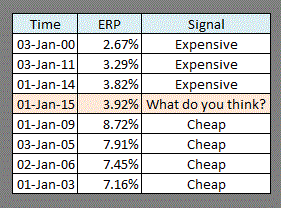
Given the information on earnings, reinvestment rate, return on equity, growth rate, and the government bond rates, we can calculate the equity risk premium implied in the market price of the index. The higher the premium, the higher the comfort level in buying, and vice versa. From an outside point of view, this is what I see:


The lowest equity risk premium implied in the market was in January 2000 implying that market prices were expensive compared to the fundamentals, and the highest was in January 2009 suggesting that prices were least expensive. On 1 January 2009, the Nifty was at 3033.45 points, which would have given an annual return of 18.23% by now. Instead, if bought in January 2000 and held on to it until today, the annual return would have been 11.62%. In January 2011, the markets were expensive again with the second lowest equity risk premium, and would have given an annual return of 7.70% as of now. 

As I see it, the index buy and sell decisions across the past years could have been made based on the information, which was available to us at each point of time.


I wouldn't want to buy into the market at these levels is obvious to me. For those who have a systematic investment plan, it is a simple process; but, for higher returns, having a look at what market prices are telling us is worth it. If there is significant cash to be committed, this may not be the time.

Markets will correct to the levels we would like it; however, for that to fructify, we need the right behavior: shun greed, fear and envy, and have patience.

Sustained business profits are not made in a short time, but over a long period. 

Tuesday, January 6, 2015

market crash, crude oil, and greece

The global markets took some toll, and have been giving some signals. That is, crude oil is going to fall further, Greece is going to exit the Eurozone, and the markets will get into some sort of recession in the coming months.

Anticipated supply in excess of demand is taking oil price lower by the day. OPEC has been pushing for supply, Europe, China and the rest are keeping demand lower; and presto, you have low prices. The price war is imminent; but who is going to win it is unclear. OPEC nations, dominant ones in particular, have lower cost of production compared to the US shale phenomenon. Those who have the capacity to endure lower prices for long are the ones who are likely to last longer. However, whether all this was really required is a matter to ponder over. A few energy companies might tumble in the process. But hey, isn't all is fair in..., or is it? Here's a prediction, though: in the long run oil prices would set themselves right. 

Europe may not be ready for another Greek crisis is alright, was it really ready for a common currency without control and accountability is another matter. Some deep thinking would have discouraged the Euro in the first place. Here's a prediction again: Greece might or might not exit the Euro, it might or not affect others in the Eurozone, Italy or France, or any other, nevertheless, in the long run the Europeans would earn more, spend more and save more.

As investors, all we want to know is which businesses are good enough to endure short term onslaughts, and yet be around to do business in the long term. If longer term cash flows and growth potential are not affected too badly, there is a case for buying into those stocks. Increasing interest rates may not threaten the US stocks as perceived to be, while falling rates can provide solace to the Indian stocks

Go look for the businesses that have been around for a long time, have capacity to wait and call shots, sell products that consumers cannot say no to, and have little or no debt. Wait for the markets to crash, pick those favorite stocks, and wait again for the markets to recover. In the meantime, do what you enjoy doing, whatever that is. Don't fret over stuff that does not matter in the long run.

Again, it comes to behaving right.

Friday, December 19, 2014

oil buyer, or oil seller, that is the question

Back in 2012, I argued that value of an oil producing business depends upon two key factors: oil reserves and oil prices. While I wrote about the significance of being realistic about oil reserves, I did not much deal with oil prices as they are not within anybody's control.

Alas, we are left to deal with it in these times. With oil prices falling just like that, there are at least two groups who are affected. Those who produce oil, and those who consume oil. There is no prize for guessing in the current times who you would like to be. 


Naturally, oil producing businesses have been hit and oh boy. At less than $60 per barrel, suddenly the time is to be the buyer of oil rather than the seller. I wonder why then the stock buyers go gaga over rising stock markets rather than falling. That post is for another time though, let's come back to our current story line. 

Oil sellers
The right thing to do for the oil producers now is to cut back on production and let market prices of oil rise to the levels required to give them the required rate of return. Unfortunately, producers with lower financial flexibility (having high debt, and low debt capacity) should panic, and have higher chances of bankruptcy. These firms might not have time to wait for the prices to rise. A sorry situation reflecting probably poor managerial skills (financing decisions). Those who have the financial flexibility would be able to cut the production, and wait for the prices to correct. There is no time frame in this respect as the prices tend to be unpredictable, and to a large extent not controllable. 

Then there is another class of oil producers whose dynamics are decided by the state rather than the owners. Take the example of ONGC whose hands are tied regarding both production and pricing. Firms like this will have no option, but to rely on the state's (rather than the firm's) economic considerations. History suggests that the state has not taken the right decisions on behalf of the owners. Therefore, ONGC has not performed the way it would have if it were a private firm.

Oil buyers
The story is quite different for the oil buyers. Businesses who consume oil in large quantities as their raw material, and having pricing power on their finished products, are likely to be key beneficiaries of low oil prices. They should be able to increase their operating margins other things being equal. Businesses selling less discretionary products to the consumers are best placed to increase their value. 

Investors
Investors will be well placed to buy stocks of oil buyers having pricing power. And those interested in buying stocks of oil sellers should consider buying those who have low debt, large reserves, and control over the timing of production. Privately owned or publicly listed oil producers are better placed in this category rather than the state owned.

Needless to say that the price of the stock compared to its value should be the primary consideration before making any buy decision.

Friday, February 7, 2014

politics and bad economics destroy value

The growth story
There have been a number of issues affecting economic growth in India in recent times. For the last several years there has been a decline in all aspects generally. However, instead of trying to resolve critical matters the game of politics coupled with lack of economic sense has resulted in a situation which is laughable

The recent news on power tariffs and recovery puts us on the spot - laugh, or sit back and ponder. Power companies generate power and sell it to the distribution companies who sell it back to the consumers. Due to the (subsidized) lower power tariffs, it is argued by the distribution companies, payments to the power companies have not been possible. The overdue payments have become significant. 

Profit or not as a goal
If the goal of a firm is to provide social benefits and not make profits it is understandable by everyone. Here irrespective of economic profits operations are carried on. The funding comes from the sponsors whether state or private. The investors, at least, will be cautious enough when supplying capital. 

Instead, if a firm's goal is to maximize its value as it is generally argued and accepted in corporate finance, the decisions taken by the shareholders, managers and other stakeholders should reflect that goal. If not, it is only going to destroy value in which case the whole point of incorporating a profit-making enterprise becomes futile. 

The power sector
In the case of power as a utility, the regulators usually guarantee a certain rate of return on equity to the generating companies. There is also a cap on this return so that super-normal profits are not achieved. This is fine because these utilities also enjoy certain benefits. 

If the power tariff goes down to such a level that the distribution companies are not able to recover their costs, and thus turn defaulters, and consequently, the generating companies are denied their dues, there is heavy cost on both working capital requirements in the short term, and on capex program in the long term. If reinvestment is not adequate it is a matter of concern for the shareholders. 

It is not fair for the minority shareholders who suffer because of the majority shareholder's irrational decisions. For instance, NTPC is already suffering due to poor policy making. 

The culprits - lower tariffs, poor managers or the regulator
It is common sense that the distribution companies should be allowed to recover their costs first, and then some profits, however capped they might be.

If it is not the case because of lower tariffs it is the regulator's responsibility to set the tariffs right. On the other hand, if it is due to poor management decisions it is again the regulator's responsibility to ensure that the licence to generate or distribute is taken away from poor operators.

Correct corporate finance decisions not votes create value
It is also common knowledge that utilities, if managed and regulated properly, provide adequate, if not super-normal, returns to the shareholders. The business itself is good enough to ensure that. 

In the final analysis, whether a firm is in the business of providing a key utility or selling tulips the value to the shareholders accrues only when economic decisions relating to investing, financing and dividends are taken in a business-like manner.

It might appear unfortunate to some, nevertheless, politics and votes have no role here.

Thursday, January 30, 2014

the fed taper and markets

The Fed has continued its policy to pull down its stimulus program, quantitative easing. And the markets across the globe react: here's one example.

The long-term-bonds-buying program, predominantly, was meant to bring down the long term interest rates. The short term rates are already lower, and the intention is to keep them lower. The result has been lower interest rates across different treasury maturities.


The goal was to see the growth in the economy. Whether that has been achieved depends upon how we see it. The indicators could be output, consumption, unemployment rate, markets or other elements. 

The GDP growth has been pretty decent:


The stock markets have gained:


The Fed therefore considers reducing the stimulus gradually, and the policy is showing up on those lines already.

Because of this the capital is supposedly flowing out of the global markets, and coming back to the US, and consequently, those markets are down.

I am not sure if it is justified for the global markets to go down. If the fundamentals of the economy of a country have changed, it is a reason for the revision of valuations. On the other hand, if the earning power, cash flows generating ability, the growth rate and risks therein have not changed significantly, the valuation should not change.

The fact that market prices have changed gives a reason for the investors to have a look at both markets in general and selective stocks in particular.

Let's check out if anything interests us.