Pages

Wednesday, April 8, 2015

shell's contradiction

According to the story, Shell is going to buy BG for $70 b. Shell is worth $199 b, and BG is worth $60 b. In July 2014, Shell had a market cap of $280 b, and in April 2011, BG had $88 b. Just a few days back, though, market cap of BG was $42 b. Well, the market has reacted to the news report.

I don't want to get into whether the acquisition makes sense in terms of synergy, control, and other benefits. I will also not comment on whether the acquisition is costly or a bargain for Shell. What I want to note is how Shell is funding its acquisition: It is a combination of cash (383 pence) and stock (984 pence) totaling 1367 pence per share of BG. 

In effect, Shell is paying $50 b in stock. My question is whether it makes sense to pay in stock at the current price. It usually makes sense to use shares as a currency when its price not cheap. In other words, if Shell considers that its stock price is higher than its intrinsic value, it can use it for acquisition. The expectation then is that it will get more value than what is paid out. 

Now let's come to what else Shell is going to do. It has committed to a shares buyback of $25 b in the coming years. There are at least two things to be checked before a firm can go for buyback of its shares: It should have excess cash; and its stock price should be cheap, or at least not higher than its intrinsic value. 

For acquisition to hold good, we have to assume that Shell, in fact, considers that its stock price is on the higher side, otherwise, it would not have used its shares for acquisition. 

Whereas for stock buybacks, we have to assume that Shell, in fact, considers that its stock price is and going to remain on the lower side, otherwise, it would not have committed to the buyback program.

Heck, too much confusion...for the Shell managers, I guess. 

Saturday, April 4, 2015

ntpc bonus debentures, and some reporting

NTPC has given away bonus debentures to its shareholders on 23 March 2015. While the corporate action has resulted in a free debt instrument in the hands of its shareholders carrying a floating rate coupon payable annually, there has been some interesting reports about its mechanism. 

It is interesting to note from this report that the company will be able to hold on to them for expansion projects; and this report which says that NTPC has issued bonus debentures for funding its expansion projects. I am not sure whether we should blame them for misguiding the readers, or blame the company for misguiding them who were unable to understand the concept in the first place. Just have a look at what the company has to say about this:


What the heck is happening here, who has paid out cash, and who has received cash? No one; and if there is no cash, where is the question of funding the projects?

Because no one has purchased these debentures, no cash has been received by NTPC. What has happened is simply the transfer from its equity to debt, thus increasing its debt ratio. Needless to say, equity has reduced and debt has increased. The debt portion will start paying interest which will be tax deductible for the company and taxable for the shareholders (now the debt holders). The book entry has managed to let the transferred amount behave like debt from now on. That's about it. 

If the profitability is not going to be affected (because of the additional interest charge), NTPC's return on equity should improve. 

I have written about NTPC before; the performance has been poor, and the stock is actually languishing. 


For someone who invested in the stock in January 2008, we can understand the frustration. The investor should be saying this: It really does not matter whether it will become a 90,000 MW company or not, what matters is its operating performance. How will it fare with its invested capital? Will it generate excess returns on its projects? Should it continue to reinvest its earnings so that it will increase its firm value (and consequently, the stock price), or should it stop reinvesting and start returning its excess cash?  

Capital allocation skills are tough, and under Indian conditions, boy, it's a double whammy.

Wednesday, April 1, 2015

can you value any asset

I recently wrote about value investors, albeit, for different reasons. Let's spare them for now. How about those who are on the other side, those who claim that they can value any asset? 

There are many who talk about valuation skills, and proclaim that they are adept at it. I wonder whether those skills are restricted to talking and writing only. I wonder whether they are able to profit from those skills in the real world investing. There is a reason why I wonder.

Value of a cash-flow generating asset is the present value of all cash flows that can be realized over its life. Anybody can do valuation. It is that simple: you only need to estimate cash flows and a discount rate to bring them to the present value. 

But wait, there is more to it. Practically, no one can estimate accurately how much cash flows an asset is going to generate in future. That is simply a prediction, and humans are not good at it. Furthermore, no one knows which discount rate is the correct one to use. 

It is clear that any valuation that we do is going to be wrong. It is also going to be colored by so many other factors such as bias and emotions. In this context, how can anyone be able to value, and profit from it? To make profits, we need to identify gaps between value and price. If the price does not factor input estimates of the analyst it is virtually impossible to make money out of his valuation. Prices are set by marginal investors who are usually large institutions. Their input estimates are going to be very different from an investor's. If those estimates are not likely to converge, value and price won't either. 

There is a good news though, if we are prepared to adhere to a different mechanism. Why get into assets whose cash flows are difficult to predict? For instance, technology companies, young growing companies, distressed businesses. It is not possible to come out with a realistic estimate of cash flows for these businesses; not even the insiders can do it. So we cannot value them reasonably, except on paper. 

The correct thing to do is to rather ignore these stocks, and move on to those where we can estimate cash flows, albeit with less precision. There are certain businesses where we can do it. For instance, those with stable and consistent cash flows, which have demonstrated high return on capital and operating margins. It is better to pick those businesses for valuation. Estimate cash flows based on past record, and future prospects (which is a lot easier than for unstable businesses), and come out with a value. This value is more likely to be in sync with the fundamentals of that business. 

The irony, however, is that such stocks usually sell at high prices. But then, who says we have to buy them regularly? There would be times when the markets are going to be in a depressed state (due to crises, or other reasons), or the company's stock itself is going to be depressed (due to issues that are likely to be temporary). These will be the moments when we should be picking. Markets will eventually come back, and that stable company's problems will eventually be solved so that the prices will reflect its fundamentals. Look at history, and you will find that such opportunities were there on several occasions. 

Of course, there are other sound approaches to investing, some of which I do use. Nevertheless, I find that waiting for the right occasion to buy is the best one. Rest of the time, we can do a few things: keep buying the index; do whatever we want to do in life to have fun, and watch (from far) markets fluctuating by the minute. 

Thursday, February 26, 2015

tesla's apple

Tesla Motors is a great company to read about and talk about. It was formed in 2003 to prove that electric cars are better, and more affordable, than gasoline-driven cars of today. That's a cool statement. There are more than 50,000 Tesla cars on the road now. Tesla owners enjoy the benefit of charging at home so they never have to visit a gas station. By 2020, Tesla's $5 b gigafactory, being built in Nevada, will produce more lithium ion cells than all of the world's combined output in 2013. Tesla is not just an automaker, but also a technology and design company with a focus on energy innovation. Super cool. 

Tesla's models include:

Tesla Roadster


Tesla Model X


Tesla Model 3 is supposed to be the best-selling car in the coming years. For under $40,000 it is going to be more affordable, and meant for the public at large.

Then there are Tesla Supercharger Stations which are free connectors that charge Tesla cars in minutes instead of hours, based on find-charge-drive-on model.

Super-duper cool. What next?

Naturally, there has been a lot of hype around managers of the company, and they have a lot to deliver.


So far the shareholders have gained much from Tesla. From the IPO price of $17 per share, it is now $203 per share, making its total equity worth $25 b. 


Not so bad.

And Elon Musk is an extraordinary individual. He owns 27% of Tesla, and has lofty targets for it. Yet, when he said what he said recently it was a jaw-dropping moment. He said, by 2025 Tesla would be like what Apple is today. He didn't seem like in jest, though he seemed more like in zest. 

Apple is worth $750 b now. But, Musk said Tesla would be worth only $700 b by 2025, not $750 b. He has $50 b savings in that, rather bold, statement. While we don't have foresight in terms of what's going to take place in future, and that includes financial predictions, many of us would rather keep our predictions private, lest we make fools of ourselves. That fear of mocking ourselves keeps us quiet. Nevertheless, there are people who don't care about all these silly things. They march on. We can applaud them, and why not? or we can mock them. I would rather do neither. All I want to do is some math and check where that statement takes us. 

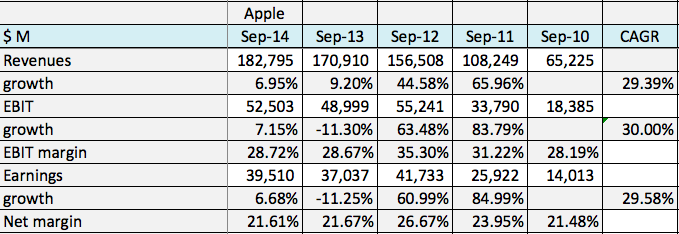
Let's look at Apple first. 


Now Tesla.


I have only included annual numbers. Apple has completed one quarter after that is not a big deal in the bigger picture.

From $65 b revenues in 2010 Apple grew at 29.39% annually over four years. Tesla has a lower base for revenues; so growth potential is more imminent. Let's hold on to this thought for the moment. Apple's margins have been very impressive, and both operating and net earnings have also grown accordingly. Apple's operating profits are $52.5 b now. Tesla, whereas, has yet to show profits. But, it has technology; so it is only a matter of time. Let's again keep this thought.

Tesla has invested about $1.5 b in operating capital (may be a little more if we include research and development costs expensed), and billions more are yet to be invested. In other words, its existing assets are minuscule compared to its growth assets. What is yet to come is going to be disruptive. Hold on to it again.

To get to Apple, we have two routes for Tesla.

First is to get Apple's current numbers and reach there in 2025.


EBIT multiple is not the best one to use when we are dealing with equity market cap. To use EBIT we have to assume similar capital structure for Tesla. Still, we need big operating earnings for Tesla in 2025.

Tesla should look like this in 2025.


Revenues should increase by almost 50% annually for the next ten years, and margins should be very high. But then again, the markets will have to give an earnings multiple of nearly 18. Can Tesla pull this off? Of course anything is possible; don't we know it has a very disruptive technology?

Second is to use the automakers (industry) numbers.


In fact, we should be using normalized data for the industry as the business is a bit cyclical. It is also just a coincidence that $700 b is close to the combined market cap of all the above automakers. Nevertheless, doesn't it look formidable?

If we pick the best performance from the automakers data above (i.e. Volkswagen's revenue and Hyundai's net margin, and then Toyota's revenue and earnings multiples), we get Tesla in 2025 as below.


Yet, $700 b appears too far off. But then, remember again that Tesla is not an automotive company; it is a technology company with super powers. We have to do something different, and disruptive too. That leads us back to Musk.


So, revenues will have to grow annually at close to 60% for the next ten years and reach to $346 b, net margin should be 10%, and the markets should give earnings multiple of 10, and presto! Tesla has a market cap of $692 b. This also translates into a revenue multiple of 2.

But, it is still $8 b short; never mind, this is only a back of the envelope exercise; actual numbers would be very different. For how different they can get, we have only to wait and watch.

How many cars and batteries, and what else, and at what price Tesla needs to sell by 2025 to get $346 b in revenues? Keep those thoughts for the moment.

There is also this argument: how many of us predicted ten years back that Apple would be worth $750 b by 2015?

Tuesday, January 27, 2015

value investor, are you

We hear, and we read about people taking pride in saying that they are value investors, not speculators or traders, and that they belong to that old school value investing camp. Then they go on about how they junk text book finance, and embrace straight-forward, simple, yet practical value investing school. They also quote their patriarchs, and several other renowned (value) investors. 

I have no particular dissent from that thought; yet, I have a certain demur. And that is about the name itself that is used particularly to differentiate from the other schools, viz. academia, speculators, traders, and the like. It seems quite cool to say that you are a value investor. At the cost of appearing silly (what's in a name?) to some, I hold on to the view that you are either an investor, or you are not; period. 

Investors have certain philosophies, which separate them from others, and we don't care whether these others belong to teaching, research, speculation, or even value investing, or not. Let's give some thought about why we care to invest. There could be three reasons: We need to consume in future. We need to retain our purchasing power in future. We face uncertainties in future. In view of this, we demand adequate compensation for deferring that urge for instant gratification, for bearing that implied tax called inflation, and for dealing with that uncertainty.

I am not sure what those value investors do differently; I believe they invest their capital to seek adequate compensation too. I would really like people (and there are institutions too) stop using that phrase value investing.

Heck, why do I care, and get excited about this? I would rather analyze value in investments. I would rather be a value analyst.


I am prepared to give in. Value investing is fine if they are involved in investing, rather than something else. Let them call themselves value investors, or some other name. And really, what's in a name?

Ouch, I can't resist this, are you a value investor?

Sunday, January 11, 2015

market signals

I am going to list down some facts, assuming they are, since most data came from the NSE website. We can argue, and draw our own conclusions based on this data. 

The long past years
Nifty started with 890.80 points on 1 January 1999, and its values at the beginning of each year have been showing an upward slope. I have ignored intermediate values to avoid clustering. As of 1 January 2015, it was at 8284 points. For an easygoing but rational investor, it would mean a return of close to 15% annually, beating probably most of the professional (institutional) advisers. It's far better not to let someone else control our affairs, finances in particular. .


Earnings of Nifty grew every year too, except for 1999 and 2009. The annual growth in earnings over the period was 10.73%. Not bad when we had at least five years of bad governance. 


In fact, 2003-2005 were the best years of earnings growth. After a not-so-good 2013, we had a much better 2014, and now, we can only hope that corporate earnings will be able to sustain a decent growth rate in the coming years.

Of course, we had a high interest rate (and inflation) environment in the past. This has the effect of giving on one hand (higher growth) and taking from another (higher cost of capital). I don't like to give ceteris paribus propositions, which look nice only on research papers.


Return on equity has been in the range of a low of a little less than 16% and a high of a little over 25%, and a little less than 19% on average.


We have a return of equity of about 16.49% now. Based on the fundamental variables, we can also have implied growth calculations; heck, when compared to the actual growth, they invariably vary.


For the sake of pricing estimates, I also list the PE ratios over time. As of 1 January 2015, we had a PE of 21.16, against a long term average of 19.20.


What do they tell us
What conclusions do we draw from these values is debatable. However, my take is as usual. I don't like to rely on market pricing as a tool for business (intrinsic) valuation; although, for buy-or-sell decisions based on price-value comparisons, pricing aspect cannot be ignored. However, I like to challenge market pricing variables, and ask whether these are justifiable. Intrinsic valuation, though, is based on estimates of cash flows, growth rates, and risk involved, none of which can be estimated accurately. For that reason, it is only easier to check market estimates to assist in decision making. It is possible to keep all variables, but one, constant, and challenge that implied variable. I find growth rates in the case of individual businesses, and equity risk premiums in the case of the entire market (index) best suited for questioning, though.

Market's own estimates, and its signals to us
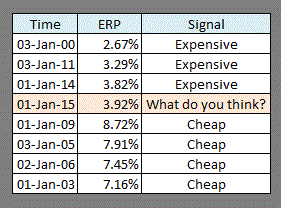
Given the information on earnings, reinvestment rate, return on equity, growth rate, and the government bond rates, we can calculate the equity risk premium implied in the market price of the index. The higher the premium, the higher the comfort level in buying, and vice versa. From an outside point of view, this is what I see:


The lowest equity risk premium implied in the market was in January 2000 implying that market prices were expensive compared to the fundamentals, and the highest was in January 2009 suggesting that prices were least expensive. On 1 January 2009, the Nifty was at 3033.45 points, which would have given an annual return of 18.23% by now. Instead, if bought in January 2000 and held on to it until today, the annual return would have been 11.62%. In January 2011, the markets were expensive again with the second lowest equity risk premium, and would have given an annual return of 7.70% as of now. 

As I see it, the index buy and sell decisions across the past years could have been made based on the information, which was available to us at each point of time.


I wouldn't want to buy into the market at these levels is obvious to me. For those who have a systematic investment plan, it is a simple process; but, for higher returns, having a look at what market prices are telling us is worth it. If there is significant cash to be committed, this may not be the time.

Markets will correct to the levels we would like it; however, for that to fructify, we need the right behavior: shun greed, fear and envy, and have patience.

Sustained business profits are not made in a short time, but over a long period. 

Tuesday, January 6, 2015

market crash, crude oil, and greece

The global markets took some toll, and have been giving some signals. That is, crude oil is going to fall further, Greece is going to exit the Eurozone, and the markets will get into some sort of recession in the coming months.

Anticipated supply in excess of demand is taking oil price lower by the day. OPEC has been pushing for supply, Europe, China and the rest are keeping demand lower; and presto, you have low prices. The price war is imminent; but who is going to win it is unclear. OPEC nations, dominant ones in particular, have lower cost of production compared to the US shale phenomenon. Those who have the capacity to endure lower prices for long are the ones who are likely to last longer. However, whether all this was really required is a matter to ponder over. A few energy companies might tumble in the process. But hey, isn't all is fair in..., or is it? Here's a prediction, though: in the long run oil prices would set themselves right. 

Europe may not be ready for another Greek crisis is alright, was it really ready for a common currency without control and accountability is another matter. Some deep thinking would have discouraged the Euro in the first place. Here's a prediction again: Greece might or might not exit the Euro, it might or not affect others in the Eurozone, Italy or France, or any other, nevertheless, in the long run the Europeans would earn more, spend more and save more.

As investors, all we want to know is which businesses are good enough to endure short term onslaughts, and yet be around to do business in the long term. If longer term cash flows and growth potential are not affected too badly, there is a case for buying into those stocks. Increasing interest rates may not threaten the US stocks as perceived to be, while falling rates can provide solace to the Indian stocks. 

Go look for the businesses that have been around for a long time, have capacity to wait and call shots, sell products that consumers cannot say no to, and have little or no debt. Wait for the markets to crash, pick those favorite stocks, and wait again for the markets to recover. In the meantime, do what you enjoy doing, whatever that is. Don't fret over stuff that does not matter in the long run.

Again, it comes to behaving right.