Pages

Saturday, May 30, 2015

when's the money amazon?

I like the business; I like the way it disrupted retail; I like the way Kindle revolutionized reading. For the year 2014, Amazon had revenues of $89 b. So far so good, and I thought about it as a firm with long term vision. But later I had to ask how long is this long term. 

Long term shareholders of this business have made money all along: In May 2010, it had a market cap of $56 b, and today it is $200 b. Just last year in Feb, it was selling for $159 b. Funnily enough, since it came out with its initial public offering in May 1997, it has never made any real money. 


Revenues increased 19% in 2014, and that's about it. Sure, Amazon is still in a disruptive growth mode, where you care about market share and then about making money. 

For its part, it presents the statement of cash flows first before statement of income and balance sheet. The reason appears to be obvious:


In claiming those free cash flows, it has conveniently forgotten that stock-based compensations are real expenses for the business.


Arguing that these costs are non-cash will be at their own peril. Otherwise, it would be much easier to pay every supplier with stocks and bring cash expenses to zero. This is for discussion another day.

It has also excluded acquisitions from calculating free cash flows, an error whether acquisitions are made through cash or by issuing stock.


At the moment, all I see is that Amazon as a business is yet to make real money. Usually, stock prices follow business profits in the long run. So far, the long run seems like too far away for Amazon because the stock prices are not reflecting business fundamentals.

There is another storyline for this business: Current earnings do not matter. What matters is the future earning power of the business. As long as Amazon is going to make disproportionately larger profits in later years, it is going to be fine. Market knows this, that's why it is factoring in the stock prices.

Which side of the story are you in? 

Saturday, May 23, 2015

rate hike and markets

If the rate hike is appropriate this year and later, what should happen to the stock prices, and the market as a whole? Well, if cash flows are not going to change the prices should fall. At least, the intrinsic value of all cash flow generating assets should fall. If they don't, it would mean that prices are expensive for a buyer. 

While bond prices adjust pretty quickly to the changes in interest rates, it is not going to be as easy as it sounds for equities. This is because at least for individual firms the cash flows pattern and their growth rate could be different. There aren't fixed coupons to be paid out and the time line is perpetuity.

There would also be flow of capital from let's say emerging markets where interest rates are much higher back to the US. Since the rate hikes are going to be gradual, to come back to what we can call the normalized interest rate (and inflation) environment it could still take several years. In the meantime, currency-based investments may still not be the best option. So for investments in the US, equities should remain favorites.

Nevertheless, interest rate is an important factor in making decisions about allocating capital. It measures our opportunity costs in investment options.

Sunday, May 17, 2015

are you a pe - squeezing the market

Value of a business is the present value of its future cash flows. For an investor it becomes difficult to predict cash flows and estimate the right discount rate. He struggles in that attempt all the time. What to expect of an investment, say, in a stock, is a pertinent question. 

While many analysts stick to the standard DCF model (of course, they do complicate it in the process is another matter), some loathe it citing reasons that it is difficult to predict cash flows. The latter take solace in applying multiples. And a few others use the combo - a mix of DCF and multiples. Really, there is no dearth of imagination when it comes to an analyst's emotions and his excel worksheet.

I can argue that it is possible to use DCF model in estimating an approximate (rather than precise) value of a business. I would rather keep that for another post.

The topic of this post is how venture capital and private equity firms earn their returns. They use different models to supply finance and acquire stake in the (often a private) business. The simplest form is usually the most sought after: Invest in equity of the business. Estimate the price (it isn't value) of the business 3-5 years hence. The pricing model usually is earnings-multiple, revenue multiple, or any other multiple. Have a minimum hurdle rate for the investment. Work back to calculate the price to be paid for the equity today.

If that means squeezing the present owners, so be it. In capitalism, it is fair. What is fancy in this investment model is that it is not fancy.

I want to argue that it is not difficult to use this pricing (not valuation) model for a small individual investor. It is actually a superior model to use for returns in excess of the market returns provided he is aware that pricing game is what is played here. The key to success with this model is of course the behavior of the investor.

Here's how it works:

The buy price depends upon the expected return:


As we can see for an investor who wants 30% return, the buy price has to be 47.40 which has an implied PE ratio of 13.54. This is about 52.60% down from the current price.

Is it possible to play this game in a publicly listed company? Of course it is possible because the market can be squeezed on occasion. For a patient investor there would be occasions to buy at his price. After all, the markets are inefficient, and a more-sensible investor can make money at the cost of the less-sensible one.

Two things hold out: Estimating future growth rate and PE ratio can be anybody's guess, and in addition, the emotions of the analyst can flow through to spoil the pricing game.

Nevertheless, thinking like a private equity investor is often useful. At least, it lets you to play the game on your terms.

Wednesday, April 8, 2015

shell's contradiction

According to the story, Shell is going to buy BG for $70 b. Shell is worth $199 b, and BG is worth $60 b. In July 2014, Shell had a market cap of $280 b, and in April 2011, BG had $88 b. Just a few days back, though, market cap of BG was $42 b. Well, the market has reacted to the news report.

I don't want to get into whether the acquisition makes sense in terms of synergy, control, and other benefits. I will also not comment on whether the acquisition is costly or a bargain for Shell. What I want to note is how Shell is funding its acquisition: It is a combination of cash (383 pence) and stock (984 pence) totaling 1367 pence per share of BG. 

In effect, Shell is paying $50 b in stock. My question is whether it makes sense to pay in stock at the current price. It usually makes sense to use shares as a currency when its price not cheap. In other words, if Shell considers that its stock price is higher than its intrinsic value, it can use it for acquisition. The expectation then is that it will get more value than what is paid out. 

Now let's come to what else Shell is going to do. It has committed to a shares buyback of $25 b in the coming years. There are at least two things to be checked before a firm can go for buyback of its shares: It should have excess cash; and its stock price should be cheap, or at least not higher than its intrinsic value. 

For acquisition to hold good, we have to assume that Shell, in fact, considers that its stock price is on the higher side, otherwise, it would not have used its shares for acquisition. 

Whereas for stock buybacks, we have to assume that Shell, in fact, considers that its stock price is and going to remain on the lower side, otherwise, it would not have committed to the buyback program.

Heck, too much confusion...for the Shell managers, I guess. 

Saturday, April 4, 2015

ntpc bonus debentures, and some reporting

NTPC has given away bonus debentures to its shareholders on 23 March 2015. While the corporate action has resulted in a free debt instrument in the hands of its shareholders carrying a floating rate coupon payable annually, there has been some interesting reports about its mechanism. 

It is interesting to note from this report that the company will be able to hold on to them for expansion projects; and this report which says that NTPC has issued bonus debentures for funding its expansion projects. I am not sure whether we should blame them for misguiding the readers, or blame the company for misguiding them who were unable to understand the concept in the first place. Just have a look at what the company has to say about this:


What the heck is happening here, who has paid out cash, and who has received cash? No one; and if there is no cash, where is the question of funding the projects?

Because no one has purchased these debentures, no cash has been received by NTPC. What has happened is simply the transfer from its equity to debt, thus increasing its debt ratio. Needless to say, equity has reduced and debt has increased. The debt portion will start paying interest which will be tax deductible for the company and taxable for the shareholders (now the debt holders). The book entry has managed to let the transferred amount behave like debt from now on. That's about it. 

If the profitability is not going to be affected (because of the additional interest charge), NTPC's return on equity should improve. 

I have written about NTPC before; the performance has been poor, and the stock is actually languishing. 


For someone who invested in the stock in January 2008, we can understand the frustration. The investor should be saying this: It really does not matter whether it will become a 90,000 MW company or not, what matters is its operating performance. How will it fare with its invested capital? Will it generate excess returns on its projects? Should it continue to reinvest its earnings so that it will increase its firm value (and consequently, the stock price), or should it stop reinvesting and start returning its excess cash?  

Capital allocation skills are tough, and under Indian conditions, boy, it's a double whammy.

Wednesday, April 1, 2015

can you value any asset

I recently wrote about value investors, albeit, for different reasons. Let's spare them for now. How about those who are on the other side, those who claim that they can value any asset? 

There are many who talk about valuation skills, and proclaim that they are adept at it. I wonder whether those skills are restricted to talking and writing only. I wonder whether they are able to profit from those skills in the real world investing. There is a reason why I wonder.

Value of a cash-flow generating asset is the present value of all cash flows that can be realized over its life. Anybody can do valuation. It is that simple: you only need to estimate cash flows and a discount rate to bring them to the present value. 

But wait, there is more to it. Practically, no one can estimate accurately how much cash flows an asset is going to generate in future. That is simply a prediction, and humans are not good at it. Furthermore, no one knows which discount rate is the correct one to use. 

It is clear that any valuation that we do is going to be wrong. It is also going to be colored by so many other factors such as bias and emotions. In this context, how can anyone be able to value, and profit from it? To make profits, we need to identify gaps between value and price. If the price does not factor input estimates of the analyst it is virtually impossible to make money out of his valuation. Prices are set by marginal investors who are usually large institutions. Their input estimates are going to be very different from an investor's. If those estimates are not likely to converge, value and price won't either. 

There is a good news though, if we are prepared to adhere to a different mechanism. Why get into assets whose cash flows are difficult to predict? For instance, technology companies, young growing companies, distressed businesses. It is not possible to come out with a realistic estimate of cash flows for these businesses; not even the insiders can do it. So we cannot value them reasonably, except on paper. 

The correct thing to do is to rather ignore these stocks, and move on to those where we can estimate cash flows, albeit with less precision. There are certain businesses where we can do it. For instance, those with stable and consistent cash flows, which have demonstrated high return on capital and operating margins. It is better to pick those businesses for valuation. Estimate cash flows based on past record, and future prospects (which is a lot easier than for unstable businesses), and come out with a value. This value is more likely to be in sync with the fundamentals of that business. 

The irony, however, is that such stocks usually sell at high prices. But then, who says we have to buy them regularly? There would be times when the markets are going to be in a depressed state (due to crises, or other reasons), or the company's stock itself is going to be depressed (due to issues that are likely to be temporary). These will be the moments when we should be picking. Markets will eventually come back, and that stable company's problems will eventually be solved so that the prices will reflect its fundamentals. Look at history, and you will find that such opportunities were there on several occasions. 

Of course, there are other sound approaches to investing, some of which I do use. Nevertheless, I find that waiting for the right occasion to buy is the best one. Rest of the time, we can do a few things: keep buying the index; do whatever we want to do in life to have fun, and watch (from far) markets fluctuating by the minute. 

Thursday, February 26, 2015

tesla's apple

Tesla Motors is a great company to read about and talk about. It was formed in 2003 to prove that electric cars are better, and more affordable, than gasoline-driven cars of today. That's a cool statement. There are more than 50,000 Tesla cars on the road now. Tesla owners enjoy the benefit of charging at home so they never have to visit a gas station. By 2020, Tesla's $5 b gigafactory, being built in Nevada, will produce more lithium ion cells than all of the world's combined output in 2013. Tesla is not just an automaker, but also a technology and design company with a focus on energy innovation. Super cool. 

Tesla's models include:

Tesla Roadster


Tesla Model X


Tesla Model 3 is supposed to be the best-selling car in the coming years. For under $40,000 it is going to be more affordable, and meant for the public at large.

Then there are Tesla Supercharger Stations which are free connectors that charge Tesla cars in minutes instead of hours, based on find-charge-drive-on model.

Super-duper cool. What next?

Naturally, there has been a lot of hype around managers of the company, and they have a lot to deliver.


So far the shareholders have gained much from Tesla. From the IPO price of $17 per share, it is now $203 per share, making its total equity worth $25 b. 


Not so bad.

And Elon Musk is an extraordinary individual. He owns 27% of Tesla, and has lofty targets for it. Yet, when he said what he said recently it was a jaw-dropping moment. He said, by 2025 Tesla would be like what Apple is today. He didn't seem like in jest, though he seemed more like in zest. 

Apple is worth $750 b now. But, Musk said Tesla would be worth only $700 b by 2025, not $750 b. He has $50 b savings in that, rather bold, statement. While we don't have foresight in terms of what's going to take place in future, and that includes financial predictions, many of us would rather keep our predictions private, lest we make fools of ourselves. That fear of mocking ourselves keeps us quiet. Nevertheless, there are people who don't care about all these silly things. They march on. We can applaud them, and why not? or we can mock them. I would rather do neither. All I want to do is some math and check where that statement takes us. 

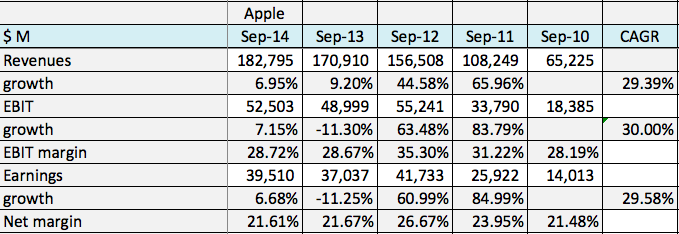
Let's look at Apple first. 


Now Tesla.


I have only included annual numbers. Apple has completed one quarter after that is not a big deal in the bigger picture.

From $65 b revenues in 2010 Apple grew at 29.39% annually over four years. Tesla has a lower base for revenues; so growth potential is more imminent. Let's hold on to this thought for the moment. Apple's margins have been very impressive, and both operating and net earnings have also grown accordingly. Apple's operating profits are $52.5 b now. Tesla, whereas, has yet to show profits. But, it has technology; so it is only a matter of time. Let's again keep this thought.

Tesla has invested about $1.5 b in operating capital (may be a little more if we include research and development costs expensed), and billions more are yet to be invested. In other words, its existing assets are minuscule compared to its growth assets. What is yet to come is going to be disruptive. Hold on to it again.

To get to Apple, we have two routes for Tesla.

First is to get Apple's current numbers and reach there in 2025.


EBIT multiple is not the best one to use when we are dealing with equity market cap. To use EBIT we have to assume similar capital structure for Tesla. Still, we need big operating earnings for Tesla in 2025.

Tesla should look like this in 2025.


Revenues should increase by almost 50% annually for the next ten years, and margins should be very high. But then again, the markets will have to give an earnings multiple of nearly 18. Can Tesla pull this off? Of course anything is possible; don't we know it has a very disruptive technology?

Second is to use the automakers (industry) numbers.


In fact, we should be using normalized data for the industry as the business is a bit cyclical. It is also just a coincidence that $700 b is close to the combined market cap of all the above automakers. Nevertheless, doesn't it look formidable?

If we pick the best performance from the automakers data above (i.e. Volkswagen's revenue and Hyundai's net margin, and then Toyota's revenue and earnings multiples), we get Tesla in 2025 as below.


Yet, $700 b appears too far off. But then, remember again that Tesla is not an automotive company; it is a technology company with super powers. We have to do something different, and disruptive too. That leads us back to Musk.


So, revenues will have to grow annually at close to 60% for the next ten years and reach to $346 b, net margin should be 10%, and the markets should give earnings multiple of 10, and presto! Tesla has a market cap of $692 b. This also translates into a revenue multiple of 2.

But, it is still $8 b short; never mind, this is only a back of the envelope exercise; actual numbers would be very different. For how different they can get, we have only to wait and watch.

How many cars and batteries, and what else, and at what price Tesla needs to sell by 2025 to get $346 b in revenues? Keep those thoughts for the moment.

There is also this argument: how many of us predicted ten years back that Apple would be worth $750 b by 2015?