Pages

Thursday, February 26, 2015

tesla's apple

Tesla Motors is a great company to read about and talk about. It was formed in 2003 to prove that electric cars are better, and more affordable, than gasoline-driven cars of today. That's a cool statement. There are more than 50,000 Tesla cars on the road now. Tesla owners enjoy the benefit of charging at home so they never have to visit a gas station. By 2020, Tesla's $5 b gigafactory, being built in Nevada, will produce more lithium ion cells than all of the world's combined output in 2013. Tesla is not just an automaker, but also a technology and design company with a focus on energy innovation. Super cool. 

Tesla's models include:

Tesla Roadster


Tesla Model X


Tesla Model 3 is supposed to be the best-selling car in the coming years. For under $40,000 it is going to be more affordable, and meant for the public at large.

Then there are Tesla Supercharger Stations which are free connectors that charge Tesla cars in minutes instead of hours, based on find-charge-drive-on model.

Super-duper cool. What next?

Naturally, there has been a lot of hype around managers of the company, and they have a lot to deliver.


So far the shareholders have gained much from Tesla. From the IPO price of $17 per share, it is now $203 per share, making its total equity worth $25 b. 


Not so bad.

And Elon Musk is an extraordinary individual. He owns 27% of Tesla, and has lofty targets for it. Yet, when he said what he said recently it was a jaw-dropping moment. He said, by 2025 Tesla would be like what Apple is today. He didn't seem like in jest, though he seemed more like in zest. 

Apple is worth $750 b now. But, Musk said Tesla would be worth only $700 b by 2025, not $750 b. He has $50 b savings in that, rather bold, statement. While we don't have foresight in terms of what's going to take place in future, and that includes financial predictions, many of us would rather keep our predictions private, lest we make fools of ourselves. That fear of mocking ourselves keeps us quiet. Nevertheless, there are people who don't care about all these silly things. They march on. We can applaud them, and why not? or we can mock them. I would rather do neither. All I want to do is some math and check where that statement takes us. 

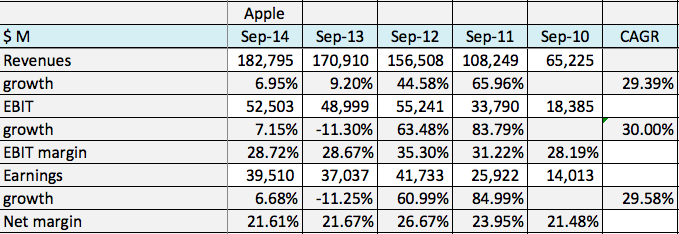
Let's look at Apple first. 

Now Tesla.


I have only included annual numbers. Apple has completed one quarter after that is not a big deal in the bigger picture.

From $65 b revenues in 2010 Apple grew at 29.39% annually over four years. Tesla has a lower base for revenues; so growth potential is more imminent. Let's hold on to this thought for the moment. Apple's margins have been very impressive, and both operating and net earnings have also grown accordingly. Apple's operating profits are $52.5 b now. Tesla, whereas, has yet to show profits. But, it has technology; so it is only a matter of time. Let's again keep this thought.

Tesla has invested about $1.5 b in operating capital (may be a little more if we include research and development costs expensed), and billions more are yet to be invested. In other words, its existing assets are minuscule compared to its growth assets. What is yet to come is going to be disruptive. Hold on to it again.

To get to Apple, we have two routes for Tesla.

First is to get Apple's current numbers and reach there in 2025.


EBIT multiple is not the best one to use when we are dealing with equity market cap. To use EBIT we have to assume similar capital structure for Tesla. Still, we need big operating earnings for Tesla in 2025.

Tesla should look like this in 2025.


Revenues should increase by almost 50% annually for the next ten years, and margins should be very high. But then again, the markets will have to give an earnings multiple of nearly 18. Can Tesla pull this off? Of course anything is possible; don't we know it has a very disruptive technology?

Second is to use the automakers (industry) numbers.


In fact, we should be using normalized data for the industry as the business is a bit cyclical. It is also just a coincidence that $700 b is close to the combined market cap of all the above automakers. Nevertheless, doesn't it look formidable?

If we pick the best performance from the automakers data above (i.e. Volkswagen's revenue and Hyundai's net margin, and then Toyota's revenue and earnings multiples), we get Tesla in 2025 as below.


Yet, $700 b appears too far off. But then, remember again that Tesla is not an automotive company; it is a technology company with super powers. We have to do something different, and disruptive too. That leads us back to Musk.


So, revenues will have to grow annually at close to 60% for the next ten years and reach to $346 b, net margin should be 10%, and the markets should give earnings multiple of 10, and presto! Tesla has a market cap of $692 b. This also translates into a revenue multiple of 2.

But, it is still $8 b short; never mind, this is only a back of the envelope exercise; actual numbers would be very different. For how different they can get, we have only to wait and watch.

How many cars and batteries, and what else, and at what price Tesla needs to sell by 2025 to get $346 b in revenues? Keep those thoughts for the moment.

There is also this argument: how many of us predicted ten years back that Apple would be worth $750 b by 2015?

Tuesday, January 27, 2015

value investor, are you

We hear, and we read about people taking pride in saying that they are value investors, not speculators or traders, and that they belong to that old school value investing camp. Then they go on about how they junk text book finance, and embrace straight-forward, simple, yet practical value investing school. They also quote their patriarchs, and several other renowned (value) investors. 

I have no particular dissent from that thought; yet, I have a certain demur. And that is about the name itself that is used particularly to differentiate from the other schools, viz. academia, speculators, traders, and the like. It seems quite cool to say that you are a value investor. At the cost of appearing silly (what's in a name?) to some, I hold on to the view that you are either an investor, or you are not; period. 

Investors have certain philosophies, which separate them from others, and we don't care whether these others belong to teaching, research, speculation, or even value investing, or not. Let's give some thought about why we care to invest. There could be three reasons: We need to consume in future. We need to retain our purchasing power in future. We face uncertainties in future. In view of this, we demand adequate compensation for deferring that urge for instant gratification, for bearing that implied tax called inflation, and for dealing with that uncertainty.

I am not sure what those value investors do differently; I believe they invest their capital to seek adequate compensation too. I would really like people (and there are institutions too) stop using that phrase value investing.

Heck, why do I care, and get excited about this? I would rather analyze value in investments. I would rather be a value analyst.


I am prepared to give in. Value investing is fine if they are involved in investing, rather than something else. Let them call themselves value investors, or some other name. And really, what's in a name?

Ouch, I can't resist this, are you a value investor?

Sunday, January 11, 2015

market signals

I am going to list down some facts, assuming they are, since most data came from the NSE website. We can argue, and draw our own conclusions based on this data. 

The long past years
Nifty started with 890.80 points on 1 January 1999, and its values at the beginning of each year have been showing an upward slope. I have ignored intermediate values to avoid clustering. As of 1 January 2015, it was at 8284 points. For an easygoing but rational investor, it would mean a return of close to 15% annually, beating probably most of the professional (institutional) advisers. It's far better not to let someone else control our affairs, finances in particular. .


Earnings of Nifty grew every year too, except for 1999 and 2009. The annual growth in earnings over the period was 10.73%. Not bad when we had at least five years of bad governance. 


In fact, 2003-2005 were the best years of earnings growth. After a not-so-good 2013, we had a much better 2014, and now, we can only hope that corporate earnings will be able to sustain a decent growth rate in the coming years.

Of course, we had a high interest rate (and inflation) environment in the past. This has the effect of giving on one hand (higher growth) and taking from another (higher cost of capital). I don't like to give ceteris paribus propositions, which look nice only on research papers.


Return on equity has been in the range of a low of a little less than 16% and a high of a little over 25%, and a little less than 19% on average.


We have a return of equity of about 16.49% now. Based on the fundamental variables, we can also have implied growth calculations; heck, when compared to the actual growth, they invariably vary.


For the sake of pricing estimates, I also list the PE ratios over time. As of 1 January 2015, we had a PE of 21.16, against a long term average of 19.20.


What do they tell us
What conclusions do we draw from these values is debatable. However, my take is as usual. I don't like to rely on market pricing as a tool for business (intrinsic) valuation; although, for buy-or-sell decisions based on price-value comparisons, pricing aspect cannot be ignored. However, I like to challenge market pricing variables, and ask whether these are justifiable. Intrinsic valuation, though, is based on estimates of cash flows, growth rates, and risk involved, none of which can be estimated accurately. For that reason, it is only easier to check market estimates to assist in decision making. It is possible to keep all variables, but one, constant, and challenge that implied variable. I find growth rates in the case of individual businesses, and equity risk premiums in the case of the entire market (index) best suited for questioning, though.

Market's own estimates, and its signals to us
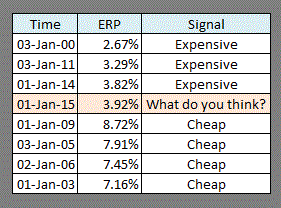
Given the information on earnings, reinvestment rate, return on equity, growth rate, and the government bond rates, we can calculate the equity risk premium implied in the market price of the index. The higher the premium, the higher the comfort level in buying, and vice versa. From an outside point of view, this is what I see:


The lowest equity risk premium implied in the market was in January 2000 implying that market prices were expensive compared to the fundamentals, and the highest was in January 2009 suggesting that prices were least expensive. On 1 January 2009, the Nifty was at 3033.45 points, which would have given an annual return of 18.23% by now. Instead, if bought in January 2000 and held on to it until today, the annual return would have been 11.62%. In January 2011, the markets were expensive again with the second lowest equity risk premium, and would have given an annual return of 7.70% as of now. 

As I see it, the index buy and sell decisions across the past years could have been made based on the information, which was available to us at each point of time.


I wouldn't want to buy into the market at these levels is obvious to me. For those who have a systematic investment plan, it is a simple process; but, for higher returns, having a look at what market prices are telling us is worth it. If there is significant cash to be committed, this may not be the time.

Markets will correct to the levels we would like it; however, for that to fructify, we need the right behavior: shun greed, fear and envy, and have patience.

Sustained business profits are not made in a short time, but over a long period. 

Tuesday, January 6, 2015

market crash, crude oil, and greece

The global markets took some toll, and have been giving some signals. That is, crude oil is going to fall further, Greece is going to exit the Eurozone, and the markets will get into some sort of recession in the coming months.

Anticipated supply in excess of demand is taking oil price lower by the day. OPEC has been pushing for supply, Europe, China and the rest are keeping demand lower; and presto, you have low prices. The price war is imminent; but who is going to win it is unclear. OPEC nations, dominant ones in particular, have lower cost of production compared to the US shale phenomenon. Those who have the capacity to endure lower prices for long are the ones who are likely to last longer. However, whether all this was really required is a matter to ponder over. A few energy companies might tumble in the process. But hey, isn't all is fair in..., or is it? Here's a prediction, though: in the long run oil prices would set themselves right. 

Europe may not be ready for another Greek crisis is alright, was it really ready for a common currency without control and accountability is another matter. Some deep thinking would have discouraged the Euro in the first place. Here's a prediction again: Greece might or might not exit the Euro, it might or not affect others in the Eurozone, Italy or France, or any other, nevertheless, in the long run the Europeans would earn more, spend more and save more.

As investors, all we want to know is which businesses are good enough to endure short term onslaughts, and yet be around to do business in the long term. If longer term cash flows and growth potential are not affected too badly, there is a case for buying into those stocks. Increasing interest rates may not threaten the US stocks as perceived to be, while falling rates can provide solace to the Indian stocks. 

Go look for the businesses that have been around for a long time, have capacity to wait and call shots, sell products that consumers cannot say no to, and have little or no debt. Wait for the markets to crash, pick those favorite stocks, and wait again for the markets to recover. In the meantime, do what you enjoy doing, whatever that is. Don't fret over stuff that does not matter in the long run.

Again, it comes to behaving right.

Wednesday, December 31, 2014

commodity, cyclicals, or pricing power

It's time for many to assess how they fared in the game of investing. I have selected some of the largest market-cap stocks from India, and some other randomly in order to check out their performance over the years.

The longer term
Since I usually do not look short term, let's start with the five-year period, where the markets returned 57%. Take TCS, India's largest company in terms of market-cap. It has returned 233% over the last five years, while Reliance lost money (negative 18%). However, it performed much better than NTPC which lost 40%; how pathetic, and how relative. So much for the previous government's promises of reforms, especially in the power sector. ONGC is up 16% in five years. Tata Steel is down 35% (blame it on bad acquisitions and more). And then there is Asian Paints, which returned 304%, and Nestle which is up 1019%.

A look at the picture below, and we get the picture, I reckon. 


I am not much interested in the year-on-year performance particularly, but some things do stand out, and tell us.

For the year 2014

For the year 2013

For the year 2012

For the year 2011

For the year 2010

The lessons
There are commodity businesses, and there are cyclical businesses, and then there are businesses which due to something about them that give them the pricing power. That is, they are able to increase prices of their products when they want to without worrying much about volume of sales. While the former categories rarely make investors rich, the latter category when purchased at the right market prices often rewards them sufficiently.

Obviously then it makes sense for us to watch those businesses which sell less discretionary products, have lower operating leverage, and not much of debt. These are the ones that have durable competitive advantages, and therefore, can sustain higher gross margins, and higher return on capital over a long period. Pick them at the right price (when markets have fallen off the cliff) in meaningful quantities, and wait for the price and value to converge. Have fun, get rich in the coming years ahead.

Monday, December 29, 2014

how instagram is worth more than $35 b

Instagram, an online photo-video sharing social media business was acquired by Facebook in April 2012 for $1 b in both cash and stock. Now it is being valued at $35 b. That is 35 times payoff in 2 years. 

Was the buy a bargain (sellers that foolish, and buyers that smart), or is this just another of analyst's fantasies?

With social media companies one cannot tell as the euphoria that was there during the late 1990s regarding information technology companies seems to be rubbing off regarding the social media companies now. Human behavior is the same at all times. Greed and Fear are the easy masks people like to wear.

I am not saying that Instagram is not worth $35 b; what I would like to ask is how do we know? It could be worth any value. There isn't any rational basis at the moment to justify with confidence that it is worth something.

We haven't got the revenues and margins; we don't know the growth rate; we haven't got the reinvestment that is required to sustain the level of growth that is expected.

We can definitely have a set of assumptions about these, and come up with a value. However, I can guarantee that the intrinsic value of Instagram as a business would be anything, but that value. The reason is simple: with technology businesses, it is almost impossible predict the future course. We might want to see a level of growth, but to achieve that growth, reinvestment of capital is required; information about market size and market share is required; we should know the sustainable margins which leads us to understand the market and predict competition.

One way to go around this is to have a distribution of assumptions and come up with probabilities, and then the expected value. Heck, it doesn't work that way. There could be probabilities, but then, in reality the actual value is not based on probability, but on a single set of fundamentals. Which of these assumptions will hold true, you never know. We can use probabilities only when there is a very high probability of an event occurring. Rest is pure academic.

Isn't then valuing a technology business a futile exercise? What is the point in valuing a business just for the sake of it? We should be able to make a buy or sell decision based on our valuation. If we are not able to do that, I find the exercise only academic. Not too bad for a class of students, though.

Hypothetically, if Instagram is worth $35 b, it is a better business than say, Hershey ($23 b), Sony ($22 b), ICICI bank ($33 b), Kellogg's ($23 b), State Street ($33 b), Southwest Airlines ($27 b), and Cognizant ($32 b). Is that so? I don't know. I am not saying that these market values reflect their actual worth. At least these firms have established revenue models.

Instagram does not have meaningful revenues at the moment. It might have a revenue model, but we are not privy to that information. I would argue that even the managers would be wrong in their estimates for a start-up business like this one.

Instagram's value could even be higher than $35 b. What I mean is that at this moment we cannot know this for sure.

With all this behind, I might as well give my estimates of Instagram.

If Facebook is worth $222 b and has 1.35 b users, we can use this information to price (not value) Instagram.

Here we go, Instagram is worth $49 b.


We can use price-to-sales ratio of Facebook to price Instagram to $53 b.


I can use a set of assumptions on revenues, operating margins, growth rate, reinvestment rate, return on capital, and use that to estimate the value of Instagram. But, I will keep that for another time.

I have had fun with these exercises in the past (TCS/Infosys, Facebook, Twitter, Twitter, Nokia, TCS, Blackberry, Google, FB/WhatsApp, TCS, Apple), but have never used that for any investing decisions. In fact, my concluding thoughts have been similar; we cannot value technology businesses accurately.

Yet, who stops us from having some fun? Let's play along...

Friday, December 19, 2014

oil buyer, or oil seller, that is the question

Back in 2012, I argued that value of an oil producing business depends upon two key factors: oil reserves and oil prices. While I wrote about the significance of being realistic about oil reserves, I did not much deal with oil prices as they are not within anybody's control.

Alas, we are left to deal with it in these times. With oil prices falling just like that, there are at least two groups who are affected. Those who produce oil, and those who consume oil. There is no prize for guessing in the current times who you would like to be. 


Naturally, oil producing businesses have been hit and oh boy. At less than $60 per barrel, suddenly the time is to be the buyer of oil rather than the seller. I wonder why then the stock buyers go gaga over rising stock markets rather than falling. That post is for another time though, let's come back to our current story line. 

Oil sellers
The right thing to do for the oil producers now is to cut back on production and let market prices of oil rise to the levels required to give them the required rate of return. Unfortunately, producers with lower financial flexibility (having high debt, and low debt capacity) should panic, and have higher chances of bankruptcy. These firms might not have time to wait for the prices to rise. A sorry situation reflecting probably poor managerial skills (financing decisions). Those who have the financial flexibility would be able to cut the production, and wait for the prices to correct. There is no time frame in this respect as the prices tend to be unpredictable, and to a large extent not controllable. 

Then there is another class of oil producers whose dynamics are decided by the state rather than the owners. Take the example of ONGC whose hands are tied regarding both production and pricing. Firms like this will have no option, but to rely on the state's (rather than the firm's) economic considerations. History suggests that the state has not taken the right decisions on behalf of the owners. Therefore, ONGC has not performed the way it would have if it were a private firm.

Oil buyers
The story is quite different for the oil buyers. Businesses who consume oil in large quantities as their raw material, and having pricing power on their finished products, are likely to be key beneficiaries of low oil prices. They should be able to increase their operating margins other things being equal. Businesses selling less discretionary products to the consumers are best placed to increase their value. 

Investors
Investors will be well placed to buy stocks of oil buyers having pricing power. And those interested in buying stocks of oil sellers should consider buying those who have low debt, large reserves, and control over the timing of production. Privately owned or publicly listed oil producers are better placed in this category rather than the state owned.

Needless to say that the price of the stock compared to its value should be the primary consideration before making any buy decision.