Pages

Wednesday, September 21, 2016

bayer-monsanto

Bayer has agreed to acquire Monsanto at $128 per share valuing its equity at $57 b in an all-cash transaction. To finance the deal Bayer intends to raise both debt and equity. If the $19 b mandatory convertible bonds are the only debt to be raised, it appears like the entire acquisition being financed by equity. Then by implication it is not an all-cash deal, but an all-equity acquisition. For that to happen, Bayer must consider that its stock is overpriced. That is the first explanation that Bayer needs to give to its shareholders, although the major equity increase is through a rights issue.

Bayer must also consider that value of Monsanto's operating business is higher than $66 b. But is it? 


Monsanto is a mature business. Its revenues have not moved much in the past three years. And it has been generating steady cash flows. How much its revenues could grow in the next 5-10 years? Perhaps they would grow at a modest rate which would also be its perpetual growth rate; Monsanto is not a high-growth business. As of May 2016, Monsanto had $10.56 b of debt and $1.37 b in cash. 

If we consider operating margin of 25% and return on capital of 20% as sustainable for a foreseeable period, we can make value of Monsanto's business a function of perpetual growth rate and expected rate of return. 

For the analysis, I have not adjusted research and development expenses that Monsanto charges to its income statement. It would be much better if that is accounted for as an asset and amortized. 

The perpetual growth rate should be sustainable and reflect its mature business profile. Expected rate of return, which becomes the cost of capital, should be based upon the opportunity costs available at the time of acquisition. Of course, it should reflect the riskiness of cash flows; but how risky these cash flows are is a matter of perception. Rather than relying on CAPM, to supply a cost of capital, I would rather use a rate that I see is suitable for the acquisition. After all, if Bayer has opportunities to invest in a business that has an expectation of 10% rate of return, why should it invest in a business that can give 7%? As of now, the 10-year treasury has a yield of 1.69%. Obviously, Bayer would like to beat it, but by how much? 


If revenues grow at 3%, Monsanto will generate free cash flows of $2,134 m. Value of the business now depends upon the expected rate of return on cash flows. 


It looks like at 7% rate of return, Bayer is expecting value increase from control and synergies of 22.39%. This is to say that Bayer expects to increase growth rate in revenues, increase operating margins and increase return on capital after the acquisition is complete. How feasible is that? I am not too sure of growth rate, but if Bayer achieves an operating margin of 30% on a sustainable basis, it appears to have nailed the deal at 7% rate of return.


If the expected rate of return is higher, obviously Bayer has a tough job ahead.

To justify the acquisition price without benefits from control and synergies, Monsanto needs to grow at a much higher rate on a perpetual basis. 


At 3.73% growth rate, Bayer should expect a rate of return of 7% on the acquisition. Any higher expectation would put Monsanto under immense pressure to grow. It looks like a rate of return of 10% is not feasible.

If Monsanto grows at a much lower growth rate of 2% (operating margin of 25%), Bayer will have a lot explain to its shareholders. 


That is even when Bayer manages to increase operating margin to 30%. 


Such is life even for the corporates. It is both uncertain and filled with probabilities. By the way, Monsanto is still trading at a 20% discount to the acquisition price. Investors, who have faith in this acquisition and Bayer, still have the opportunity.

Wednesday, September 7, 2016

questions to buffett, 3 and another

I have always wanted to ask Warren Buffett a few questions, which have been in my mind for quite sometime. I have 3 questions for him, and another as a bonus question.

why back out of own path
Buffett was quite cool when he said what he said in 1955 as a 25 year old.


I was blown away when I first read the Forbes article. Here's someone, barely 25, talking about retirement in 1955. He did not mean to retire, retire like everybody past 60 does. He was talking about teaching and reading, and yet, confident of becoming rich managing his own cash. That's not retirement, but financial independence as we see it now. He did not want to be part of the rat race. He neither had plans of a partnership, nor taking up a job. For me, it was a profound statement because personally I could very much relate to it.


So then why did he choose to form the partnership?


Why did he himself offer to form the partnership when he thought he was going to be quite happy (and also rich) doing what he wanted to do, i.e. be on his own not being accountable to someone else?

why manage other people's money
Buffett is arguably the best investor the world has ever seen. I don't think there can ever be another of his kind. His ability to pick stocks is not matched by anyone considering consistency and duration.

If he had not formed the partnership, and opted to manage his own capital instead as he wanted to anyway in the first place, he would as well have achieved superior results. Perhaps, over the long period, the rate of return might have been higher because of the lower base. When he closed his partnership in 1969, its assets were $100 m, and Berkshire today has billions of dollars to manage. Both at their respective times are large numbers to invest.

Buffett's actual performance on Berkshire market price is 20.9% over 51-year period (2015), and 30% over 25-year period (1989).

If Buffett had listened to his heart in 1955 and chosen to manage only his capital of $127,000, its value would have been $11.2 b by 2015 considering 20.9% return. If we consider 25%, the capital would have grown to $82.8 b. No wonder compound interest works like magic; I dare not think of 30%. He is worth $67.6 b as of now. But that hardly matters, does it? He would be worth $1 b at 16.1%; a piece of cake for him.

Beyond a certain point, all dollars are directed righteously to charity. His frugal lifestyle hardly requires much cash; most ordinary people could have a similar lifestyle, but alas, they don't; that's a behavioral pattern, which I reserve for another day's discussion.

My point is whether he would be worth $11 b, $82 b, or $67 b is irrelevant. The question is why did he choose to manage other people's money? I don't consider taking cash from others and being obligated to the responsibility of keeping them informed of all times in terms of targets, key information, explanation for gaps, positive or negative, between actual and targeted, is a good idea. Definitely not for someone who is as smart as Buffett is. Perhaps, he wanted to get rich a bit quicker collecting performance fees, did he?

why close partnership and then start allover
In his 9 October 1967 letter to his partners, Buffett first mentioned about change of investment environment and personal factor. He noted that he did not want to form habits that ceased to make sense. Change of heart, so to speak.


He said he also wanted to do things which were non-economical, rather than only chasing the biggest point gains in his economic activities. He said he preferred, but did not say he would, to own controlled businesses that let him be with people he liked and have a life personally enjoyable.


Finally, he informed his partners in his 29 May 1969 letter of his decision to quit.


Much the quantitative guy that he was at the time, under the patronage of his mentor, Ben Graham, Buffett noted that good investment opportunities were lacking. Stock prices were very high; value did not seem to make sense.


He formally informed them that he wanted to retire. He did not mention what he meant by retire, though.

He mentioned quite frankly that he did not understand the investment environment, and did not hope to get lucky with other people's money.


Yet, he did not have a plan for the future; but he did mention that his priorities at 60 would be different from those at 20. I thought his remarks in 1955, 18 years prior, were more clear.


He was worth $25 m at that time, and could have chosen the path he had seen in 1955. If he had, his capital would have been worth $65 b in 2015 at 18.6%; $15 b at 15%. So he would be easily worth between $15 b and $65 b today had he chosen the path of a 25 year old.

So again, why did Buffett, despite all his aspirations to detach himself from economic only activities, continued to engage and immerse himself in only business and investment? Perhaps, he thought advance premiums from insurance operations were sort of free capital (when managed well like he did) compared to his partners' capital which had a cost, did he?

why coke
My final question, and I cannot resist this. Why coke?

the tap dance
Buffett could have done this or that. In the final analysis it really does not matter. In fact, from my personal point of view, and I am sure from world's point of view, it was good that he did what he actually did. If not, we would not have got the Warren Buffett; we would have missed his philosophies, his thoughts, and his wit; and that would be a big loss for mankind.

It gets better from his point of view because he really seems to enjoy what he has been doing for years. No wonder he tap dances to work.

Yet, if only he could answer my questions.

Tuesday, September 6, 2016

tata coffee: not much to take out

Tata Coffee's market value increased from Rs.5,074 m (high) in 2006 to Rs.23,533 m in 2016. It was as low as Rs.3,117 m in 2006. One would have earned 16.58% or 22.4% depending upon when one bought it, and if one had bought it. Not bad. 

Nevertheless, in 2016 the investor would have made 3.23% based upon the high price and 29.11% based upon the low price in 2011. The disparity is because of the double whammy presented by the market itself: a high PE of 27.67 and a low PE of 9.04 for the stock in 2011. 

In the last five years, revenues increased by 6.28%, yet earnings per share increased by 10.18% helped by other income and exceptional items. The average operating margin has been approximately 14%.

The return on capital has remained low, and was 9.1% in 2016. The company's annual average spend on reinvestment was Rs.278 m in the last five years. 

The alarming part though is that Tata Coffee's incremental return on capital has deteriorated. 


For any business to be successful, the key is to have the ability to generate a very high rate of return on its incremental capital. Unfortunately for Tata Coffee, the historical return on capital is already low, and its incremental return on capital is worse. 

With 19 coffee estates measuring 18,273 acres, instant coffee capacity of 8,400 MT; 7 tea estates measuring 6067 acres; and pepper vines, I need to estimate the growth rate, which if I use what I reckon is reasonable takes the value of Tata Coffee to a very low number. It's a struggle to find the growth rate.


The company has identified volatility in the international coffee prices, currency rate movements, high, price-sensitive competition, and dependency on nature as key risks involved in the business.

It has Rs.11,344 m of goodwill on the balance sheet; its subsidiary, Consolidated Coffee Inc. earned Rs.804 m of which, Rs.402 m was attributable to Tata Coffee. Consolidated Coffee owns Eight O' Clock Coffee Company.

The good news is that there has not been any dilution to equity. However, Tata Coffee should strive to have the ability to take sufficient cash out compared to what it has put in its operations. Can the company pull it off?

Friday, September 2, 2016

sovereign gold bonds, not colored

I have already displayed my dislike for gold for investment purposes; I don't like it for decoration either; wasteful altogether.  It is like when there is demand, supply shouldn't stop. To say that Indians are fascinated with the yellow metal is an understatement, what with 1000 tons of annual consumption. In a country where foreign exchange is precious, the dollar spend on gold never ceases. There isn't any appreciation for the lost opportunity; and the cost is massive.


After the government came out with the sovereign gold bonds, has the equation changed for gold buyers? The short answer is: No for those who love decoration; and may be for others. 

Before we go further, here's the brief.
  • Bonds held in demat form and traded on the exchanges.
  • There will be no physical gold.
  • Time to maturity is 8 years.
  • Interest is paid semi-annually on the investment at 2.75% pa, which is taxable.
  • Redemption proceeds are calculated based upon units held at the prevailing market price.
  • Capital gain on maturity is not taxable; before maturity is taxable.
  • Minimum investment is 1 gram and maximum is 500 grams.
  • Units held are protected; however, there is no protection against capital loss due to price fall.
At least there is no physical trace of gold; and with no foreign exchange involved makes it interesting. The government is not going to deliver gold upon maturity; all that is involved is, cash in and cash out. There isn't any yellow to be seen; and this might make the majority of Indians go gaga. Never mind, the few remaining will have reasons to think more rationally. 

These bonds are sort of derivative instruments, whose price would change based upon the price of the underlying, i.e. the gold. How likely are these prices to go up? If history is any indication, there might be a little scope to make these bonds good enough. From 1969-2012, the prices increased by 9.25% annually; from 1992-2012, 7.77%; from 1997-2012, 10.15%; from 2002-2012, 17.91%; from 2007-2012, 17.85%; and from 1969-2005, the prices increased by 7.57%; however, from 1980-2012, it was -(0.55)%. What is our fallback time period?

Now that the new tranche of September 2016 is coming up, the investor's prime concern should be where the prices would be in September 2024; and then marginal tax rate of the investor; all the rest can be safely ignored. The gold price for the September 2016 investment is fixed at Rs.3,150 per gram.

In the last 7 years, gold prices have increased annually at 10.65%. If this is any indicator, the bonds are going to be fabulous. Alas, that may not be the case; that is called the risk in the game.


Whether these bonds are any good for investment purposes depends upon the expectations of the investor. 

Let's start with the base rates. If the alternative is to keep the cash in bank deposits, the opportunity cost is about 7.25%; the long term government bonds trade at 7.12% today. This is the pretax rate of return. Since capital gains on the bonds are tax free, we need after-tax rates. For someone who is at 20% tax, the after-tax rate of return is 5.70%. 

So how much the gold prices will have to increase for the bond investor to match the government bond rates?

For someone who is in 0% tax rate, it is going to be 4.78%. That is to say, the gold prices will have to increase from Rs.3,150 to Rs.4,238 per gram by September 2024. 


For the 20% tax rate investor, the gold prices will have to increase by 3.78% annually until September 2024 to match the government bond rate of return.

Since I believe that investment in gold is based upon the greater fool theory, gold prices can be anywhere in September 2024. For each, the hunch is unique; yet, the hunch it is. 

For the 30% tax rate investor: If the price remains at Rs.3,150 in 2024, the rate of return will fall to 1.92%. To make it a little more interesting, to get 0% return (i.e. just the capital is protected) over the 8-year period, the gold prices will have to fall by 2.07% to Rs.2,665 per gram.

The gold bond investor would obviously expect more than the government bond rates. What if the investor expects 10% after-tax return?


Well, the investor at 25% tax rate would have to see the gold price increase by 8.46% annually over the 8-year period to get 10% after-tax return on cash flows. I come back to the hunch.

Wednesday, August 24, 2016

the timken story

The company makes tapered roller bearings (71%) and AP cartridge tapered roller bearings (21%), and it also trades in other types of bearings. The traded bearings are sourced from its group companies globally. The company also provides maintenance and refurbishment services.


Its growth largely depends upon that of manufacturing and infrastructure sectors. It has manufacturing facilities in Jamshedpur and Raipur which mainly cater to medium and heavy trucks, off-highway equipment, railways and exports.

As per management, the current size of anti-friction bearings market is approximately Rs.95 b, of which automotive industry has 45% share and industrial sector has 55%. The company had revenues of Rs.10.62 b for the year ended March 2016. So there is space to grow. 

The management also notes that low quality and counterfeit in the market and volatility in prices of metal components (main raw materials: steel, rings and accessories) as major threats to its business. Yet, it appears to be excited about the government's planned expenditure in building road and rail infrastructure corridor, private participation in defense and allied sector, and electrification drive.

Timken India is currently valued by the market at Rs.38.57 b. Timken Singapore Pte holds 75% of shares in the company; the ultimate holding company is The Timken Company, USA, which is worth $2.69 b as priced by the market.

Timken India pays royalty to its holding company; for 2016 it paid Rs.222 m, which is approximately 2% of revenues. It also pays inter-company service charges to the group companies.

It has 68 m shares outstanding. Apart from the institutional placement of 4.26 m shares at Rs.120 per share in 2014, the company has never diluted its shares. The placement had to be done to bring down the shareholding of the parent to 75% to adhere to the regulatory guidelines.

The company never dividends until 2012 when it made a hefty payout of Rs.1.27 b. Then in 2014 it paid dividends of Rs.6.50 per share (remember dilution of the holding company's equity); for 2016, it paid Rs.1 per share. Timken does not have a reliable payout policy yet.

What is interesting is that the market has steadily increased its expectations about the company and accordingly, its price over the last decade.


At the current price of Rs.569.65, the stock is trading at over 42 times its earnings. Although the PE multiple is a pricing measure, it can also be analyzed based upon the intrinsic value of a business. What we get out of the exercise is the implied PE multiple. For instance, if the value of the business is 100 and its earnings are 5, the implied multiple is 20. 

So then there had to be some fundamental change in the business affairs of Timken India for the multiple to expand.

Revenues grew at a cagr of 18.06% in the last 5 years and 12.37% in 10 years. We can choose to ignore the minor variation caused by the change of its financial year end from December to March from 2012 onwards.


Operating income grew at 20.64% and 10.43% during the respective periods; and earnings for common grew at 12.48% and 9.20%.


EPS grew at a slightly lower rate due to the institutional placement in 2014; it grew at 11.03% annually in the last 5 years and at 8.49% in the last 10 years.


That's the past. What we are really interested in is the future story for the business. How much can the revenues grow in the next 5 years? For the moment, let's expect to grow at 20% per annum. During the stable growth period the business cannot grow at a rate higher than the long term growth rate of the economy; therefore, let's set the perpetual growth rate to reflect that.


Operating margins started declining since 2006, but have increased in the last 2 years. Let's expect Timken to better its margins in the future and reach to 15% as a stable business. Note that this margin is expected to be perpetual and therefore sustainable.


2012 had a triple advantage: 15-month period; higher revenues and operating income; and lower operating capital. Therefore the return on capital was much higher. From 2012 onwards, the company spent approximately Rs.3 b in reinvestment; higher capex for expansion projects and also higher working capital requirement. In the previous 6 years, the aggregate reinvestment was Rs.602 m. Let's hope that Timken will be able to maintain a return on capital of 25% as a stable business.

Revenue growth rate of 20% is not going to come easy and free. There has to be right amount of reinvestment. Timken has already planned capacity expansions for railway bearings at Rs.1.24 b, and for tapered roller bearings at Rs.643 m, both at Jamshedpur plant. At 2.33 times capital turnover, the reinvestment is going to be there each year. Let's expect Timken to reach the stable growth period after 10 years of high growth.

Timken has generated free cash flows to firm of Rs.1.55 b in the last decade.


Where does it all end? Based upon our expectations, the projected numbers show that the invested capital is set to grow at 15.21% in the next decade compared to the historical rate of 12.73%; operating income at 16.70% compared to 10.43%; and FCFF at 37.96% compared to 29.96%.

Timken had excess cash of Rs.334 m as of March 2016 and investments in mutual funds of Rs.384 m, the market value of which should be higher. It had debt of Rs.63 m including interest-bearing deposits from dealers and distributors. It also had contingent liabilities (sales tax, income tax, excise, customs and other claims) of Rs.219 m; how much of this is going to be cash outflows is left for us to estimate.

Now the value of Timken's operating business becomes a function of our expected rate of return. If we accept that our expectations of 20% revenue growth, 15% operating margin and 25% return on capital are sustainable, the stock is currently priced (at Rs.569.65) by the market to give a return of 9.23% in the long term. Is that rate of return reasonable?

I would rather ask, is 15% operating margin sustainable for the business? Timken has never reached that in the last 10 years. I would also ask, can it increase its revenues by 4 times its current revenues by 2026? Will the market be able to accommodate that? Then there is the philosophical question, what happens if our expectations about the business and market turn out to be all wrong?

How about some sensitivity? If we tweak a little bit and change revenue growth rate to 15% and sustainable operating margin to 12%, the expected return falls to 7.65%.

If we consider that intrinsic valuation through discounted cash flows is too complex involving estimates of cash flows and growth rates, which we are incapable of being correct, we need not tread that path. We can bring the number of years far less than perpetual and try to price the stock.

Timken earned Rs.13.52 per share in 2016. The price of the stock becomes a function of growth rate in earnings, the multiple at which we expect it to trade and our expected rate of return. Conversely, we can keep the current price of the stock constant (the less we argue with the market, the better) and calculate the expected rate of return.


If we expect earnings per share to grow at 12% in the next 10 years and the stock to trade at 40 times, the stock at its current price would give an annual return of 11.42%. If growth rate is 15%, the rate of return is going to be 14.40%. That's a profound story, isn't it?

So what if earnings grow at 10% and the stock trades at a multiple of 25? Do we like to earn 4.40% in the next decade? At 11% growth rate, which is the last 5-year average, with a multiple of 40, the rate of return is going to be 10.42%; at 8.50%, which is the last 10-year average, the rate of return is 7.93%. Such is life.

Wednesday, August 17, 2016

buffett's apple

While some of the renowned investors have been talking about downside of investing in Apple, Warren Buffett has been doing something different.  

No technology please
For years he propagated that because he does not understand technology, he does not invest in those stocks. He famously stayed away from the internet boom (and the subsequent bust), and had the last laugh. People admired him even more.

Oh sure
Alas, he bought Apple stock in May 2016 and then again in August. No, he cannot say that it was his managers who bought it. I don't buy the argument that he let them deal with the billions themselves without his approval. Who's kidding who here? 

Why's it now
This article mentions the real reason Buffett may have bought Apple. Those noted include:

1) Apple is no longer a fast grower;
2) Apple has now become an old fashioned value stock;
3) Apple is no longer a technology stock; it is a consumer staple;
4) Apple now is a clear contrarian play.

Well, the author may have come up with some good reasons to perhaps buy the Apple stock. However, I don't think that those are the real reasons for Buffett to be interested in Apple. Why didn't he buy Microsoft on similar grounds? Don't give a bull like his friendship with Bill Gates would have been a conflict of interest. Why not Oracle, or many other slow growth, yet sort of stable, technology stocks? If we have the will, we can come up with reasons backing our will. 

The real reason that Buffett has changed the course is this:

He had better investment ideas when he was dealing with smaller sums of cash in earlier years. He stuck to his philosophy of buying businesses he understood, which had sustainable competitive advantages. The outcome was admirable. He did not have to payout dividends or do buybacks for he supplied superior returns to the shareholders through his capital allocation skills.

Today with $20 b plus cash coming out each year, he is in denial: That he can still continue to deploy capital at a rate that is better than the market. That his rate of return is going to be higher than his fellow shareholders; that his opportunity cost is higher than theirs. He is in denial that Berkshire does not need to payout dividends at all; there is no need to consider buybacks at terms different from his earlier formula.

Buffett and his market
I have noted my thoughts about Berkshire earlier. Whether it is going to lag the market is a question we can answer in hindsight only.

In the last decade, Berkshire's market performance compared to the market itself is not too bad.


Purchase in 2000: Berkshire's market price per share increased by 7.06% annually since 2000 compared to 5.01% for S&P-500 (including dividends). That is good for someone who bought in 2000 and held through 2015. If sold in 2005, the returns would be 4.52% for Berkshire compared to 0.54% for S&P-500. That's a big margin, what I called Buffet's last laugh on the dot-com bust. It would be 5.41% and 1.42% if sold in 2010.

Purchase in 5-year periods: What if the return is compared over the previous 5-year period? If purchase was in 2005 and sale was in 2010, the return would be 6.31% for Berkshire and 2.30% for S&P-500. So far so good for Buffett.

In the last 5 years though Buffett seems to have lost the edge. If the stock was purchased in 2010 and held through 2015, the return would be 10.42%; not bad at all. However, if the cash was invested in S&P-500 instead, the return would be 12.57% dividends included. Perhaps the investor would have been better off if the index was preferred to Buffett.

The desperation
Yet, Buffett is a bit desperate today. He needs more ideas where he can deploy those continuing excess cash flows; and hey, they are not forthcoming as frequently as they used to before; and that is not his fault. Though his fault lies in denying to accept that fact.

He bought Apple stock because he became desperate, and defied his own philosophy. It does not matter whether the stock does well or not.

The lack of edge
The key question now to deal with is: In whose hands that excess cash is going to be more valuable - Buffett or shareholders? If value of a business is the present value of excess cash discounted at the rate that is appropriate, it will be higher with those who can increase that cash at a higher rate over a long period.

Buffett or his fellow shareholders, who's got the answer? 

Thursday, August 4, 2016

the spirit of united spirits part 2

The business
The company had revenues of Rs.94 b, operating earnings of Rs.8 b and net earnings of 9.7 b for the year ended 31 March 2016. There were operating losses during the previous year. The company says it is the second largest spirit company in the world and the largest one in India.  93 m cases were produced during the financial year that ended. It has a portfolio of over 140 brands, with 15 brands having sales of over 1 m cases and 3 brands with over 10 m cases. Pretty solid. 

United Spirits is in the business of manufacture, sale and distribution of alcohol beverages, predominantly in India. It has 19 subsidiaries, one associate and 74 manufacturing facilities. The business strategy is in the process of a significant change since Diageo took full control of the business in July 2014. Diageo is a global leader in alcohol beverages with a collection of premium brands and operates across the world.

United Spirits:

Diageo:

The market
Alcohol beverages market includes beer, distilled spirits and wine. In India it also includes country liquor. United Spirits is primarily into India made foreign liquor (IMFL) market, which accounts for 70% of the total market, and the company has a market share of 40% in volumes and 50% in value. 


Whisky leads both the total market and the IMFL market in India. Beer is the second widely consumed alcohol beverage.


While both popular and premium brands have a ready market, premium brands are gaining market share, albeit slowly. Premium brands also enjoy better margins; therefore, contribute higher to the operating earnings. 

United Spirits competes with Pernod Ricard in premium segment and with Radico Khaitan and Tilaknagar Industries in popular segment. Allied Blenders and Distillers is also a competitor. United Spirits lags its competitors in terms of operating margins. Surely, something must have gone wrong for the company.

The decade that went past
The company has not performed well in the past due to several reasons: increasing burden of excise duties, high debt, inefficient working capital management, increasing raw material prices and bad business execution. It also has had corporate governance issues.


Revenues increased 5% annually in the past 5 years and about 16% in the past 10 years. In 2014, the company impaired Rs.32 b goodwill recognized during its acquisition of Whyte and Mackay. This is what happens when you buy for GBP 600 m in 2007 and sell for GBP 430 m in 2014. High finance costs have been a drag on the company's performance.


Both operating and net margins have been falling.


All this has had an obvious impact on the earnings per share. 


Market price
The story so far has been clear: bad. Yet, the market value of equity has not quite reflected it. So far in 2016, it was valued as high as Rs.585 b and as low as Rs.324 b. Even the lower price has an implied PE of over 33.


As of now, the company is valued by the market at Rs.335 b implying high multiples of its current earnings. Why so? Probably because markets look into the future and discount all information that is available. Efficient market hypothesis, I guess. Here, the market is probably thinking that Diageo will fix all the problems and make the business profitable.

Enter Diageo
The good news, however, is that since Diageo took over control, there have been things that are positive for the business. Now the operating margin is at 8.52% and net profits margin is at 10.32%. EPS is Rs.66.59. Return on capital is 12.96% and return on equity is 146% mainly due to the clean-up of bad assets. Diageo has sold Whyte and Mackay which accounted for 16% of revenues and shares held in United Breweries. Debt is lower than before. It has also brought in changes to the management and the board.

With the current numbers if we try to value the business, the market price appears too high. That means we need to assume much better picture going forward. The operating and net margins will have to go up, revenues will have to grow at a much higher rate. Reinvestment has to be based on efficient use of capital.

Highly regulated; no pricing power
Can this happen for a business which is highly regulated, and laden with high debt and working capital requirements?

Consider this: The company is operating in an environment where the government is involved in licensing, production (setting up the plant), distribution (wholesale and retail) and pricing of products. There are taxes even for the inter-state movement of liquor.

In addition, at least four states have already banned liquor, and Kerala and Tamil Nadu are in the process of implementing the ban. Tamil Nadu has already become a troubled market for United Spirits with limits on volume sales in the state.

The government has also tried to affect the prices of ethanol (which is about 40% of raw materials cost) adversely for United Spirits.

Direct advertisement is not possible for the liquor business. So only people with liquor-sense would appreciate those indirect advertisements which cost about 10% of revenues annually.

Excise duty as a percentage of revenues has increased from 43% in 2006 to 59% in 2016. The company paid Rs.134 b in excise duties for the year 2016 and a total of Rs.801 b in the last 10 years.


Excise duty is a major revenue for the state governments. The fact that liquor has been excluded from GST in its current form says something.

Finally, lack of adequate pricing power puts any business in jeopardy.

Where are the competitive advantages?
The biggest negative is also the biggest positive for United Spirits. Because the industry is highly regulated, there is a huge entry barrier. It is very difficult for a new player to obtain licenses, set up plants and distribution channels across the country and price the products to achieve positive net present value of its cash flows.

Then there are other positives as noted by management and analysts: Demographic structure, low per-capita consumption compared to the world average, rising disposable income, portfolio of brands, production and distribution facilities and Diageo at the top to steer the wheel.

Focus on premium brands
Diageo has plans to repackage the company's top brands and introduce to the market in a more prominent manner. It expects to increase market share of premium brands which are currently 37% (volume) and 51% (value).

It has already sold non-core assets to reduce debt which is Rs.42 b as of now. Management has projected that revenues have the potential to increase by 13% in the next five years. Diageo has an operating margin of 28% compared to United Spirit's 8.52%. I am not sure what will be the sustainable target operating margin. I don't think there is much scope for improvement in reinvestment though; current capital generates revenues 1.65 times. While there is scope for working capital efficiencies, overall capital requirements should be in line with the industry average.

Value and price
I tried to value United Spirits with discounted cash flows and found that market price was quite high. It might be interesting to try to price the stock. In 5 out of last 10 years, the company had negative EPS. I don't want to give too much emphasis on the past. Let's say that its current EPS of Rs.66.59 grows at 12% in the next 10 years. Market price in year 10 then would be a function of the PE multiple applied for the stock.

And the buy price of the stock would be a function of expected rate of return:


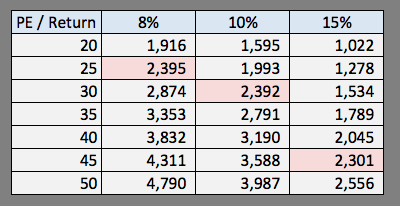
Based on the current market price, for instance, if the investor's expected rate of return is 8%, the stock would have to be priced at a PE multiple of 25 at year 10; any higher multiple will increase the rate of return. Is 8% good enough? We don't know especially with the lower inflation and interest rates environment anticipated. For each investor his or her own opportunity cost. I have not factored dividends, if any, in the cash flows; that will be an additional return.

If the expected rate is 10%, the stock would have to be priced at 30 times earnings; and for 15% return, it should be 45 times. The stock has been priced at higher than this multiple many times in the past. In 2016 itself it was priced at about 60 times earnings. If the stock is really going to give an EPS growth of 12% over next 10 years, it would be a high performing stock warranting a higher multiple. How much higher is anybody's guess.

Now these expected prices are based on the performance of 12% growth in EPS. It will be phenomenal if it actually happens, but we are not sure. It could as well be lower. My guess is as good as anybody's. We can price the stock with the lower growth rate too.

The Diageo ride
There is some comfort that one can take if it sounds acceptable. Diageo acquired controlling stake in the business in 2013 and 2014. First it acquired 36 m shares in United Spirits based on a preferential allotment at Rs.1440 per share in 2013. Next it acquired 1.96 m shares at Rs.2400 per share and after that 3.5 m shares at Rs.2474.45 per share from the market. Finally it acquired 37.78 m shares at Rs.3030 per share through a tender offer in July 2014. Its average cost of acquisition of 79.61 m shares (54.78% control) was Rs.2263.86 per share.

This price is close to the current market price. An investor who buys United Spirits stock today will ride along with Diageo in the future. Diageo has noted that it expects its acquisition to be economic profits positive in year 5 assuming 12% cost of capital. Is it that its investment should give a return of 12% in the next 5 years? Whatever that means. I have also written about United Spirits earlier.

The challenges
With entry barriers as the primary long term competitive advantage and brands as the secondary, Diageo will have a test of time.

There is a plethora of qualifications and emphasis of matters from the auditors highlighting breaches of historical agreements, and deficiencies in control environment and corporate governance. New management will have to tackle all this to enhance the image of the company and its business. United Spirits has contingent liabilities of Rs.11.8 b as of 2016. A portion of this might as well be cash outflows in the coming years.

Goodwill
The balance sheet includes Rs.1.12 of goodwill; it is not clear which acquisition it pertains to. Since Diageo has impaired significant value of goodwill where the present value of cash flows were much lower, we can assume that the current carrying value of goodwill is value accretive.

IPL franchise
The carrying value of IPL franchise rights was Rs.3.9 b, and these are surprisingly grouped under operations. Whenever the game of cricket became part of the liquor business operations we cannot tell. The revenues of Rs.1.35 b and direct costs of Rs.1.08 b are classified under operating revenues and operating expenses respectively. There are additional costs related to the franchise probably resulting in a loss for the year. Ideally, these should be separated and shown under other income. We cannot include IPL revenues in cash flows and project it as part of liquor beverage business. Nevertheless, the market value of franchise rights is probably higher than its carrying value.

Diageo India
Diageo also operates independently in India as a private business. There is no clarity as to why this has not merged with United Spirits and how it is going to affect United Spirits operations.

The 12% growth
The job for Anand Kripalu and Diageo is cut out: 1) Increase revenues; 2) Increase operating margin; 3) Reduce debt; 4) Efficiently reinvest capital; 5) Do not dilute equity. These efforts should lead to increase in earnings per share.