Pages

Tuesday, May 15, 2018

how much do you need

I have noted in the past that being financially independent is very much possible for an average person earning average income both in the US and in India

Yet this February 2018 article suggests that the middle class in India requires at least Rs.100 m in retirement funds in order to maintain a reasonable lifestyle. This assumes a post tax annual income of Rs.3 m. There are two problems with this: 

One, we don't know what a reasonable lifestyle is; in fact, it differs from person to person. Two, required annual income is a function of today's cash and its time value. Annual costs of Rs.3 m today is more than reasonable for the middle class. Whereas its present value is in excess of Rs.1.5 m if we consider 10 years from today and assume inflation rate of 6% during the period; and even this I reckon is probably more than reasonable for the most middle class in India. Even after 20 years, the present value of Rs.3 m is close to Rs.1 m. Not many middle class earn that much today.  So we need to define when this Rs.3 m is relevant. 

But the author does make valid points regarding patience and quality of the underlying business, which the so-called investors do not adhere to. 

And now in May 2018, I find this article and the discussion thereafter suggesting that retirement in India requires at least Rs.150 m in order to maintain a comfortable lifestyle. They say that the required annual income from this capital is Rs.5 m to Rs.10 m; and their required rate of return to beat inflation is 10%, and 15% for a comfortable lifestyle. 

By the way, 10% return on Rs.150 m is Rs.15 m pretax, which could be close to Rs.10 m post tax. And the present value of Rs.10 m at 6% inflation rates over the 20-year period is over Rs.3 m. I am not too sure whether a couple (as the article suggests) retiring in India requires more than Rs.3 m annually. It would be too naive to generalize and conclude; yet, I can say for the most that income (which is about $45,000) should be able to give a reasonably comfortable lifestyle, for there aren't too many making that much in India. 

Instead of being specific, it is better to leave it to the person to decide what is reasonable and what is comfortable. That said, my take is that both India and the US are not that expensive to live a good life. A capital of Rs.150 m (or $2.25 m) capital in 20 years is worth over Rs.45 m at 6% inflation and $1.25 m at 3% inflation as of today. Think about it. 

My calculation of the required capital for retirement is simple as I have noted here; it is better to assume a zero real rate of return over the period. That means the return earned on capital is equal to the inflation rates during the period. The calculation then becomes both easier and conservative, and the capital required, a function of only two factors: One, sustainable annual expenses in today's value, and Two, the number of years. Here we don't assume reasonable and comfortable in generalized terms. 

For instance, if the W couple's annual costs are Rs.650,000 ($10,000) and the number of years of retirement is 30, the required capital is Rs.19.5 m ($300,000). If the C couple's costs are Rs.1.95 m ($30,000) and years are 25, the capital required is Rs.48.75 m ($750,000). You see how it is to each, his or her own. That's the way it should be. And the added flavor is that usually you do get to earn in excess of inflation rates.

In my view, retirement is a terrible word; it denotes doing nothing, which is not the way to lead life. Never let mind and body lay idle. The key is to be financially independent as soon as possible, and then take up something that excites you in life which you can keep doing as long as you can. There are times when this excitement can be monetized too; that's the icing.

Thursday, May 3, 2018

tcs, and $1 trillion

TCS has defied odds; there is no denying. I compared both Infosys and TCS in July 2013, and noted how things changed since 2009 in favor of TCS. In October 2013 when TCS hit $65 b in market capitalization, I wondered whether it was worth it based upon its fundamentals. Then came July 2014 when TCS equity was priced by the markets at $85 b, and I was skeptical again. Now it is a $100 b company. In fact, this report had actually predicted it would. I only hope that the author had put his own cash into his thoughts. 

Sure it is a $100 b firm; so what? What can investors do about it, buy more, or book profits? That's the question. If you read this report, the stock has the potential to rise 10 times, and become a $1 t company. Yeah, that's $1,000 b; isn't that great? For record, there isn't any $1 t company on the planet, not yet. 

TCS had net earnings of Rs.258 b ($3.9 b) for 2018. Let's keep the math simple rather than going into complex predictions. That implies a PE multiple of 25 times as of now. The report says, does not predict, that in 8 years TCS could become $1 t company if it grows at 33% annually over the period.


The author is right. If earnings grow at 33% and the multiple remains at 25 times, it's a $1 t math. But then, if the multiple goes up to 30 times, it will be $1.2 t; or if earnings grow at 25% over 8 years, the market value will be $600 b, keeping the multiple intact. 

We have to remember that a 25 times earnings multiple after 8 years will mean that the business will have strong expectations of earnings growth in years beyond. That implies, TCS has the potential to become much more valuable than $1 t. To see why, let's assume earnings growth of 33% in 8 years, but also assume that the growth rate will taper, and therefore apply a lower multiple of say, 15 times. Now the business will be worth close to $600 b. 

You see what I mean? Math is not the value driver. The value drivers are cash flows and growth, and expected rate of return. 

And there is always the justification. 


In 2009, TCS market cap was as high as Rs.1,034 b and as low as Rs.406 b. In 2009, its earnings were Rs.52.5 b, and for 2018, they were Rs.258 b. The earnings multiple implied in getting a value of Rs.520 b in 2009 is about 10 times. 

Let's do the math again. If the markets knew that TCS would grow at a very high rate from 2009 to 2018, the multiple would have been more than 10 times; let's keep at 25 times. At our new assumed multiple, the market value of TCS equity based upon 2009 earnings would be Rs.1,312 b. That gives us annual growth rate of 20%, not 33%, from 2009 to 2018 for market prices. 

Now even if we apply 22% growth rate in the next 8 years, and give a multiple of say, 15 times, the market capitalization of TCS would be $300 b; we are keeping the currency rates constant. There are two problems with this prediction too. One, it is much easier for Rs.278 b revenues (2009) to grow at 22% than for Rs.1,231 b revenues (2018). It is called the base effect. In fact, the actual revenue growth during the period was 18%. And you know what, TCS revenues grew by 4% for 2018. Two, we are all hopeless in making predictions.

This is how I see it: TCS has been a great business, and ably managed; and in all probability, it will continue to be one. But it is preposterous to assume a large growth rate going forward; and 33% growth rate is outrageous. The business challenges are very different from what they were a decade ago. The Indian IT firms will have a drastic makeover and shift in focus to do if they are to remain relevant and profitable in the coming years. And this itself is a huge headwind.

As I always say, time will tell.

Wednesday, May 2, 2018

indian fmcg, and the fang

Here's an article published today, which says that Dabur's market valuation is absurd, and is not supported by earnings growth.


The author has singled out FMCG stocks for their crazier valuations. He also makes some fancy statements like the gap between their valuations and earnings growth is like earth and sky. There are two problems that I see with his remarks. 

One, you don't see only FMCG stocks priced weirdly. There are a whole lot of other sectors where we find gap between price and value; I mean where price is too much compared to their value. Does he think for instance, Dmart cheap just because it has and is expected generate higher growth rate? Of course it is a well run, profitable retail business; but that does not mean we should buy its stock at whatever prices marked by the markets. How about Eicher Motors? or does he consider Kotak Bank a value buy looking at its price to book? What are his thoughts on the NBFCs, or Airlines, or Telecom?

Then there is the second problem which is with his timing of the post. Does he think Dabur stock is expensive now? Its price was high compared to value in 2017 as well. In fact, a bunch of Nifty stocks was expensive back then. Tell us something new; or at least don't single out. We would have appreciated if the post was of expensive valuations in general. 

It is not about earnings growth only as the author emphasizes. It is always about the price of a stock compared to its intrinsic value. And the value is driven by its cash flows, not earnings. Yeah, earnings help generate cash flows; but they are not the same. Value also depends upon the expected rate of return, which again is influenced by the prevailing interest rates. 

The article also makes a statement: that the Indian FMCG valuations are crazier than that of FANG stocks. How profound is that. The author fails to recognize that value is driven by the prevailing interest rates. And the interest rates are influenced by the inflation rates. Other things being equal, the higher the inflation rates, the higher the growth rate.

Of course the FANG stocks cater to the world markets. But if you look at their annual reports, you know their growth rates; and also know how some of them are not yet that profitable. Here's their story. 


Facebook has been a heck of a story. Look at how the market valuations have progressed over the years. It is priced at 25 times earnings. I haven't had a chance to look at its latest financial statements. It's been some time since I noted my thoughts on Facebook. 


Then you have Amazon. A terrific business, but a terrible investment on value terms. In my view this has always been the case. 


Although Netflix has done well to its shareholders, it is not like other FANGs. It is yet to generate substantial free cash flows. I am not sure if its business model is as strong as Amazon's is.


There is no question that Google has performed well on both operating and market fronts. Value of these FANG stocks depends upon their ability to generate free cash flows on a consistent basis. And this depends upon their revenue growth, operating margins, and reinvestment requirements. Because they are technology stocks, we need to do some adjustments to their reported earnings. One big adjustment is how accounting rules treat research and development costs, and how they should actually be treated. Then you have operating leases and advertising costs. While R&D and advertising costs are like investments for future, operating leases are like debt.

Based upon reported numbers, Facebook trades at 25 times, Amazon at 250 times, Netflix at 187 times, and Alphabet at 27 times earnings.

The author of the article appears to be supportive of PP Long Term Equity Fund. I don't have anything against the fund, and it is left to their managers to manage the fund based upon their philosophies.

I think the fund started buying Alphabet from May 2014 onwards steadily increasing to 16,593 shares as of June 2016. They sold 1,500 (not sure why) shares in July 2016, and the remaining shares are in the fund as of March 2018. It bought its first Facebook stock in July 2017, and has consistently increased the holding to 42,580 shares as of March 2018. In addition to these stocks, the fund has also invested in 3M, IBM, Nestle, and Suzuki stocks. Now, it is a bit surprising to me that the fund finds stocks in the US market to be value accretive compared to the stocks in India.

Facebook isn't a 25% growth stock, and Alphabet isn't a 20% growth stock. In addition, both the firms are quite large: Facebook is priced at $500 b, and Alphabet is a $725 b company. Both are technology companies, where the road ahead to growth is difficult to predict. If Facebook and Alphabet it is, then why not Amazon? The fund hasn't bought Amazon as yet. It did buy Apple, first in May 2016, and then sold all of 12,550 shares it owned in October 2017. To each, his or her own. Remember now Warren Buffett has the second largest holding in the Apple stock.

I am not sure if the fund activities are long term oriented as far as foreign stocks are concerned. It would have been much better if it had created a separate fund called say, US markets fund and made that its investment philosophy. Buyers of the US stocks would go there. The existing fund then would be the long term equity fund focused on only Indian stocks. That way investors would be much clear about its objectives.

Here's the thing: The Indian stocks will aways have higher growth rates compared to the US stocks even when we know that certain of their companies are global. Then it comes to comparing the prevailing prices to their values for each of the individual stocks. There are bargains in both the markets; but, more in the Indian markets simply because it is a growing market.

While the fund may have its good intent, the author of the article appears to be a bit biased, as he is towards other companies too. This isn't a complaint, for all of us are biased in some way or the other. For instance, his dislike for Reliance Industries is well known despite the fact that Reliance has been the most valuable firm in India for long. It throws out a lot of free cash flows from its core petrochemical and refining businesses. Just that its reinvestment has been much higher what with retail and telecom ventures. Here's another question: is Reliance expensive too compared to its earnings growth? What about Hero Motors, or Maruti? Want any more names?

Of course stocks are expensive now compared to their value; but that is not limited to Dabur, or FMCG. A careful unbiased analysis will tell us where we stand today. There are always certain stocks available at prices that we want; for that we need to stop listening to others, and have faith in our own analysis.

Saturday, April 28, 2018

ferrari at $23 b

Revenues for the year 2017 stood at Euro 3.4 b increasing 10% annually over the last four years. Over the same period, operating profits increased by 20% to Euro 775 m. Earnings increased by 22% to Euro 535 m; so did earnings per share. Operating margins were 22.68% (2017) compared to 15.59% (2013). Very high return on equity. Average free cash flows to firm were Euro 300 m. Not a bad performance for an auto business having sold only 8,398 cars in 2017. 


Sports V8 were in maximum demand. 


Ferrari sells a fair bit of engines too.


Now, how much should this firm be valued? It is currently priced by the market at $121.99 per share. That is $23 b or say, Euro 20 b in market value for the equity. Compare that to free cash flows to firm, and then consider Euro 1.8 b of debt; and there is cash of Euro 648 m. 

The market price appears a bit pricey. If that was the case, the equity was available for half the current price sometime in 2017 itself (its low price). In 2016, the stock sold at $32 per share when it was low. For someone who bought at that price, the increase in market value was nearly 4 times within a year. There is money to be made in every stock if you are good at market timing. Alas, isn't that difficult? Who knew it would be as low as $32 and as high as $122? Someone said it once, it is very hard to predict, especially the future.

Ferrari is a great franchise. But then every good business isn't a good buy; and at times, even a bad business can be a screaming buy. The game is between value and price; always.

The board is considering a share buyback program.


The number of shares outstanding (189 m) has not changed since 2013; and in February 2018, the Euro 100 m buyback initiative was announced by the company. In 2018, Ferrari bought 190,600 shares at $119.82 per share.


The management obviously considers that price is a bargain compared to its intrinsic worth.

To justify a buyback, two things have to fall in place: Excess cash, and price paid much lower than its value. Only time will tell whether $120 is a bargain. In the mean time, driving new Ferrari down the street is definitely red, faster than wind, passionate as sin.

Tuesday, April 24, 2018

invest when you have cash?

I hear some of the market experts saying, it is futile to time the market, so invest when you have cash, and sell when you need cash. I find this not only unwarranted, but also an incomplete advice. 

How can someone invest when stocks are priced at unprecedented levels compared to their intrinsic value? Do they mean to say, you have cash now, so buy Tesla? or Nestle? How about Valeant, or Rcom? I can list several stocks; but the point is, unless you have carried out some analysis of the business and its value, you cannot decide on buys or sells. It is fundamental to investing that you compare value with price. It will prove stupid if you go on a buying spree just because you have cash. You will have to wait for too long if you want prices at your levels, is again a remarkably unremarkable thought. It is better if we give these advices a pass.

There is only one occasion, and it is a powerful one, when you have to ignore market prices, and yeah, invest when you have cash. That is when you are investing in the market itself. That is say, S&P-500 index or Nifty-50 index. The index has to be a diversified market index, not a sectoral or thematic one. Three things matter then: Lower expense ratios; Higher liquidity; and lower tracking errors. Once the index is selected, go and invest when you have cash. In fact, invest periodically irrespective of the market prices. You don't have to compare intrinsic values and so forth. Over a long period, you will earn returns close to the market itself, which will not be too bad compared to other alternative investments available to you. This strategy is most suited to those who have no time or interest in analyzing stocks. 

I wouldn't recommend this strategy to any mutual fund investors making periodic contributions (systematic investment plans), especially for the US investors. Mutual fund managers can turn out to be idiots; and handing cash to idiots is as idiotic. In India, I would reluctantly approve since there are some mutual funds who can beat the market. Yet, this isn't my highly recommended strategy. I don't like to give cash to others to manage; therefore, I wouldn't advice other investors either. 

So you have two choices: Invest in the index irrespective of market prices, and carry on with your life; have fun. or 

Learn to play the value-price game, and pick stocks. Here you could have occasions when you have to sit on lots of cash. Invest when you have cash is a bullshit advice for stock pickers. They pick stocks when prices are cheap compared to value, and sell when otherwise. 

Monday, April 23, 2018

tesla, what's with it

Tesla may not be a pure auto company; With battery and solar energy embedded, it is electric cars, solar panels, and energy storage in one company. Does that mean it should be worth $50 b? Sure it was priced similar exactly a year ago.


One year market return isn't there. Yet in the last five years, it has marched forward in a way that has left some wondering, and a few more with aspirations.


How long can it go is in the story that is to unfold. You cannot sell less than 75,000 vehicles and say, you are worth $50 b, like it did in 2017. And you cannot sell about 100,000 vehicles and say, you are worth $50 b again, like it is now.

Of course, value of a firm has not much to do about its past. It is the future cash flows and growth that matter more. And then there are expectations of the rate of return to be earned based upon those cash flows. In present value terms, that is the intrinsic worth of the business underlying the stock. How many are willing to take the pain to assess this without much of a bias?

But for Tesla it is even more challenging: It has never earned operating profits so far; not even when we capitalize its large research and development spends. From 2009 to 2017, Tesla incurred cumulative operating losses of $2 b after adjusting for R&D costs. Positive net earnings have been out of reach so far. It had operating capital of $17 b as of December 2017. What it means is that this $17 b is not making any cash for its business. Consider this as the opportunity cost for the existing shareholders.

It also had $13 b of debt as of December 2017. When a business cannot earn consistent cash flows sufficient to service its debt, it has no business asking more from lenders. Funnily, it did; Tesla raised $1.8 b in August 2017; it had to offer higher yields of 5.30% making it sort of a junk bond offering.  

And now we find that Moody's has downgraded the corporate bond rating to B3, which means that it is speculative with high credit risk. Its junior notes maturing 2025 have been downgraded to Caa1, which means that they are of poor quality with very high credit risk.

Who are we going to blame? There is Tesla as business, there is its charismatic CEO, and then you have the lenders. If you believe in caveat emptor, like I do, your pick has to be the lenders. Look, lending is a serious business; I mean it is a skilled investing decision. You got to be able to receive back with profits what you have lent. 

Here's the summary of Tesla's cash flows for the last three years.


A casual look, and you will find that only positive cash flows are from financing. And here are its contractual obligations leading up to the next five years and later.


How Tesla is planning to come good on these obligations is the focus point of both the shareholders and lenders. Raising more debt? $500 m is not going to be enough, never mind the crazy rationale behind it. 

Tesla needs operating cash flows, and more of them for many years ahead, consistently. In the absence of it, there is no question of raising debt for it simply cannot afford it. It is surprising that both Musk and lenders did not grasp it. If there is some hope about the business as it should be for any entrepreneurship, the only recourse is raising equity. Musk and company might want to resist dilution, but it has become a survival issue now. Dilute the equity, and focus on Model 3 ramp up. 

With so much debt maturing in the coming years and along with other business commitments, it is a tricky math though. It is also a bit tricky to figure out at what price to issue equity, if at all. 

Is there still hope of hitting $700 b in market capitalization for Tesla? Well, only time will tell. In the mean time let's accept that hope is a powerful tool. So let's hope for the best.

Sunday, April 22, 2018

mcdonald's drive thru

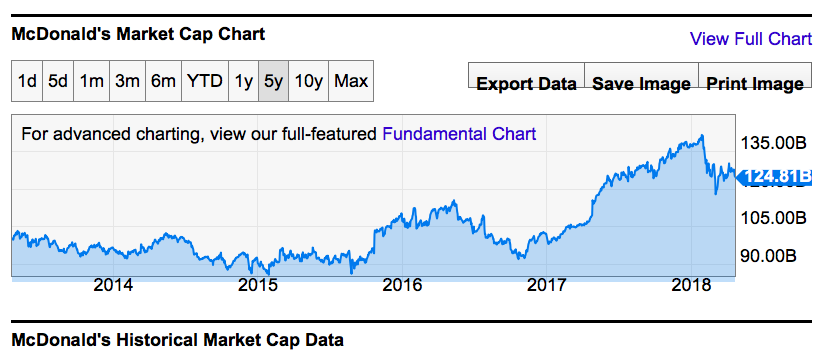
McDonald's Corporation is worth $125 b. 


At its high stock prices in 2007, it was valued $74 b by the market; and at low prices, $49 b. That means, if you had bought the stock at high prices, the annualized rate of return isn't much to date. Even at low prices, the return is not tempting. But then again, who is good at market timing? If you check the past five years, the story is similar.

This is what happens with an aging business. Consider this: McDonald's revenues in 2007 were $22 b; they were $27 b in 2012; and revenues were $22 b in 2017. There is no growth in revenues for this burgers-and-fries business. 

Reported operating profits were $3.8 b, $8.6 b, and $9.5 b in 2007, 2012, and 2017 respectively. When we adjust for leases and advertising costs, they change to $5 b, $9.5 b, and $10.1 b for the respective years. Adjusted operating margins look much better now (44%) compared to what they were in 2012 (34%), and in 2007 (22%). 

Return on equity also improved significantly. For 2017, return on equity becomes meaningless as the equity turned negative in 2016. This is not alarming because it was due to excessive stock buybacks rather than accumulated losses. McDonald's is profitable and has healthy free cash flows.

Earnings per share were $2.06, $5.45, and $6.54 prior to adjustments for leases and advertising costs. When you capitalize leases and advertising costs, the EPS changes to $2.83, $6.16, and $6.97 for 2007, 2012, and 2017 respectively. While the 10-year annualized increase was in double digits rate, the 5-year increase has been very low. This is despite McDonald's huge stock buybacks over the years. 

It repurchased 237 m shares in the past five years, and 465 m shares in the last 10 years. At the beginning of 2007, it had 1,203 m shares outstanding, which by the end of 2017 were 794 m. It is clear that if stock buybacks weren't carried out, earnings per share would have been lower, and of course, McDonald's would have retained its cash balance.

The future, though, doesn't look very bright for the business. Stephen Easterbrook surely has a task at hand. Where will he have to look?


Even the high growth markets aren't growing.


Free cash flows to firm were $2.6 b, $4.9 b, and $5.1 b for 2007, 2012, and 2017 respectively. Even if we consider $5 b as sustainable free cash flows to firm, we have debt to back out to arrive at equity values. 

McDonald's had $29 b of long term book debt as of 2017. It also has long term leases which make up almost another $10 b of debt in present value terms. That is $39 b of total debt. With cash and other operating assets of $3.5 b, the net debt value is about $36 b. 

To justify market value of $125 b for its equity, McDonald's operating assets will have to be worth about $165 b. With $5 b of FCFF, that implies a multiple of 33 times. And McDonald's isn't a growing business.

But then Tesla has never had free cash flows; it has never had operating profits; and had debt of $13 b as of 2017; yet, it's equity is worth $50 b. While McDonald's is aging, Tesla has survival issues to deal with.

Who are we to argue with the markets? We might as well profit out of their follies.